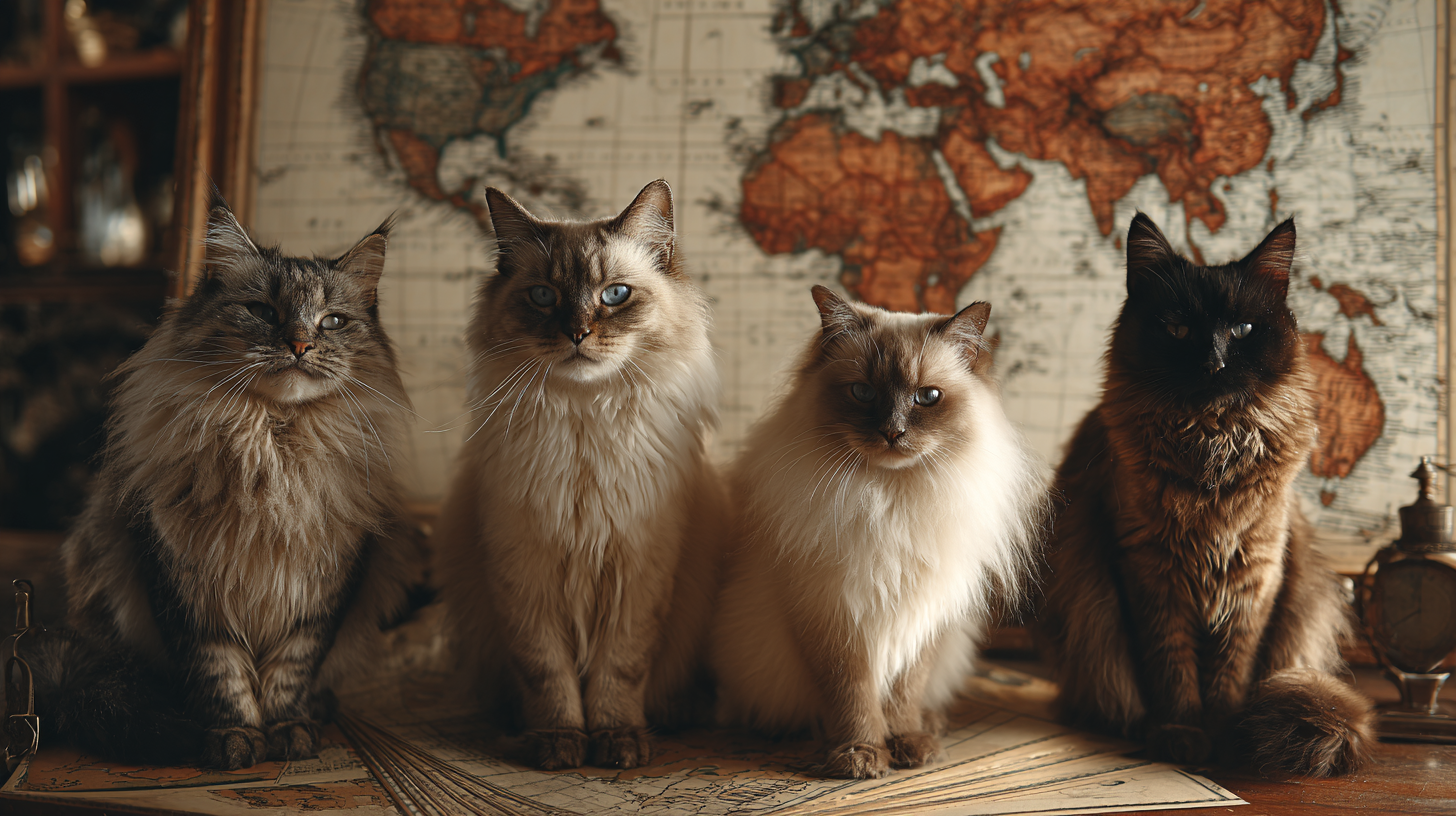
Your cat may spend most of their day staring out the window or knocking things off shelves, but their breed carries a story that spans continents, centuries, and sometimes a remarkable amount of human drama. The 67 pedigreed breeds below trace their roots across 20 countries — from the sacred temples of ancient Thailand to a barn in rural Montana where a curly-haired kitten changed cat breeding forever.
Breeds by Country of Origin
Click any country card to explore its breeds — with photographs and full breed profiles.
Countries Ranked by Breed Count
The United States dominates so completely that it produces more breeds than the other 19 countries combined. Here is the full ranking — and why the numbers are more complicated than they look.
| # | Country | Breeds |
|---|---|---|
| 1 | 🇺🇸 United States | 28 |
| 2 | 🇬🇧 United Kingdom | 8 |
| 3 | 🇷🇺 Russia | 4 |
| 4 | 🇹🇭 Thailand | 4 |
| 5 | 🇨🇦 Canada | 3 |
| 6 | 🇪🇬 Egypt | 3 |
| 7 | 🇫🇷 France | 2 |
| 8 | 🇹🇷 Turkey | 2 |
| 9 | 🇲🇲 Burma | 2 |
| 10 | 🇦🇺 Australia | 1 |
| 11 | 🇨🇳 China | 1 |
| 12 | 🇨🇾 Cyprus | 1 |
| 13 | 🇬🇷 Greece | 1 |
| 14 | 🇮🇷 Iran | 1 |
| 15 | 🇮🇲 Isle of Man | 1 |
| 16 | 🇯🇵 Japan | 1 |
| 17 | 🇳🇴 Norway | 1 |
| 18 | 🇸🇬 Singapore | 1 |
| 19 | 🇸🇴 Somalia | 1 |
| 20 | 🇦🇪 UAE | 1 |
Based on 67 breeds from the Cat API dataset. Breed type classification follows CFA natural/developed/mutant categories.
It All Starts in One Place
Every single domestic cat alive today — pedigree or moggy, £3,000 Bengal or rescued tabby — shares a single common ancestor: Felis silvestris lybica, the Near Eastern wildcat. Genetic studies published in Science confirm that domestication happened roughly 10,000 years ago in the Fertile Crescent, most likely in what is now southeastern Turkey and northern Syria. Wild cats were drawn to human settlements by the rodents that came with grain stores. A mutually beneficial relationship was formed — and it has never ended.
What is remarkable is how recently cats spread globally. A landmark study published in Science in late 2025 used ancient DNA to overturn the long-held assumption that cats arrived in Europe with Neolithic farmers. They didn't. Domestic cats reached Europe only around 2,000 years ago, almost certainly via North Africa and Roman trade networks. China got domestic cats even later — around 1,300 years ago via the Silk Road, and before that, the cats living there were an entirely different species: the leopard cat (Prionailurus bengalensis).
The breed explosion happened in just 70 years
The first cat show was held at Crystal Palace, London, on 13 July 1871. Of the 67 breeds in this article, only a handful existed then. The majority were created between 1950 and 2000 — most of them in the United States, often starting from a single extraordinary cat.
United States
28 breedsNo country comes close. The United States has produced more recognised cat breeds than the rest of the world combined — 28 in this dataset alone. Almost all were deliberately created from the 1950s onward, often by a single breeder responding to a spontaneous mutation in their cattery or a stray with unusual features.
The American approach to cat breeding is entrepreneurial: spot something unusual, develop it into a reproducible type, give it a compelling name, and register it. The result is an extraordinary diversity of shapes, coat textures, and personalities — from the enormous, gentle Maine Coon (one of the few genuinely natural American breeds, descended from colonial working cats) to the hairless Bambino, a deliberate cross between the Sphynx and the Munchkin created in the early 2000s.
Several of the most globally popular breeds are American-made despite carrying exotic names: the Balinese (not from Bali — named because its grace reminded the breeder of Balinese dancers), the Himalayan (not from the Himalayas — named after the colourpoint pattern in Himalayan rabbits), and the Ragdoll, developed in Riverside, California in the 1960s by a breeder who made somewhat improbable claims about her founding cat Josephine.
The Maine Coon: America's only natural giant
The Maine Coon is the exception to America's "designed breed" story. These cats evolved naturally in New England's harsh winters — their tufted paws act as snowshoes, their dense waterproof coats repel sleet, and their bushy tails can wrap around their bodies for warmth. Folk legend claims they're descended from raccoons (genetically impossible) or Marie Antoinette's smuggled cats (charming, unverified). Reality is simpler and just as good: they're the descendants of longhaired cats brought by European settlers, shaped by centuries of New England winters. They are now the world's most registered pedigree breed, having overtaken the Ragdoll in 2025 CFA rankings.
United Kingdom
8 breedsBritain gave the world organised cat fancy — Harrison Weir founded the first proper cat show at Crystal Palace in 1871 — and several of the most distinctive breeds to follow. The British Shorthair is Britain's own native cat, formalised from the working cats that Roman legions brought to the island nearly 2,000 years ago. Stocky, calm, and famously resembling a teddy bear, it remains the UK's most registered pedigree breed by a distance.
Two of Britain's most distinctive breeds emerged from spontaneous mutations in the 1950s and 60s. The Cornish Rex appeared on Bodmin Moor in 1950 when a cream kitten named Kallibunker was born with an extraordinary fine, wavy coat — the result of a recessive gene affecting only the undercoat, leaving him without guard hairs. A decade later, the Devon Rex appeared in Buckfastleigh with a different curly coat mutation — and when breeders crossed the two, they got only straight-coated kittens, proving the mutations were genetically unrelated.
The Scottish Fold appears in this dataset as a UK breed — and while the founding cat Susie was indeed a Scottish barn cat discovered in Perthshire in 1961, the breed has a complicated legacy. Its characteristic folded ears result from a dominant mutation (FOCD) that causes cartilage malformation throughout the body. The breed is banned from registration in Scotland, banned from breeding in the Netherlands, Austria, and Belgium, and not recognised by the GCCF or FIFe — yet it remains wildly popular globally, partly due to celebrity ownership.
Russia
4 breedsRussia's contribution to the pedigree cat world is vastly underappreciated in the West. Four breeds in this dataset — the Russian Blue, Siberian, Donskoy, and Kurilian Bobtail — and at least five more (Peterbald, Ural Rex, Karelian Bobtail, Toybob, Neva Masquerade) exist in various stages of international recognition.
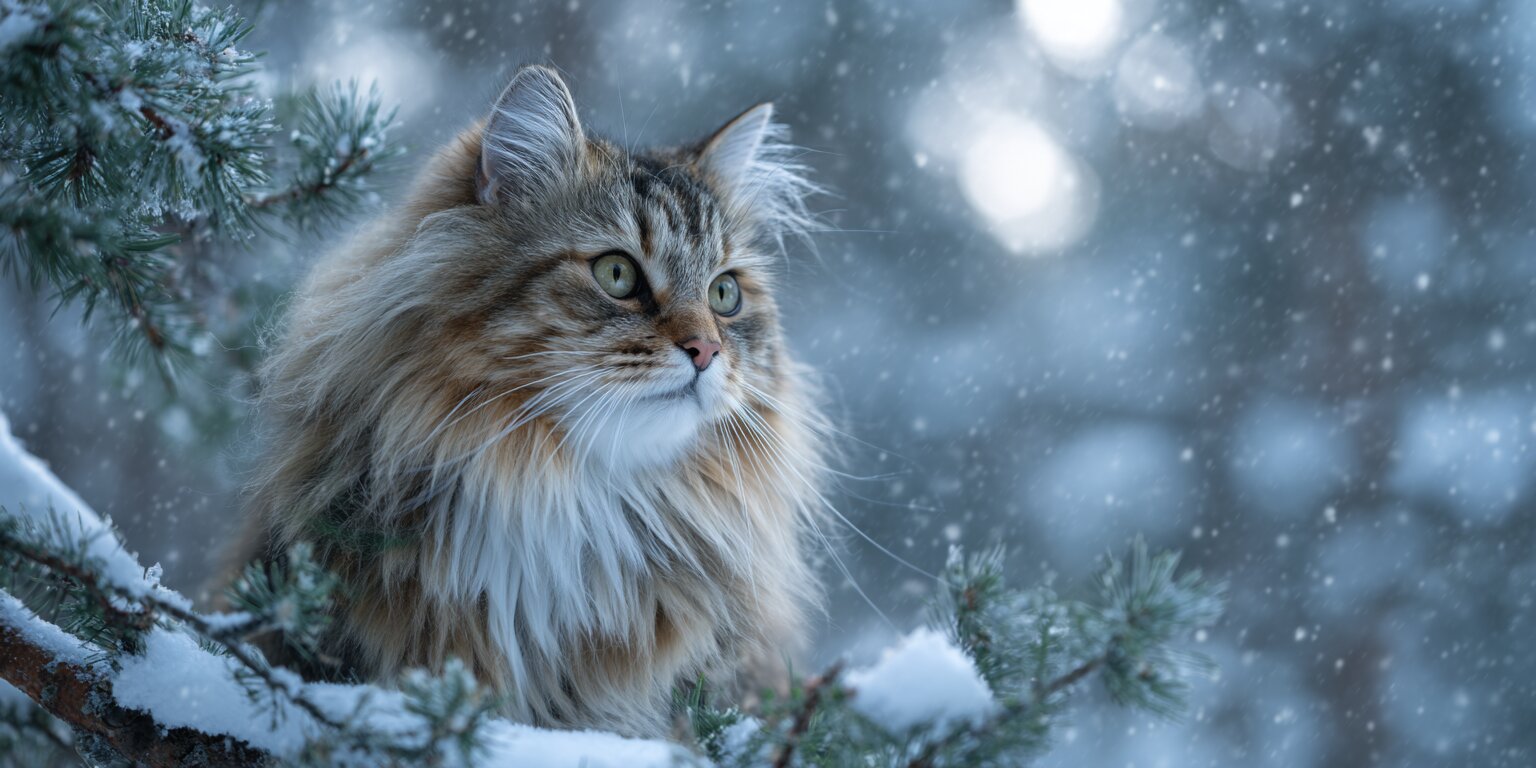
The Siberian is Russia's national cat — a centuries-old forest breed documented in Slavic folklore, with a triple-layered waterproof coat that handles -30°C winters without complaint. The Russian Blue is traditionally attributed to Arkhangelsk (Archangel), though the evidence is largely oral tradition; what is documented is that the breed nearly went extinct in World War II and was rebuilt through judicious crosses with Siamese, then refined back toward its silver-blue type over decades.
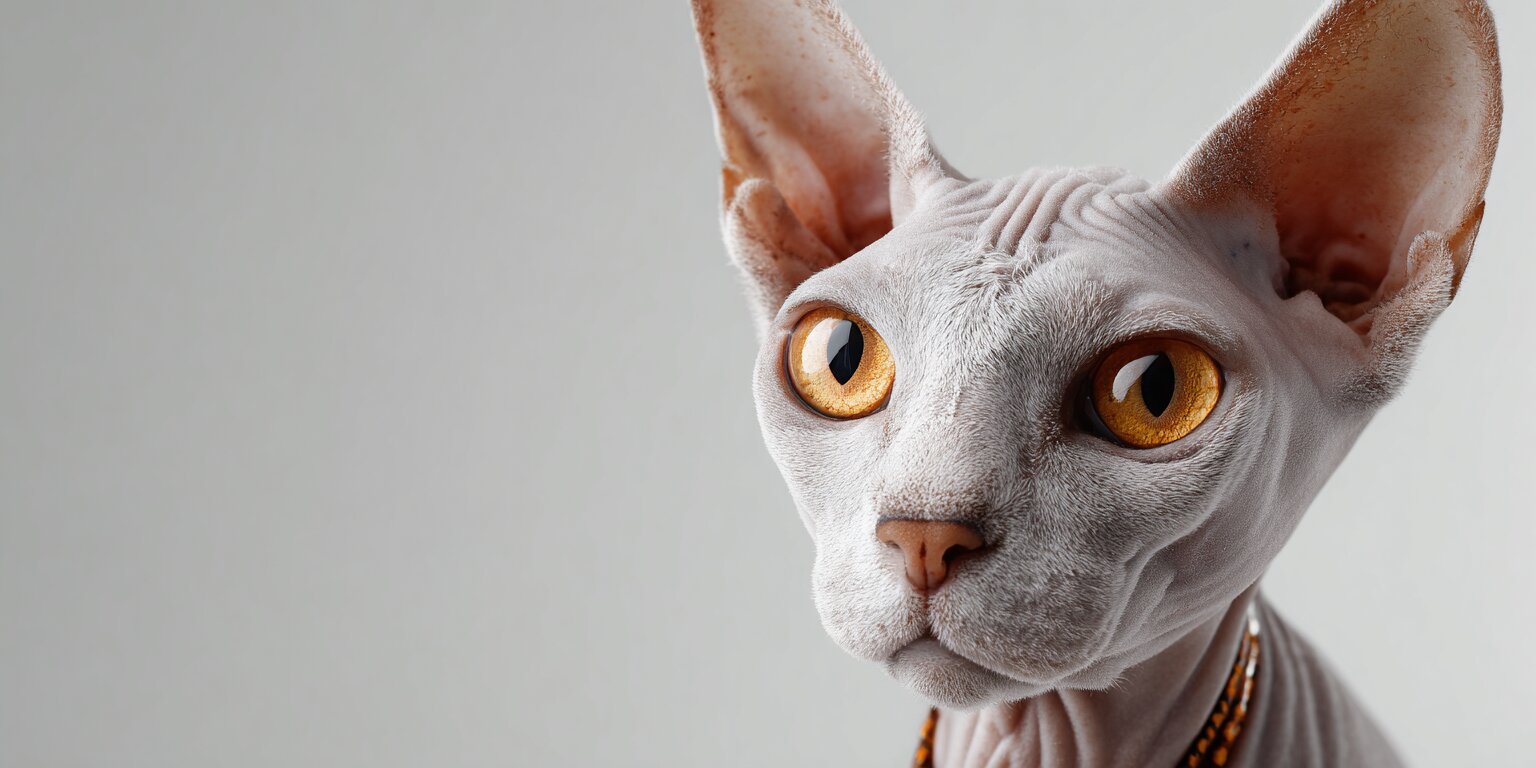
The Donskoy has a more dramatic origin: in 1987, a professor named Elena Kovaleva rescued a kitten named Varvara from street boys in Rostov-on-Don who were torturing it. Varvara began losing her fur at four months old. Rather than treating this as a disease, breeder Irina Nemikina recognised a dominant mutation and developed it into a breed. Unlike the Canadian Sphynx (which carries a recessive hairless gene), the Donskoy's gene is dominant — meaning a single copy makes a cat hairless.
Thailand
4 breedsThailand possesses the richest documented cat heritage of any country in the world. The Tamra Maew — the "Treatise on Cats" — is a collection of illustrated manuscripts from the Ayutthaya period (14th–18th century) describing 17 auspicious and 6 inauspicious cat types in remarkable detail, with full-colour illustrations that are immediately recognisable today. In November 2025, the Thai Cabinet formally designated five native breeds as national symbols — the first country in the world to do so officially.
The Siamese is Thailand's most famous export — known in Thai as Wichien Maat ("Moon Diamond"). First documented in the Tamra Maew and first imported to Britain in the 1880s, it became so popular that Western breeders systematically changed it: the original Siamese had a moderate, rounded body and a softer face. What we call the "modern Siamese" is an extreme, wedge-headed animal that would not be recognised by the Thai cats depicted in those 700-year-old manuscripts. The original type has since been revived under the name "Thai" by breeders importing cats directly from Bangkok.
The Khao Manee ("White Gem") was historically bred exclusively by Thai royalty. Legend holds that stealing one was punishable by death. They are pure white, with eyes that are typically odd — one blue, one gold — and are considered to bring good fortune. Until 2009, they were virtually unknown outside Thailand.
Turkey
2 breedsTurkey's two breeds are among the oldest continuously documented in the world. The Turkish Angora was recorded in Europe as early as the 17th century and was brought to the French court of Louis XIV, becoming a prized possession of European nobility. So extensively was it crossbred with Persians over the following centuries that it nearly disappeared as a distinct type — a situation so alarming that the Turkish government, under Atatürk, launched a preservation programme at Ankara Zoo in the 1930s, focusing on pure white specimens with odd eyes.
The Turkish Van has a confusing history. Despite being named after Lake Van in eastern Turkey, the breed was actually developed in the United Kingdom from the 1950s onward, by British photographers Laura Lushington and Sonia Halliday who brought back foundation cats from various parts of Turkey — not from the Lake Van area. Known as "the swimming cat" for its love of water, the Turkish Van is a large, semi-longhaired breed with the distinctive "van pattern": white body with coloured markings only on the head and tail.
Egypt & The Middle East
3 breeds + Arabian MauEgypt is arguably where the domestic cat's relationship with humans first became culturally significant — cats were sacred to Bastet, depicted on tomb walls, and mummified by the million. The Egyptian Mau is the only naturally spotted domestic cat breed, and its spots are genuine — not a product of tabby striping, but a distinct pattern caused by a separate gene. "Mau" is simply the ancient Egyptian word for "cat" (and also, charmingly, the sound it makes).
The modern Egyptian Mau breed traces to the 1950s, when an exiled Russian princess, Nathalie Troubetskoy, obtained spotted cats reportedly from Cairo via the Egyptian ambassador to Italy, then emigrated to the United States in 1956 with three cats. Whether today's Egyptian Mau has an unbroken genetic connection to ancient Egyptian cats is debated; genetic studies confirm Middle Eastern origins but also significant Western breeding influence. The Chausie — also listed as Egyptian origin in this dataset — is actually a hybrid between jungle cats (Felis chaus) native to the Nile region and domestic cats, developed mainly in the USA.
From the UAE comes the Arabian Mau, a desert-adapted landrace that has lived on the Arabian Peninsula for over 1,000 years, developing large ears for heat dissipation and a short coat with no undercoat. German breeder Petra Müller began standardising them from UAE street cats in 1995. They are recognised by the World Cat Federation but not yet by CFA or TICA.
France
2 breedsFrance claims two elegant, historically rich breeds. The Chartreux is France's national cat — a blue-coated breed with a woolly double coat and distinctive copper eyes. The romantic legend connecting it to Carthusian monks was debunked in 1972, when the Prior of La Grande Chartreuse officially stated that monastery archives contain no records of monks breeding such cats. The name almost certainly derives from "pile des Chartreux," a type of luxurious Spanish wool that the coat resembled. The modern breed traces to the Léger sisters, who discovered a surviving colony on the island of Belle-Île-en-Mer around 1925.
The Birman ("Sacred Cat of Burma") is listed as French origin because — despite the Burmese temple legend beloved of breeders — all credible historical evidence points to the breed being created in France around 1920, most likely from crosses between Siamese and longhaired cats. The multiple conflicting origin stories (stolen by grateful priests, delivered by Vanderbilt yacht, gifted by a dying Kittah monk) were almost certainly fabricated by early breeders seeking an exotic narrative. After nearly disappearing in World War II — only two Birmans were known to have survived in all of Europe — the breed was rebuilt over the following decade.
Canada
3 breedsCanada's most famous cat is one of the most instantly recognisable in the world. The Sphynx originated in Toronto's Roncesvalles neighbourhood in 1966, when a domestic cat named Elizabeth gave birth to a hairless kitten nicknamed Prune. The hairlessness results from a recessive mutation in the KRT71 gene, which affects the hair shaft structure. The modern Sphynx also incorporates genes from hairless barn cats found in Wadena, Minnesota in the 1970s. Despite being named after the Great Sphinx of Giza, they are very much a Canadian-Minnesotan production.
Around the World
Norway, Japan, Australia, Singapore & moreSome of the world's most distinctive breeds come from countries with just a single entry in the dataset.
Norway 🇳🇴 — Norwegian Forest Cat: Norse mythology tells of Freya's chariot being drawn by two enormous cats, and the "mountain-dwelling fairy cats" of Viking legend that could scale sheer rock faces. Whether or not those legends describe the Norsk Skogkatt, these cats genuinely are extraordinary climbers, with strong curved claws and a semi-waterproof coat that evolved for Scandinavian winters. King Olav V designated the Norwegian Forest Cat Norway's national cat, and a breeding programme in the 1970s saved it from extinction after it nearly vanished during World War II.
Japan 🇯🇵 — Japanese Bobtail: Present in Japan for over 1,000 years, the Japanese Bobtail's distinctive pom-pom tail is the result of a recessive mutation that has become fixed in the breed through centuries of isolation. The iconic maneki-neko — the beckoning cat statue found in shop windows across East Asia — is modelled on this breed. During the Edo period, long-tailed cats were feared as potential nekomata (shapeshifting evil spirits), which made the naturally bobtailed cats preferable companions.
Australia 🇦🇺 — Australian Mist: The only breed developed in Australia, created by Dr. Truda Straede in Sydney from 1976 onward using half Burmese, quarter Abyssinian, and quarter domestic shorthair. It was specifically bred to be a calm, indoor-tolerant companion that wouldn't threaten Australia's native wildlife. Renamed from "Spotted Mist" to "Australian Mist" in 1998 when a marbled coat pattern was added to the standard. TICA granted Championship status in 2014.
Singapore 🇸🇬 — Singapura: The world's smallest recognised cat breed — adult females can weigh as little as 1.8kg. The official story describes Tommy and Hal Meadow finding tiny "drain cats" on Singapore's streets in 1974. The story became complicated in 1987 when import documents revealed the founding cats had been shipped from the US to Singapore — possibly Abyssinian crosses — before being "discovered." Singapore made the Singapura its tourism mascot in 1991 regardless. The truth of the breed's origins remains unresolved.
Isle of Man 🇮🇲 — Manx: The Manx is tailless — not through any deliberate breeding decision, but through a spontaneous dominant mutation that became fixed in the island's isolated population over centuries. The mutation affects the T-box gene responsible for tail development, giving cats a spectrum from fully tailless ("rumpy") to near-normal ("longy"). The Manx has appeared on Isle of Man currency and postage stamps since the 1970s and is arguably the island's most internationally recognisable symbol. Folklore says a Manx was the last animal onto Noah's Ark, arriving so late that the closing door docked its tail — a story almost certainly invented to explain something breeders didn't yet have the genetics to understand. Check Isle of Man cat import rules →
Cyprus 🇨🇾 — The Aphrodite: Cyprus is not just a source of cat breeds — it is the site of the oldest confirmed human-cat relationship in the world. Archaeologists excavating the Neolithic site of Shillourokambos in 2004 discovered a wildcat buried alongside a human, dating to approximately 9,500 years ago — 4,000 years before the Egyptian cat cult that most people associate with cat domestication. The modern Cyprus (or Aphrodite) cat breed was only formally standardised in the 2000s, but the island's cats have been living alongside humans for nearly as long as cats have been domesticated anywhere. Named for the Greek goddess of love, who was born on Cyprus according to mythology. Check Cyprus cat import rules →
Greece 🇬🇷 — Aegean: Greece's only recognised breed developed naturally on the Cyclades islands of the Aegean Sea without any human breeding programme — fishermen's cats that became such an integral part of Greek island life that they evolved their own distinct type. The Aegean was only formally recognised as a breed in the 1990s, making it one of the newest natural breeds. Despite being numerous on their home islands, Aegean cats are extremely rare elsewhere in the world, with almost no established breeding programmes outside Greece. Check Greece cat import rules →
Somalia 🇸🇴 — Somali (but not actually from Somalia): The Somali is a longhaired Abyssinian — a recessive longhair gene that occasionally appeared in Abyssinian litters was developed into a separate breed in the late 1960s and early 1970s by Canadian and American breeders. It was named "Somali" because Somalia is adjacent to Ethiopia (formerly Abyssinia), the country after which the Abyssinian is named — even though the Abyssinian itself almost certainly isn't from Ethiopia either. The Somali is included in the Somalia entry of this dataset purely due to the naming convention. Check Somalia cat import rules →
Breeds Named After Places They've Never Been
Cat breed names are often more aspirational than geographic. As the International Cat Association's own breed documentation notes, many geographic names were chosen by Western breeders "to sound exotic" — with no connection to the breed's actual origins. Here are the most egregious examples.
Developed in the USA in the 1950s from longhaired Siamese mutations. Named because the breeder thought their flowing movement resembled Balinese temple dancers.
Created in the USA and UK in the 1930s–50s from Persian × Siamese crosses. Named after the colourpoint pattern seen in Himalayan rabbits.
Developed in England in the early 1950s from Siamese × black domestic crosses. Named for its resemblance to Havana cigar tobacco.
Born in Toronto, Canada, in 1966. Named for its resemblance to the Great Sphinx of Giza, which is the extent of the Egyptian connection.
A longhaired Abyssinian developed in the US and UK from the 1960s. Named because Somalia borders Ethiopia (Abyssinia) — where the Abyssinian itself probably didn't come from either.
Created in Louisville, Kentucky in 1958 to resemble a miniature black panther. Named to evoke India's black leopards — which do actually live near Bombay, so 2/10 for effort.
Natural Breeds vs. Human-Made Breeds
The Cat Fanciers' Association formally categorises breeds into four groups: Natural, Hybrid, Established, and Mutant. The distinction matters more than it might seem, because natural breeds have millennia of genetic stability behind them, while newer experimental breeds can carry health issues that haven't yet had time to surface in large breeding populations.
Natural breeds: shaped by geography, not breeders
Mutation breeds deserve special mention: these started as a single spontaneous genetic event — one extraordinary kitten — that a perceptive breeder chose to develop rather than dismiss. The Scottish Fold (folded ears, 1961, Perthshire), the Cornish Rex (curly coat, 1950, Cornwall), the Devon Rex (different curly mutation, 1960, Devon), the Sphynx (hairlessness, 1966, Toronto), the American Curl (backward-curling ears, 1981, California), the Selkirk Rex (dominant curly coat, 1987, Montana) — all trace to a single extraordinary cat. One mutation. One breeder who saw potential. Millions of cats that followed.
Origin vs. Import Rules: What Actually Matters for Travel
For cat owners planning international travel, a breed's origin country is interesting — but it's the destination country's import rules that determine what paperwork you'll need, how long the process takes, and how much it will cost. And some breeds face specific restrictions that have nothing to do with where they came from.
Breed-specific import restrictions to know
- ●Australia bans Bengal cat imports as of March 2025 — concerns about wild genetics affecting native wildlife.
- ●Savannah cats (F1–F3) are restricted across multiple EU countries, Australia, and parts of Asia due to their serval ancestry.
- ●Hybrid wild cat crosses (Chausie, Serengeti, Cheetoh) face restrictions in several countries under CITES regulations for wild cat hybrids.
- ●Scottish Folds are banned from breeding (not import) in the Netherlands, Austria, and Belgium due to animal welfare concerns.
Regardless of breed, every country requires a microchip, health certificate, and up-to-date vaccination records as a minimum. Stricter destinations — Japan, Australia, New Zealand, Singapore — add rabies titer tests, mandatory waiting periods, and in Australia's case, arrival through a single government-approved quarantine facility. Use CatAbroad to check the exact requirements for your destination before you book anything.
Planning to travel with your cat?
Check the import rules for over 190 destination countries — microchip requirements, vaccine timelines, titer tests, and estimated costs.
Explore all destinations on CatAbroad Australia
 Japan
Japan United Kingdom
 Singapore
 Thailand
 Turkey
 Russia
 Canada