
Moving to Singapore with a cat is entirely possible in 2026, but it is a document-heavy process that must start at least seven to eight months before you fly, not seven days. Singapore's Animal & Veterinary Service (AVS), part of the National Parks Board (NParks), enforces one of the strictest pet import regimes in Asia because the country is rabies-free and intends to stay that way. This guide walks through every requirement — microchips, blood tests, permits, quarantine and approved entry points — using the exact timelines, costs and government bodies you need to plan a smooth, quarantine-free arrival. For a complete overview, see our full Sg cat import guide.
Singapore Cat Import at a Glance
Before diving into the paperwork, here is the headline picture for anyone researching Singapore pet import requirements 2026. Most cats arriving from rabies-controlled countries such as the UK, USA, Canada, Australia and most of the EU can enter Singapore without quarantine — provided every step below is completed in the correct order and within the correct timeframes.
Singapore — At a Glance
| Difficulty | Moderate to Strict (long lead time required) |
| Quarantine | Conditional — none for Category A/B cats meeting all requirements; mandatory 30 days for Category C |
| Microchip | ISO 11784/11785-compliant 15-digit chip required |
| Rabies Vaccine | Required, given at least 30 days before travel |
| Import Permit | Yes — issued by AVS/NParks before departure |
| Typical Cost | SGD 1,200–4,500 (approx. USD 890–3,340) excluding quarantine |
| Processing Time | 7–8 months total, driven by the mandatory 6-month post-titer wait |
For the complete country profile, including recent policy updates, see our full Singapore guide.
Step-by-Step Import Requirements for Moving to Singapore with a Cat

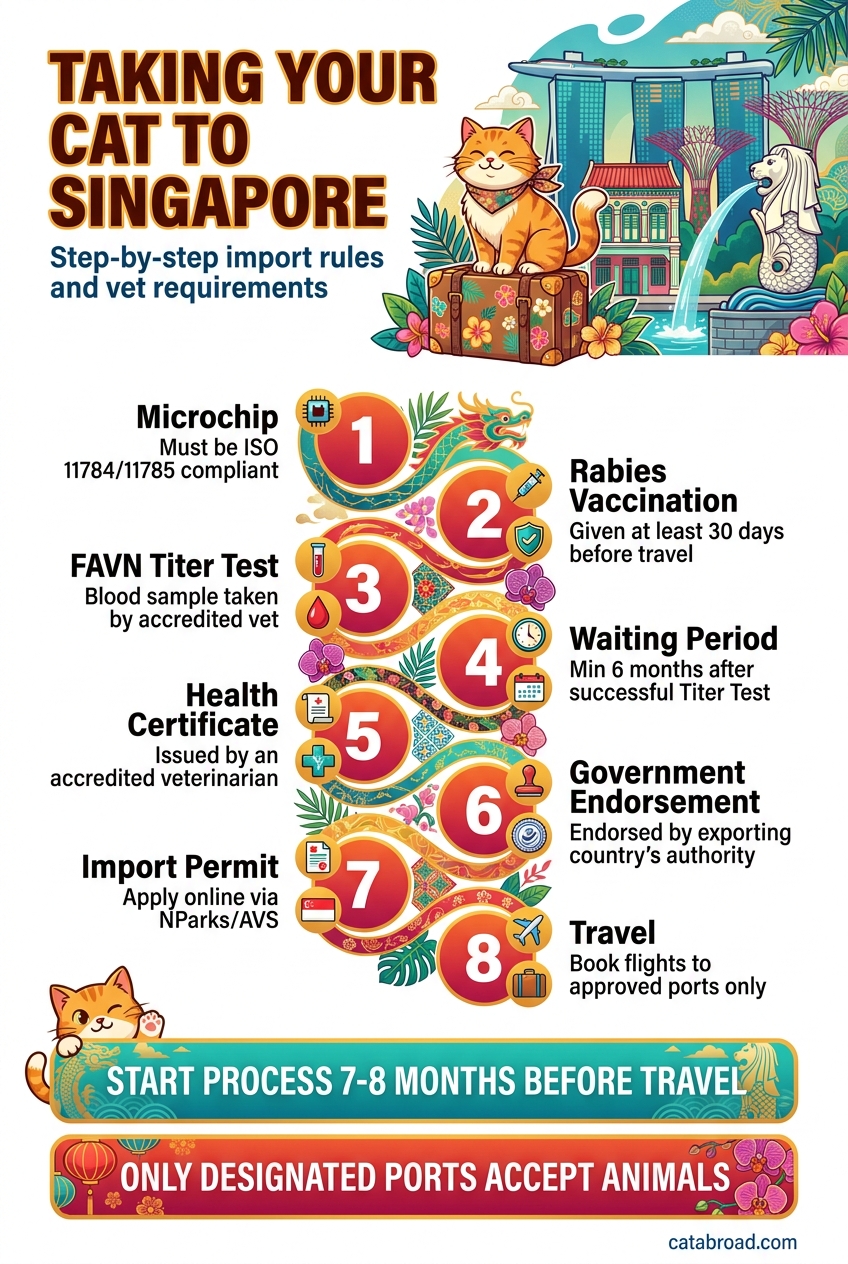
The Singapore cat import process follows a strict, sequential order — completing steps out of sequence (for example, vaccinating before microchipping) will invalidate the paperwork and force you to restart the clock. Below is the exact order AVS expects.
Step 1: Implant an ISO-compliant microchip
Your cat must be fitted with an ISO 11784/11785-compliant 15-digit microchip before any other procedure, including the rabies vaccination. If the microchip is implanted after vaccination, AVS will reject the vaccination record and you will need to re-vaccinate. Non-ISO chips are accepted only if you travel with your own compatible scanner.
Step 2: Administer the rabies vaccination
An inactivated (killed) rabies vaccine must be given at least 30 days before the blood sample is drawn for the titer test, and the cat must be at least 12 weeks old at the time of vaccination. If your cat's vaccination has ever lapsed, a fresh primary course and a new 30-day wait are required — booster continuity matters.
Step 3: Book the FAVN/RNATT rabies titer test
A blood sample must be drawn by an AVS-accredited or government-approved vet at least 30 days after vaccination and sent to a recognised laboratory (such as Kansas State University's Rabies Laboratory in the US or an equivalent WOAH-reference lab in your region). The result must show a neutralising antibody titer of at least 0.5 IU/mL.
Step 4: Observe the mandatory 6-month waiting period
Your cat cannot enter Singapore until at least 180 days have passed since the date the blood sample was taken (not the result date). This waiting period is the single biggest reason families underestimate the timeline — it alone takes half a year, so plan your relocation date around this milestone first.
Step 5: Obtain a veterinary health certificate
Within 14 days of travel, an accredited vet must examine your cat and issue a health certificate confirming it is free from infectious disease, external parasites (such as ticks) and clinically fit to fly. This certificate must match the bilateral format Singapore accepts from your exporting country.
Step 6: Get government endorsement of the health certificate
The health certificate must be endorsed by your exporting country's official veterinary authority — for example, APHA in the UK, USDA APHIS in the United States, or the CFIA in Canada — confirming the signing vet's credentials. This endorsement usually takes 2–5 working days and must be completed before departure.
Step 7: Apply for the Singapore import permit
Apply online through AVS's e-service at www.nparks.gov.sg/avs before your cat travels. Import permits are typically processed within 1–3 weeks and are valid for a fixed window, so time the application to align with your confirmed flight date rather than applying too early.
Step 8: Book travel to an approved port
Cats must arrive via Singapore Changi Airport's Animal & Plant Quarantine Inspection Centre (or, if driving from Malaysia, via Woodlands or Tuas Checkpoint with prior clearance). Confirm your airline accepts live animal cargo and that an AVS-licensed cargo agent will handle clearance on arrival.
Microchip and Vaccination Requirements for Singapore Cat Import
Every stage of Singapore cat import hinges on getting the microchip and vaccination sequence right, because AVS cross-checks dates on every document against the chip number.
Good to Know
All documents — the vaccination certificate, the titer test result, and the health certificate — must quote the exact 15-digit microchip number. A single typo between documents is one of the most common reasons import permits are rejected or delayed at Changi.
The rabies vaccine must be an inactivated (killed) vaccine, not a modified-live vaccine, and administered by a licensed vet at least 30 days before the blood sample for the titer test is drawn. Kittens must be at least 12 weeks old when first vaccinated. If your cat's booster has ever lapsed beyond the manufacturer's revaccination window, AVS treats this as a break in continuity and requires a completely new primary vaccination followed by a fresh 30-day wait before the blood draw can be taken.
Pro Tip
Ask your vet to keep the rabies vaccine batch number and the microchip scan printout together with the invoice. Government endorsement offices frequently request this supporting paperwork alongside the certificate, and having it ready avoids a second appointment.
Singapore Import Permit and Health Certificate Requirements

An import permit from the Animal & Veterinary Service (AVS), a cluster of the National Parks Board (NParks), is mandatory for every cat entering Singapore — there is no exemption for short stays, transits, or diplomatic postings. Applications are lodged online through AVS's licensing e-service, and the applicant must be either the pet owner or a licensed pet transport agent acting on their behalf.
Processing typically takes 1 to 3 weeks once all supporting documents (proof of microchip, vaccination record, titer test result, and the exporting country's rabies-risk category) are uploaded. The permit is only valid for a defined arrival window, so apply once your flight is booked rather than months in advance.
The veterinary health certificate is a separate document issued within 14 days of departure by an accredited vet, confirming your cat is clinically healthy, free of external parasites, and fit to travel. This certificate must then be endorsed by the official veterinary authority of the exporting country (APHA in the UK, USDA APHIS in the US, CFIA in Canada, or the relevant competent authority elsewhere) — AVS will not accept a certificate signed only by a private practice vet without government endorsement.
Good News
Cats travelling from officially rabies-free countries such as Australia, New Zealand and Japan (Category A) skip the FAVN titer test and 6-month wait entirely — they only need the microchip, vaccination, health certificate, government endorsement and import permit.
Cat Quarantine Singapore: When Is It Required?
Singapore classifies exporting countries into three risk categories, and this classification determines whether cat quarantine in Singapore applies to your pet at all.
Category A (rabies-free): Australia, New Zealand, Japan, Hawaii and a small number of other officially rabies-free territories. No titer test, no quarantine — just vaccination, health certificate and permit.
Category B (rabies-controlled): the UK, Ireland, most of the EU, the USA, Canada and Singapore's regional neighbours with effective rabies control. Cats need the full sequence — microchip, vaccination, FAVN/RNATT titer test, 180-day wait, health certificate, endorsement and permit — but avoid quarantine entirely if every step is completed correctly.
Category C (higher risk / unlisted): countries without recognised rabies control programmes. Cats from these countries face a mandatory 30-day quarantine at an AVS-licensed quarantine facility (commonly referred to as the Animal Lodge), regardless of vaccination or testing status.
Warning
If your cat fails to meet even one requirement — for example, the blood sample was taken before 30 days post-vaccination, or the 180-day wait was not fully observed — AVS can impose quarantine on arrival regardless of which category your departure country falls into. There is no appeal process that waives this once the cat has landed.
Quarantine facility fees run from roughly SGD 30–55 (USD 22–41) per day, meaning a full 30-day stay can cost SGD 900–1,650 (USD 665–1,220) on top of every other expense — a compelling reason to get the pre-export paperwork exactly right.
Approved Entry Points for Bringing a Cat to Singapore

Not every airport, seaport or checkpoint in Singapore is authorised to process live animal imports. Getting this wrong means your cat will not clear customs even with perfect paperwork.
By air, all cats must arrive at Singapore Changi Airport and be cleared through the Animal & Plant Quarantine Inspection Centre at the Changi Airfreight Centre. Most airlines require cats to travel as manifested cargo rather than accompanied checked baggage; Singapore Airlines operates a dedicated live-animal handling service (often marketed as PetXpress) that many relocating owners use. Clearance must be carried out by an AVS-licensed cargo or pet transport agent — you cannot simply collect your cat from a standard baggage carousel.
By land, cats arriving from Malaysia may enter via Woodlands Checkpoint or Tuas Checkpoint, provided the import permit and all clearance documents have been arranged with AVS in advance. There is no approved sea entry point for pet cats — Singapore's cruise and ferry terminals do not process live animal imports.
Good to Know
Transiting through a third country en route to Singapore can complicate your paperwork if the transit country has its own live-animal transit rules. Always check whether your layover airport allows animals to remain airside without a separate transit permit.
Cost Breakdown for Moving to Singapore with a Cat
Total costs vary considerably depending on whether quarantine applies, which airline you use, and where your cat is travelling from. Below is a realistic breakdown for a Category B departure (UK, US, EU, Canada) with no quarantine required.
Cost Breakdown
| Item | Cost (SGD) | Cost (USD) |
|---|---|---|
| Microchip implantation | SGD 40–70 | USD 30–52 |
| Rabies vaccination | SGD 50–90 | USD 37–67 |
| FAVN/RNATT titer test (lab fee) | SGD 250–350 | USD 185–260 |
| Health certificate & vet exam | SGD 130–220 | USD 96–163 |
| Government endorsement of certificate | SGD 70–200 | USD 52–148 |
| AVS import permit fee | SGD 25–40 | USD 18–30 |
| Airline/cargo transport (varies by route) | SGD 800–3,000 | USD 590–2,220 |
| Quarantine (Category C only, 30 days) | SGD 900–1,650 | USD 665–1,220 |
Owners commonly report all-in costs of SGD 1,200–4,500 (USD 890–3,340) for a quarantine-free import, dominated by airline cargo charges rather than government fees. Budget on the higher end if your cat needs a larger IATA-compliant crate or if you are flying during peak relocation season (June–August, when many expat contracts turn over).
Singapore Cat Import Document Checklist

📋 Document Checklist
- ☐ISO 11784/11785-compliant microchip certificate showing implant date and 15-digit number
- ☐Rabies vaccination certificate (dated at least 30 days before the titer blood draw)
- ☐FAVN/RNATT titer test result showing a reading of at least 0.5 IU/mL (Category B/C only)
- ☐Proof of the 180-day waiting period from blood sample date to arrival date
- ☐Veterinary health certificate issued within 14 days of travel
- ☐Government endorsement of the health certificate from the exporting country's competent authority
- ☐AVS import permit (applied for online via www.nparks.gov.sg/avs)
- ☐Confirmed flight booking with an airline/cargo agent approved for live animal transport to Changi
- ☐IATA-compliant travel crate sized correctly for your cat
Choosing a Pet Relocation Company for Your Singapore Cat Import
Given the complexity of the six-month timeline, many owners hire a professional pet relocation company to manage the paperwork, book cargo space, and liaise with the AVS-licensed agent at Changi. When evaluating providers, check the following before signing a contract.
First, confirm the company has direct, recent experience specifically with Singapore imports — rules differ significantly from neighbouring countries like Malaysia or Hong Kong, and a generalist mover may misjudge the 180-day rule. Second, ask whether they are IPATA (International Pet and Animal Transportation Association) members, which is a reasonable proxy for industry-standard practices. Third, request a written, itemised quote that separates government fees, vet fees, crate costs and airline charges — vague all-in quotes often hide mark-ups on the FAVN lab test or airline cargo rates.
Fourth, ask who handles clearance at the Changi Animal & Plant Quarantine Inspection Centre on arrival day, and whether that person is directly employed or subcontracted. Finally, ask for references from clients who moved cats (not just dogs) to Singapore in the last 12 months, since crate sizing and behavioural handling differ between species.
Pro Tip
Even if you use a relocation company, keep your own copy of every certificate and email confirmation. If AVS queries a document at the border, you want to be able to produce originals immediately rather than waiting for an agency to respond after hours.
Common Mistakes When Moving to Singapore with a Cat
Most quarantine surprises and rejected permits trace back to a small number of avoidable errors. Here are the three most frequent ones we see from owners planning a Singapore cat import.
Warning
Vaccinating before microchipping. AVS requires the microchip to be in place before the rabies vaccine is administered so the chip number can be recorded on the vaccination certificate. Doing it in the wrong order forces a full re-vaccination and restarts the 30-day and 180-day clocks.
Warning
Booking flights before the 180-day wait is complete. Because the waiting period is calculated from the blood sample date — not the result date, not the vaccination date — owners frequently book flights two or three weeks too early and are forced to pay rebooking fees or, worse, arrive to find their cat quarantined.
Warning
Assuming the health certificate alone is sufficient. A certificate signed only by a private vet, without government endorsement from the exporting country's official authority, will be rejected by AVS at the permit application stage — this endorsement step is frequently overlooked until days before departure.
Warning
Attempting to bring a cat through an unapproved entry point, such as a cruise terminal or as unaccompanied checked baggage on an airline without a live-animal cargo agreement. Cats arriving at a non-approved point can be refused entry or held indefinitely pending AVS instructions.
At a Glance: Singapore Cat Import Requirements
Frequently Asked Questions
Does Singapore require quarantine for cats?
Quarantine is conditional, not automatic. Cats arriving from Category A (rabies-free) or Category B (rabies-controlled) countries that complete the microchip, vaccination, FAVN titer test and 180-day wait correctly can enter without quarantine. Cats from Category C countries face a mandatory 30-day quarantine at an AVS-licensed facility regardless of vaccination status.
How long before travel do I need to start the Singapore cat import process?
Start at least 7 to 8 months before your planned move date. This accounts for the 30-day gap between microchipping and vaccination, the 30-day gap before the titer blood test, and the mandatory 180-day (6-month) wait after the blood sample is taken, plus permit processing time.
How much does it cost to bring a cat to Singapore?
For a quarantine-free import from a Category B country, expect total costs of SGD 1,200–4,500 (USD 890–3,340), covering microchipping, vaccination, the FAVN titer test, health certificate, government endorsement, import permit and airline cargo fees. If quarantine applies, add SGD 900–1,650 (USD 665–1,220) for a 30-day stay.
Can I bring my cat to Singapore as checked baggage on a passenger flight?
Most airlines require cats to travel as manifested cargo through an AVS-licensed cargo agent rather than as accompanied checked baggage. Singapore Airlines operates a dedicated live-animal handling service, but you should confirm your specific airline's live-animal cargo policy before booking, as not all carriers accept pets on all routes.
What is the FAVN test and why does Singapore require it?
FAVN (Fluorescent Antibody Virus Neutralisation) or RNATT is a blood test measuring rabies antibody levels after vaccination. Singapore requires a result of at least 0.5 IU/mL, taken at least 30 days after vaccination, followed by a 180-day wait, to prove your cat has developed adequate immunity before entering the country's rabies-free environment.
Which entry points in Singapore accept cats?
Cats must arrive by air through Singapore Changi Airport's Animal & Plant Quarantine Inspection Centre, or by land via Woodlands or Tuas Checkpoint if travelling from Malaysia with pre-arranged AVS clearance. There is no approved sea entry point for pet cats in Singapore.
Do I need an import permit to bring a cat to Singapore?
Yes, an import permit from the Animal & Veterinary Service (AVS), part of NParks, is mandatory for every cat entering Singapore with no exemptions for short visits. Applications are submitted online via the AVS e-service and typically take 1 to 3 weeks to process once all supporting documents are uploaded.
Related Country Guides
 Australia
 Japan
Japan Malaysia
 United Kingdom
 United States
📋 Official Requirements: View the full import rules and vet requirements for taking your cat to Singapore on CatAbroad.com.