
Australia sits alongside Japan and New Zealand at the very top of the world’s strictest pet import regimes. The country has never had a recorded case of rabies, and the Australian Government intends to keep it that way. Get a single step wrong — the wrong microchip, a missed treatment window, a non-approved laboratory — and your cat faces mandatory quarantine at your expense. This guide covers every step of the process in full, so nothing gets missed.
Why Australia Is So Strict
Australia is an island continent with some of the world’s most unique and irreplaceable wildlife. A single rabies introduction could devastate native fauna and overwhelm a health infrastructure with no established outbreak response framework. The Australian Department of Agriculture, Fisheries and Forestry (DAFF) treats biosecurity with the same seriousness as customs and border control — because in Australia, it effectively is.
This is why cats entering Australia face a process almost identical to Japan’s: mandatory ISO microchipping, a rabies titer test with a 180-day observation window, cargo-only air transport, and post-arrival quarantine at a government facility. There are no shortcuts, no waivers, and no flexibility on timing. The good news is that the process is well-documented, and if you start early and follow each step precisely, it is entirely manageable.
Timeline Overview
The minimum time from first vet visit to arrival in Australia is approximately 7 to 8 months. The critical thing to understand is that the 180-day clock does not start when you begin the process — it starts when the laboratory receives your cat’s blood sample for the titer test. Everything before that is preparation.
Minimum Import Timeline
Day 0+: Primary rabies vaccination (inactivated or recombinant type only)
Day 30+: Booster rabies vaccination (minimum 30 days after primary)
Day 30+: Blood draw sent to DAFF-approved laboratory — 180-day clock starts on lab receipt date
At least 21 days before export: External parasite treatment (ticks & fleas)
Within 45 days of export: First internal parasite treatment
Within 5 days of export: Second internal parasite treatment + government-endorsed health certificate
Day 180+ after lab receipt: Earliest possible arrival in Australia (Melbourne only)
Critical Timing Note
Step 1: Microchip — Microchip First, Always
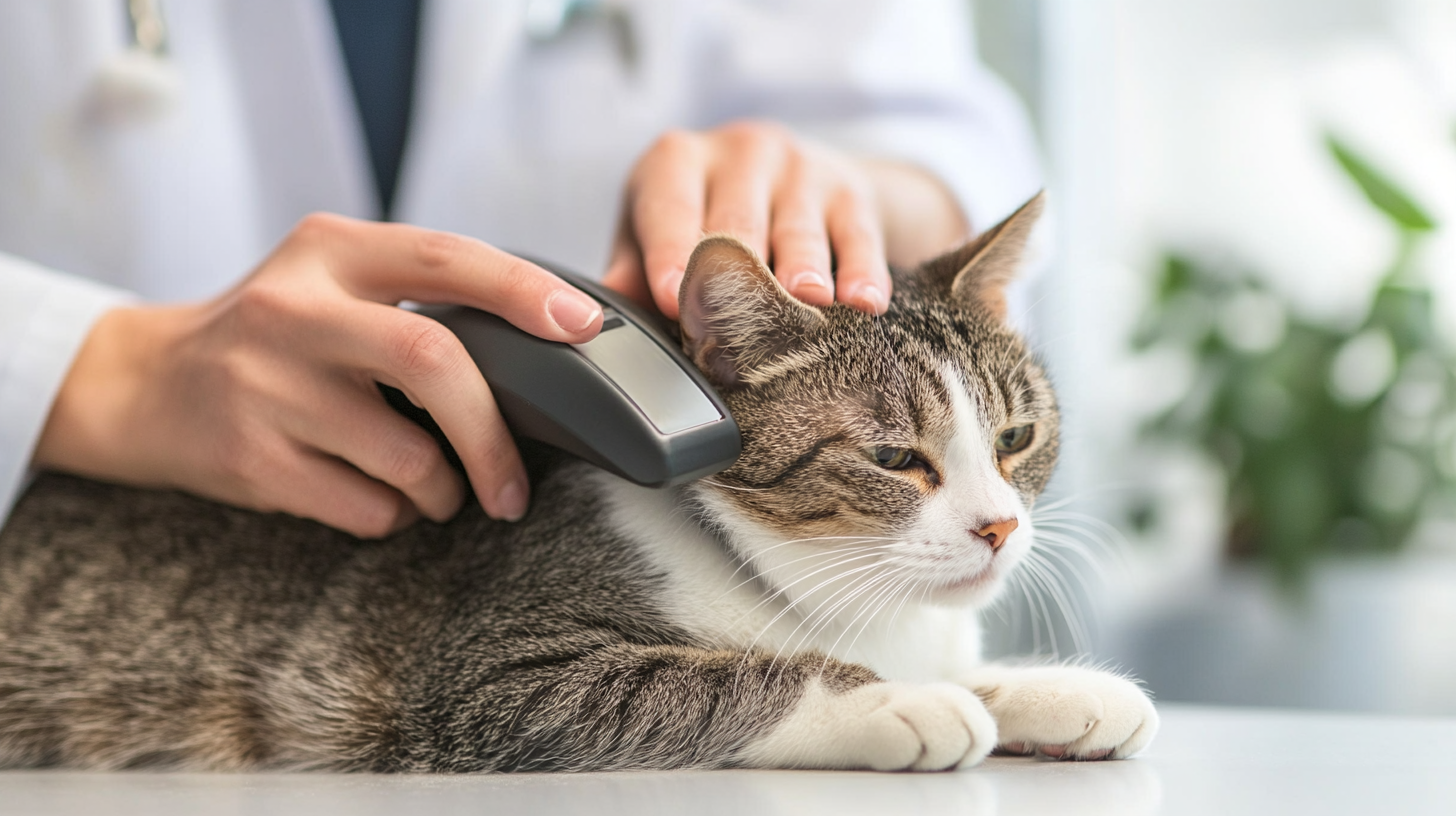
Australia’s rules on microchip sequencing are absolute: the microchip must be implanted before any vaccination or blood test is performed. If a vet vaccinates your cat and then microchips it — even on the same day — Australia will not recognise that vaccination and you must start again from scratch.
The chip must comply with ISO standards 11784 and 11785, producing a 15-digit identification number. This is not the same as older 9-digit or 10-digit AVID or HomeAgain chips used in the United States. If your cat already has a non-ISO chip, your vet can implant a second ISO-compliant chip alongside it — this is routine practice. Once implanted, ask your vet to scan it immediately and record the number on all documentation.
Tip
Step 2: Rabies Vaccinations
Australia requires a valid rabies vaccination prior to the titer test blood draw. In practice, most cats need two vaccinations to reliably produce a passing titer result: a primary vaccination followed by a booster at least 30 days later. A single vaccine produces a weaker primary immune response; the booster triggers a stronger secondary response far more likely to meet the ≥0.5 IU/ml threshold Australia requires.
The vaccine must be either inactivated (killed) virus or recombinant type. Modified live virus (MLV) vaccines are not accepted. Accepted brands include Imrab 3, Nobivac Rabies, Purevax Rabies (recombinant), and Rabisin. Confirm the product type with your vet and ensure the vaccine name appears on all documentation exactly as it appears on the manufacturer’s datasheet. Keep the vaccination current throughout the entire process — if it lapses during the 180-day wait, you may need to restart from the titer test stage.
Step 3: Rabies Titer Test
After the booster vaccination, your vet draws blood and sends it to a DAFF-approved laboratory for a Rabies Neutralising Antibody Titer Test (RNATT). The result must show ≥0.5 IU/ml of rabies neutralising antibodies, proving your cat’s immune system has mounted an adequate response. The blood must go to a laboratory specifically approved by DAFF — not just any accredited animal health lab.
- •USA: Kansas State University Rabies Laboratory
- •EU: ANSES Nancy Laboratory, France
- •UK: APHA Weybridge (Animal and Plant Health Agency)
- •Australia (return tests): CSIRO, Geelong
Confirm the full approved lab list with DAFF before submitting any samples, as it is updated periodically. Courier the blood with tracked shipping to minimise transit time — every day the sample spends in transit is a day not counted toward your 180.
If Your Cat Fails the Titer Test
Step 4: The 180-Day Wait
Cats cannot enter Australia until 180 days have passed from the date the laboratory received their passing blood test. This is the same epidemiological safeguard used by Japan and New Zealand — rabies can incubate for up to 6 months before showing symptoms, so this window confirms your cat was genuinely rabies-free in a controlled environment before travel. Your cat must remain in the approved country of export for the entire period.
Use the waiting time productively:
- •Crate train early and thoroughly. Cats comfortable in their crate before travel cope dramatically better with the cargo hold and quarantine facility. Start with the crate open with food inside, build up to closed-door sessions, then car trips.
- •Book cargo space with your airline well in advance. Not all airlines carry live animals to Australia, and space is limited. Summer heat embargoes can restrict transport windows.
- •Set vaccination renewal reminders. If the rabies vaccination lapses during the 180-day wait, you may need to restart the titer test process entirely.
- •Organise all documentation. DAFF inspectors at Mickleham require the complete chain of paperwork — microchip records, vaccination certificates, lab reports, health certificates — in order and immediately accessible.
Step 5: Pre-Flight Parasite Treatments
Australia has three mandatory parasite treatments before export, each with a specific timing window. These are not optional and must be recorded in the official treatments register, which forms part of the health certificate. Product names, treatment dates, and batch numbers must all be documented by your vet.
Mandatory Treatment Windows
Internal Parasites — Dose 1: Within 45 days of export
Internal Parasites — Dose 2: Within 5 days of export
Strict Windows
Step 6: Import Permit & Health Certificate
Apply for your cat’s import permit through the DAFF Biosecurity Import Conditions (BICON) system as early as possible — ideally during the 180-day waiting period. The permit specifies exactly which country your cat is coming from and the conditions that apply. These differ significantly by origin country; cats from approved rabies-free countries follow a different, potentially shorter pathway.
The veterinary health certificate must be issued by an authorised government vet within the window specified in your import permit (commonly within 5–10 days of departure). In the US, this means a USDA-accredited vet with APHIS endorsement. In the UK, an Official Veterinarian (OV) with APHA endorsement. Australia’s DAFF provides specific approved forms — do not use generic health certificate templates. Download the correct forms from the BICON system for your specific import pathway.
Flying to Australia: Manifest Cargo Only
This is one of the most important practical realities of moving a cat to Australia: cats cannot travel in the cabin on any flight to Australia. All cats must be transported as manifest cargo — a specific cargo classification with its own documentation, handling procedures, and IATA crate standards. This is different from excess baggage; your cat travels in a separate cargo hold, handled by the airline’s cargo division.
You will typically check your cat in at the cargo terminal rather than the passenger check-in desk, often several hours before your own flight. The crate must be IATA Live Animals Regulations (LAR) compliant — large enough for the cat to stand, turn around, and lie down, with adequate ventilation on at least three sides.
Airlines that commonly transport cats to Australia as manifest cargo include Qantas, Singapore Airlines, Emirates (select routes), and Cathay Pacific (via Hong Kong). Always confirm live animal acceptance directly with the cargo division — not the passenger service team — and book cargo space early, as it is subject to capacity and temperature restrictions.
Temperature Restrictions
Mickleham Quarantine Facility
All cats entering Australia must land at Melbourne Airport (MEL) and be transported directly to the Post Entry Quarantine (PEQ) facility at Mickleham, approximately 30 kilometres north of Melbourne’s CBD. There is no alternative entry point — you cannot fly your cat directly into Sydney, Brisbane, or any other Australian city. If your final destination is elsewhere in Australia, you arrange onward domestic transport separately after quarantine is complete.
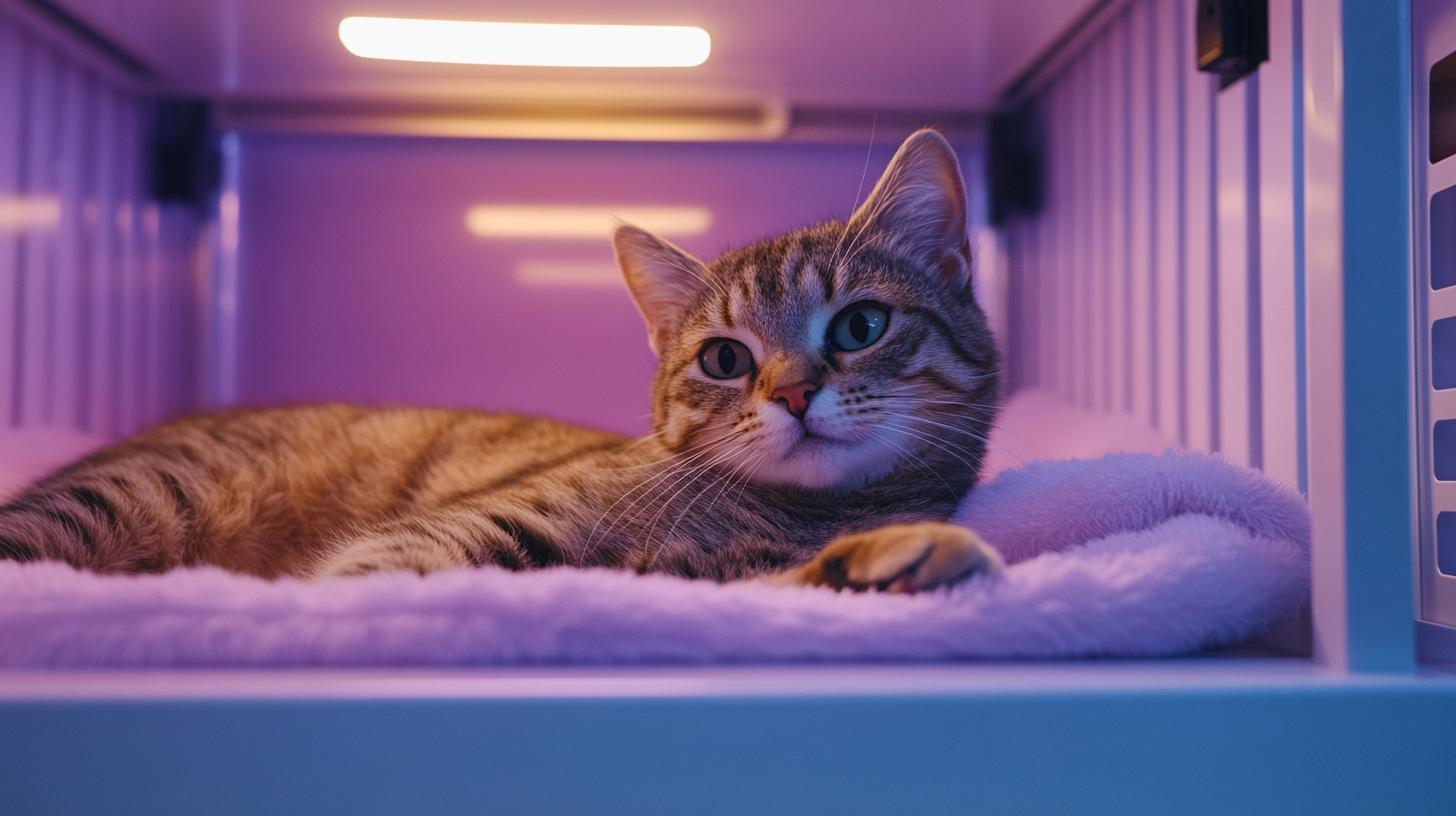
The standard quarantine period is 10 to 30 days, depending on your cat’s country of origin and whether you have completed the optional identity verification step. Mickleham is a purpose-built facility with climate-controlled individual suites, professional animal care staff, and regular veterinary oversight. It is not a pound or a shelter. Your cat will receive regular human interaction, consistent feeding, and professional care throughout the stay. Visits are permitted during scheduled hours — contact the facility directly to confirm current arrangements.
Mickleham Quarantine Costs (2026 Estimates)
10-day stay: Approximately AUD $900–$1,800 plus one-time processing fees
30-day stay: Approximately AUD $2,500–$4,500 plus one-time processing fees
Identity Verification: Cutting Quarantine from 30 to 10 Days
Australia offers an optional but highly valuable process called identity verification. Completing it reduces mandatory quarantine from 30 days down to just 10 — a saving of up to 20 days and potentially AUD $2,000–$3,000 in quarantine fees. Identity verification involves an accredited government vet in your home country attending your cat in person, confirming the microchip reading matches all documentation, and witnessing the final parasite treatments and health examination.
The verification must be conducted by a vet on Australia’s approved list of identity verifiers — check the DAFF BICON system for the approved list in your country. The cost of a single verification consultation is almost always significantly less than the 20 additional days of quarantine fees it saves. If an approved verifier is accessible in your area, it is strongly worth booking.
The Complete Process at a Glance
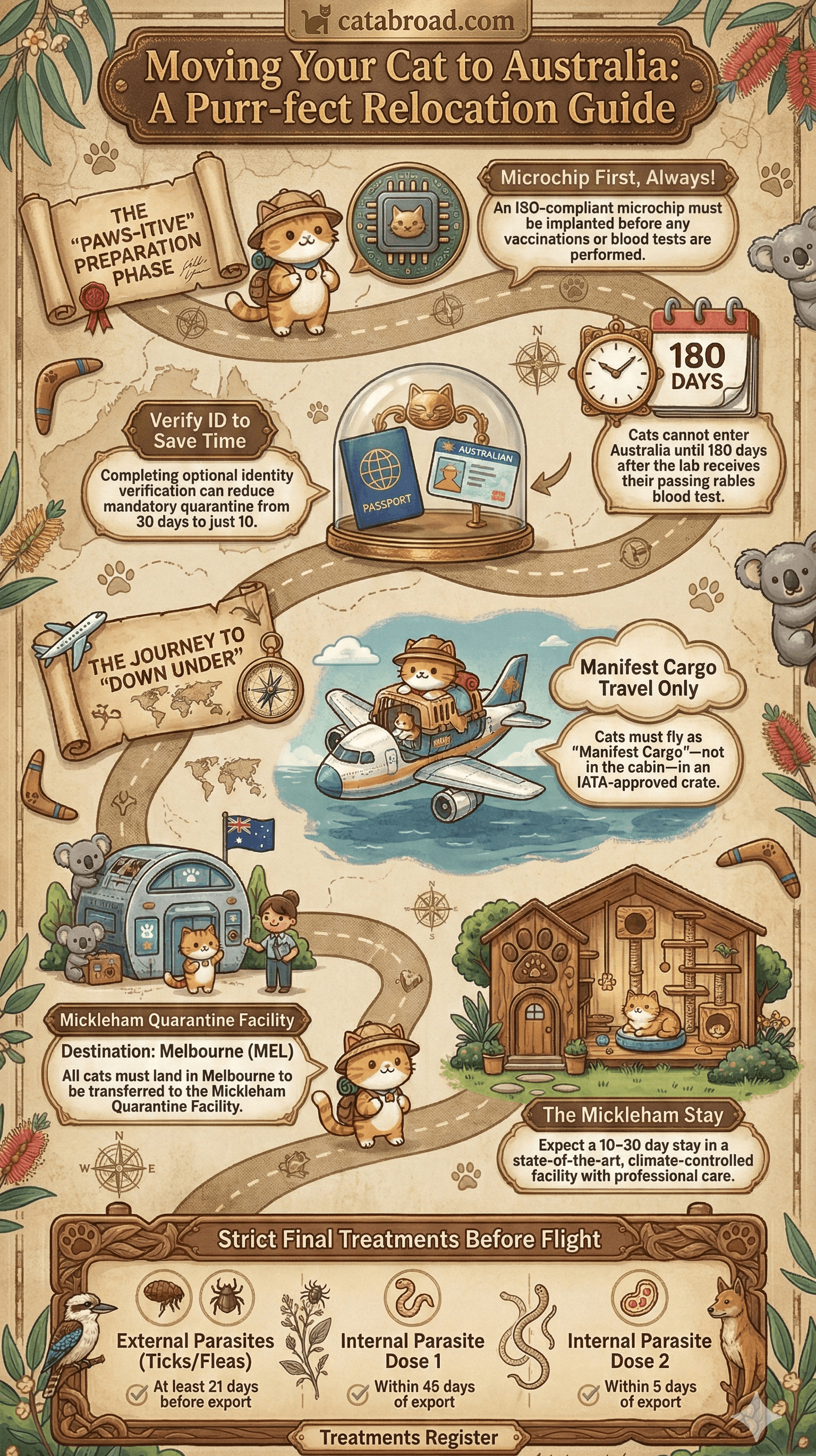
The full import process — from the preparation phase through to the Mickleham stay — is summarised in the infographic below. Save or share it with your vet to make sure everyone involved understands the sequence and timing requirements before you begin.
Cost Summary
Estimated Total Costs
Two rabies vaccinations: $60–$140 / £50–£110
RNATT titer test (lab + vet draw): $200–$350 / £150–£280
Parasite treatments (x3): $80–$150 / £60–£120
Import permit (DAFF BICON): $50–$100 / £40–£80
Health certificate + government endorsement: $200–$500 / £150–£400
Identity verification (optional but recommended): $100–$250 / £80–£200
Airline manifest cargo fee: $500–$2,000+ / £400–£1,600+
IATA-approved crate: $80–$300 / £60–£250
Mickleham quarantine (10 days): $600–$1,200 / £480–£960
Mickleham quarantine (30 days): $1,800–$3,500 / £1,400–£2,800
Total estimate (with 10-day quarantine): $1,900–$5,100+ / £1,500–£4,100+
Common Mistakes That Cause Problems
Avoid These Errors
❌ Non-ISO microchip (9 or 10 digits) not replaced with 15-digit ISO chip
❌ Titer test blood sent to a laboratory not on DAFF’s approved list
❌ Titer result fails — retest required, 180-day clock resets
❌ Rabies vaccination lapses during the 180-day waiting period
❌ External parasite treatment given fewer than 21 days before export
❌ Second internal parasite dose given more than 5 days before export
❌ Cat booked on a passenger flight — all cats must travel manifest cargo
❌ Attempting to land at any airport other than Melbourne (MEL)
❌ Import permit not obtained from DAFF BICON before travel
❌ Generic health certificate form used instead of DAFF-approved template
Any single one of these errors can result in extended quarantine or refusal of entry.
Frequently Asked Questions
Can I fly my cat to Australia in the cabin?
No. All cats entering Australia must travel as manifest cargo in an IATA-approved crate. Cabin transport is not permitted under any circumstances on any airline.
Does my cat have to land in Melbourne?
Yes. All cats entering Australia must arrive at Melbourne Airport (MEL) and be taken directly to the Mickleham Post Entry Quarantine facility. Sydney, Brisbane, and all other Australian airports are not designated entry points for cats.
What is the minimum time the process takes?
Approximately 7 to 8 months from the date of microchipping to the earliest possible arrival in Australia. The 180-day clock starts when the laboratory receives the blood sample for the titer test, not when the vet draws it.
Can I visit my cat during quarantine at Mickleham?
Yes, visits are typically permitted during scheduled hours. Contact the Mickleham facility directly to confirm current visiting arrangements, as policies can vary.
What if my cat is coming from a rabies-free country?
Cats from approved rabies-free countries such as New Zealand or certain Pacific islands may follow a different, potentially shorter import pathway. Check the DAFF BICON system for the specific conditions applicable to your country of export, as these differ significantly from the standard pathway described in this guide.
 Australia
 Japan
Japan New Zealand
 Singapore
 United Kingdom
 United States