Indonesia is one of the most searched destinations on CatAbroad — and one of the most misunderstood. Whether you are relocating to Jakarta for work, moving to Bali for the lifestyle, or joining the growing digital nomad community in Canggu, bringing your cat is entirely possible — as our Indonesia country guide summarises at a glance. But Indonesia’s import process is genuinely complex: a rabies titer test, a government import permit that takes 6–8 weeks, and a mandatory 14-day quarantine on arrival are all non-negotiable. Start early, follow the steps precisely, and your cat will be sharing a villa with you before you know it.
Why Indonesia Is a Hard-Rated Destination
CatAbroad rates Indonesia as Hard for cat imports, and the rating is deserved. Unlike EU countries where a microchip, rabies vaccine, and health certificate are enough, Indonesia layers on three additional requirements that each add weeks or months to your timeline: a rabies antibody titer test, an advance import permit from the Indonesian Agricultural Quarantine Agency (IAQA), and a mandatory 14-day stay in a government quarantine facility on arrival.
None of these can be rushed or bypassed. The import permit alone takes 6–8 weeks to process. Plan for a minimum of 4 months of preparation from your first vet visit to boarding your flight — and that assumes nothing goes wrong with the titer test result.
The Complete Step-by-Step Process
Indonesia’s import process is managed by Barantin (Badan Karantina Indonesia — formerly the Indonesian Agricultural Quarantine Agency, IAQA), a cabinet-level agency formed in 2023. All imports must comply with their current requirements, published by Barantin (Badan Karantina Indonesia) at karantinaindonesia.go.id. Here is the full sequence.
Indonesia Cat Import: Steps at a Glance
Step 2: Rabies vaccination → wait 30 days
Step 3: Rabies antibody titer test (≥0.5 IU/ml required)
Step 4: Additional vaccines (feline panleukopenia, calicivirus, rhinotracheitis)
Step 5: Apply for IAQA import permit (allow 6–8 weeks)
Step 6: Health certificate within 7 days of departure
Step 7: Fly into Jakarta CGK or Denpasar DPS
Step 8: 14-day government quarantine on arrival
Step 1: ISO Microchip
Your cat must carry an ISO 11784/11785 compliant, 15-digit microchip. This is the international standard chip and is different from the 9-digit or 10-digit AVID/HomeAgain chips still common in the United States. If your cat already has a non-ISO chip, your vet can implant a second compliant chip alongside it — this is routine practice.
The microchip must be implanted before the rabies vaccination, or on the same vet visit with the chip confirmed working first. IAQA documentation links every subsequent record back to the chip number, so getting this right from the start is critical.
Step 2: Rabies Vaccination and Titer Test
Indonesia requires a valid rabies vaccination followed by a rabies antibody titer test showing a result of at least 0.5 IU/ml. The sequence matters: vaccinate first, wait at least 30 days for the immune response to build, then draw blood for the titer test.
The blood sample must be sent to an internationally recognised laboratory. Indonesia accepts results from approved labs including those recognised by the OIE (World Organisation for Animal Health). In the US, Kansas State University Rabies Laboratory is commonly used. In Europe, ANSES Nancy in France is a standard choice. Ask your vet to confirm the laboratory is currently on the Indonesian approved list before sending the sample.
If Your Cat Fails the Titer Test
Step 3: Additional Vaccinations
Beyond rabies, Indonesia requires cats to be vaccinated against feline panleukopenia (cat flu), calicivirus, and rhinotracheitis — typically covered by the standard FVRCP combination vaccine given as part of routine annual care. Confirm with your vet that all three are current and that the vaccination records clearly show the vaccine name, batch number, and administration date.
Step 4: The IAQA Import Permit
This is the step that surprises most first-time importers. Indonesia requires an import recommendation letter from the IAQA obtained before your cat can enter the country. You cannot apply on arrival — the permit must be in hand before you fly.
You can apply through the nearest Indonesian embassy or consulate in your home country, or directly to IAQA online at their official portal. The application requires your cat’s microchip number, vaccination records, and titer test results. Processing typically takes 6–8 weeks, though this can vary. The permit fee is IDR 500,000 (approximately $32 USD).

Pro Tip: Apply for the Permit Early
Step 5: Health Certificate Within 7 Days of Travel
Within 7 days of your departure date, a licensed government-authorised veterinarian must examine your cat and issue an official veterinary health certificate. In the US this is an Accredited Veterinarian issuing a USDA-endorsed certificate (your state APHIS office handles the endorsement). In the UK, use an Official Veterinarian with APHA endorsement. In the EU, your national competent authority endorses the certificate.
The health certificate confirms your cat is fit to travel, free from signs of infectious disease, and that all vaccinations are current. It must accompany your cat on the flight and be presented at the IAQA inspection on arrival. Do not use a standard private vet certificate — it must carry the government endorsement stamp.
Entry Points: Jakarta or Bali?
Cats must arrive through an airport with IAQA quarantine facilities. The two main options are:
- •Jakarta Soekarno-Hatta (CGK) — The most common and recommended entry point. Jakarta has the best-equipped IAQA quarantine facilities and the widest range of international flights from Europe, the US, and the Middle East. If you have a choice, entering via Jakarta reduces logistical risk.
- •Denpasar Ngurah Rai (DPS) — Bali — Bali does accept cat imports and has IAQA quarantine facilities, but they are more limited than Jakarta. Direct long-haul routes into Bali are fewer, so many travellers connect through Singapore (Changi) or Kuala Lumpur. If your final destination is Bali, flying via Jakarta and connecting domestically (without your cat in cargo on the second leg) is worth discussing with your pet relocation specialist.
The 14-Day Quarantine: What to Expect
All cats entering Indonesia serve a mandatory 14-day quarantine at an IAQA government facility regardless of how complete their documentation is. There are no exemptions. The quarantine begins on the day of arrival.
Conditions at IAQA facilities vary significantly. Jakarta’s CGK facility is generally considered better-maintained and more professionally run than some regional options. Before you travel, it is worth contacting the specific facility to understand their visiting policy (most allow owners to visit during limited hours), what bedding or comfort items can be left with your cat, and what food they provide versus what you can bring.
Quarantine costs are additional to your other expenses: budget approximately IDR 3,000,000–5,000,000 (roughly $190–$320 USD) for the full 14 days, though this figure can vary by facility and cat size.

Common Mistakes That Derail Indonesia Cat Imports
❌ Titer test sent to a laboratory not on Indonesia’s approved list
❌ Health certificate older than 7 days on the day of travel
❌ Non-ISO microchip (AVID 9-digit or HomeAgain 10-digit chips are not accepted)
❌ Missing or incomplete additional vaccine records (FVRCP)
❌ Arriving at an airport without IAQA quarantine facilities
❌ Assuming Bali has the same quarantine infrastructure as Jakarta
Any of these errors will result in your cat being refused entry or held in unofficial facilities at significant cost.
Living with a Cat in Indonesia: Bali, Jakarta, and Beyond
Once your cat completes quarantine, life in Indonesia can be genuinely wonderful for both of you — with some important caveats.
Jakarta has the best veterinary infrastructure in Indonesia. There are several expat-oriented clinics in South Jakarta (Kemang and SCBD areas) with English-speaking vets, modern equipment, and reasonable prices by international standards. If your cat has ongoing medical needs or you simply want peace of mind, Jakarta is the right base.
Bali is the most popular destination for expat cat owners but requires more research. Quality ranges from excellent specialist clinics in Seminyak and Kerobokan to basic general practices in rural areas. The Bali Street Dog Foundation also assists with cats in emergencies. The critical issue for Bali is rabies: unlike many popular tourist misconceptions, rabies is endemic in Bali. The virus circulates primarily through dogs, but cats can be exposed through contact with infected animals. Keep your cat’s rabies vaccination strictly current and consider making them an indoor-only cat, particularly in areas where stray animals are common.
Surabaya has reasonable vet care for a city of its size, and smaller cities like Yogyakarta and Lombok have basic facilities that will handle routine care but may not be equipped for complex procedures.
Heat and humidity are the other major lifestyle consideration. Indonesia is tropical year-round, so ensure your accommodation is air-conditioned and that your cat has access to cool resting spots. Cats from temperate climates often take a few weeks to acclimatise. Tick-borne diseases are also more common than in Europe or North America — discuss a preventative parasite regime with your vet both before departure and upon arrival.
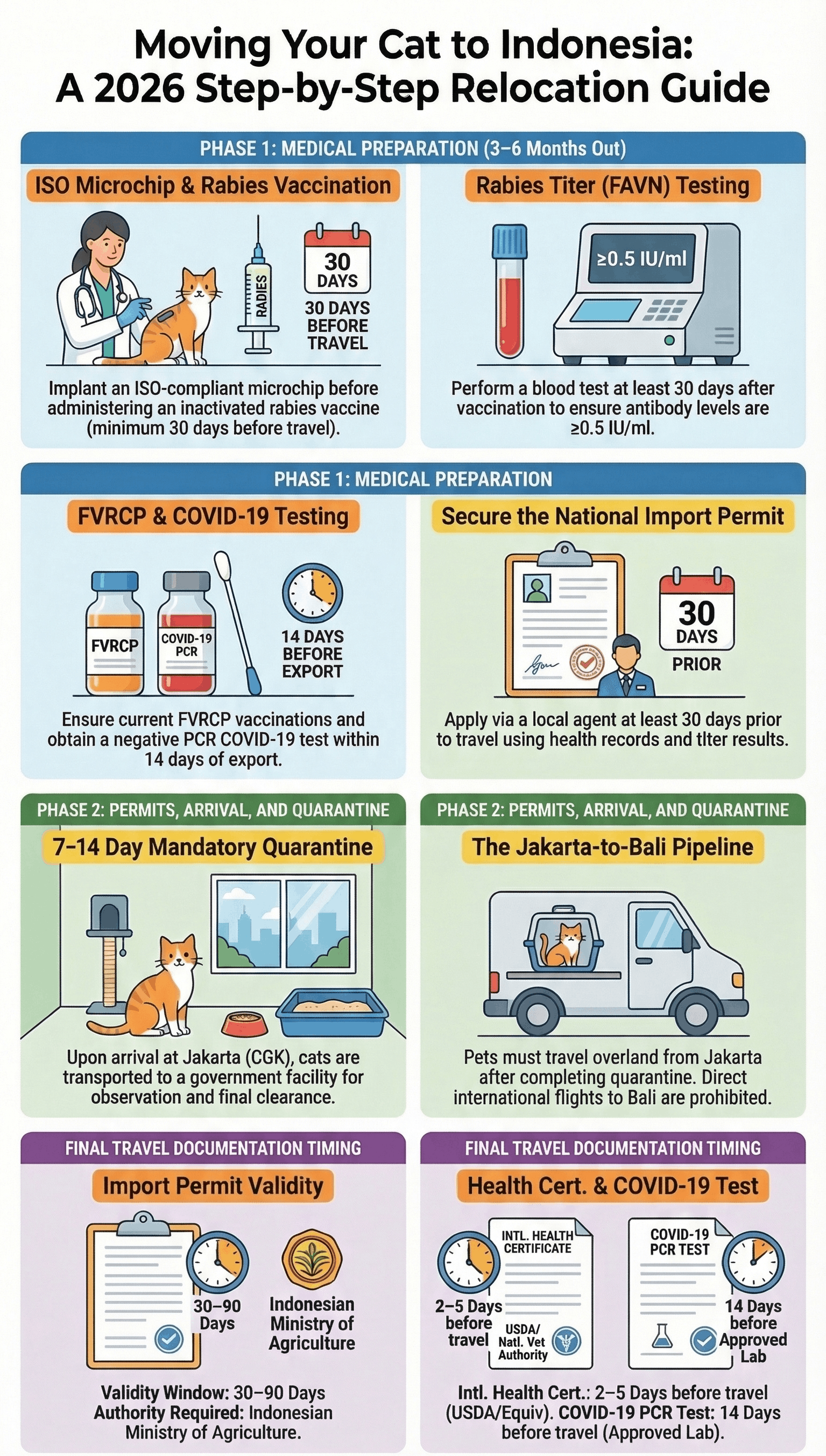
Indonesia Cat Import: Visual Overview
The infographic below summarises the key steps, timeline, and costs at a glance — useful to share with your vet or keep as a checklist during preparation.
Cost Breakdown
Estimated Costs: Moving a Cat to Indonesia
Rabies vaccination: $40–$80
Rabies titer test (blood draw + lab): $150–$300
Additional FVRCP vaccines: $30–$60
IAQA import permit: IDR 500,000 (~$32)
Veterinary health certificate + government endorsement: $100–$250
Flight (cabin, regional): $200–$400
Flight (cargo, intercontinental): $1,500–$3,500
IATA-approved crate: $50–$300
14-day quarantine: IDR 3,000,000–5,000,000 (~$190–$320)
Total estimate: $800–$4,000+ depending on origin and travel method
Should You Use a Pet Relocation Service?
For a destination as complex as Indonesia, many owners find that using a professional pet relocation service saves significant time and stress — particularly for the permit application and quarantine coordination, which involve communication with Indonesian government offices and can be challenging in English.
A good relocation specialist will handle the IAQA permit application, liaise with the quarantine facility on your behalf, confirm your documentation is complete before departure, and meet your cat at the airport. For long-haul moves from the US or Europe, this can be well worth the additional cost.
Professional Pet Relocation
Planning a move to Indonesia with your cat?
Starwood Animal Transport specialises in international pet relocations. They handle the Barantin permit, quarantine coordination, vet documentation checks, and door-to-door logistics — so nothing gets missed.
Get a Free QuoteFrequently Asked Questions
How long does it take to bring a cat to Indonesia?
The minimum is approximately 4 months: microchip and rabies vaccination, then 30 days before the titer test, then 6–8 weeks for the import permit. Add the final health certificate in the last week before travel and 14 days of quarantine on arrival. Build in extra time if you are moving from outside Asia — logistics are more complex for intercontinental moves.
Is Bali safe for cats given the rabies situation?
Bali does have endemic rabies, primarily transmitted by dogs. The risk to an indoor cat is low but not zero. Keep your cat’s rabies vaccination current, avoid letting them roam freely outside, and have your local vet’s emergency number saved. Many expat cats live happily in Bali long-term with sensible precautions.
Can my cat travel in the cabin to Indonesia?
This depends entirely on your airline and route. Regional carriers such as Garuda Indonesia, AirAsia, and Singapore Airlines allow small cats in-cabin on some routes (typically regional flights within Asia). For intercontinental flights from Europe or North America, cats almost always travel as manifest cargo. Check the specific airline policy for your exact route before booking.
Can I visit my cat during the 14-day quarantine?
Most IAQA facilities allow owner visits during set hours, typically 1–2 hours in the morning or afternoon. Policies vary by facility — contact the specific quarantine station at your entry airport in advance to confirm visiting arrangements and what you can bring (bedding, food, toys).
What happens if I arrive without the IAQA import permit?
Your cat will be refused entry or held in unofficial holding while you attempt to arrange documentation — at your cost, which can be substantial. The permit cannot be obtained on arrival. This is not a grey area: do not board your flight without the permit in hand.
 Indonesia
 Malaysia
 Singapore
 Philippines
 Thailand