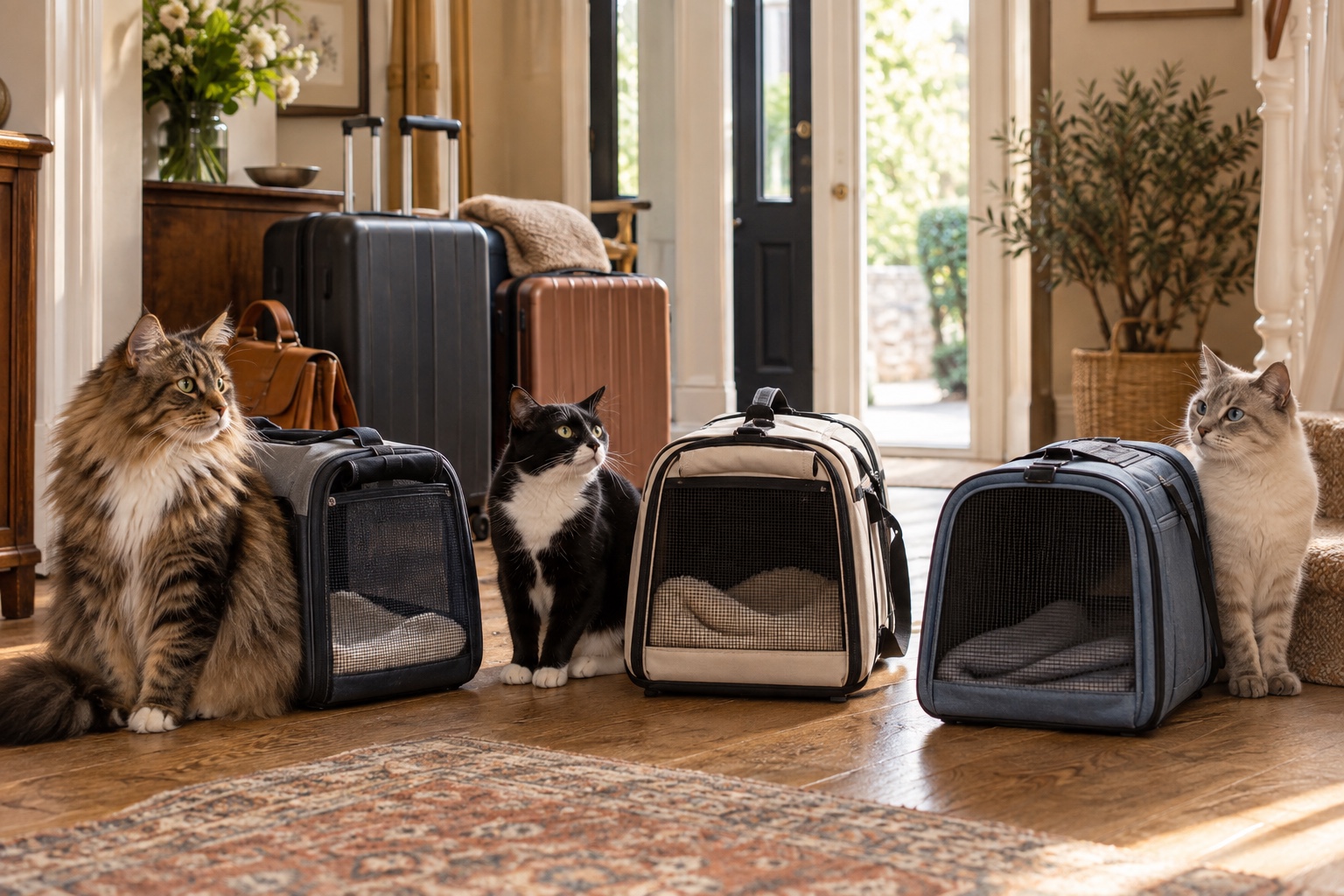
One cat under the seat is a solved problem. You pick a foreign carrier that takes cabin pets from the UK, pay the fee, weigh the carrier, and go. With two cats, the plan starts to unravel; with three, the cabin quietly stops being an option at all. Not because airlines dislike multi-cat households, but because every limit in the system is written per passenger, per flight and per crate — and cats are the one thing you can't check as excess baggage.
This guide is for people leaving the UK with two or more cats. It covers the three places the plan breaks — cabin caps, crate rules and the five-pet threshold — then the cost, the paperwork and the routes that actually work.
At a glance: two people with two small cats may be able to travel in the cabin; one person with two adult cats will usually need cargo or a shared charter; three or more cats are normally planned as one cargo consignment. The five-pet threshold changes the paperwork, not the airline’s individual acceptance decision.
Partner disclosure: This guide includes tracked PetAir links. PetAir confirms the route, dates, suitability and final price.
Why two cats break the cabin option
Three separate limits stack up against you.
- Per passenger: almost every airline allows one pet carrier per person. A solo traveller with two cats has already hit the wall.
- Per flight: airlines cap cabin animals per aircraft — typically two to four in economy. Two passengers with two cats need two of those slots on the same flight, and they go early.
- Per carrier: a handful of carriers let two small animals of the same species share one bag, but the combined weight limit doesn't move. Two adult cats plus a carrier under 8 kg is rare.
| Airline (from UK) | Pets per passenger | Two cats in one carrier? | Cap per flight |
|---|---|---|---|
| KLM / Air France | 1 | No | Limited; varies by aircraft |
| Lufthansa / Swiss / Austrian | 1 carrier (2 on request) | Yes, if same species and 8 kg combined | Varies by aircraft |
| Turkish Airlines | 1 | Small cats only, 8 kg combined | Limited |
| Iberia / TAP / ITA | 1 | No | Limited |
| Air Canada | 1 | No | 2–4 depending on cabin |
| Etihad | 1 (2 for two passengers from one household) | No | Limited; service animals take priority |
The two-cat cabin plan that works
If you're two people with two cats going to Europe, Turkey or Canada, this is doable: one booking, two passengers, one cat each, pets added at the time of booking so both cabin slots are secured on the same flight. Choose a route with several daily frequencies (Amsterdam, Paris, Frankfurt) so there's a fallback if the first flight's pet slots are gone. Sit together, and be aware many airlines won't put two pet carriers in adjacent seats — you may be a row apart.
If you're one person with two cats, the cabin only works on a carrier that allows two in one bag, and only if the cats are small. For most adult pairs, that's the end of the cabin conversation.
Three or more cats: this is a cargo move
At three cats — or two cats and one traveller, or any number going to a cargo-only destination — the cats fly as manifest cargo. That's not a downgrade; it's the professional route, and for multiple animals it's usually the calmer one, because everything is booked as a single consignment on a single flight rather than scavenged from cabin slots.
The key question then becomes crate configuration, and that's governed by the IATA Live Animals Regulations that every airline follows.
Sharing a crate: the honest trade-off
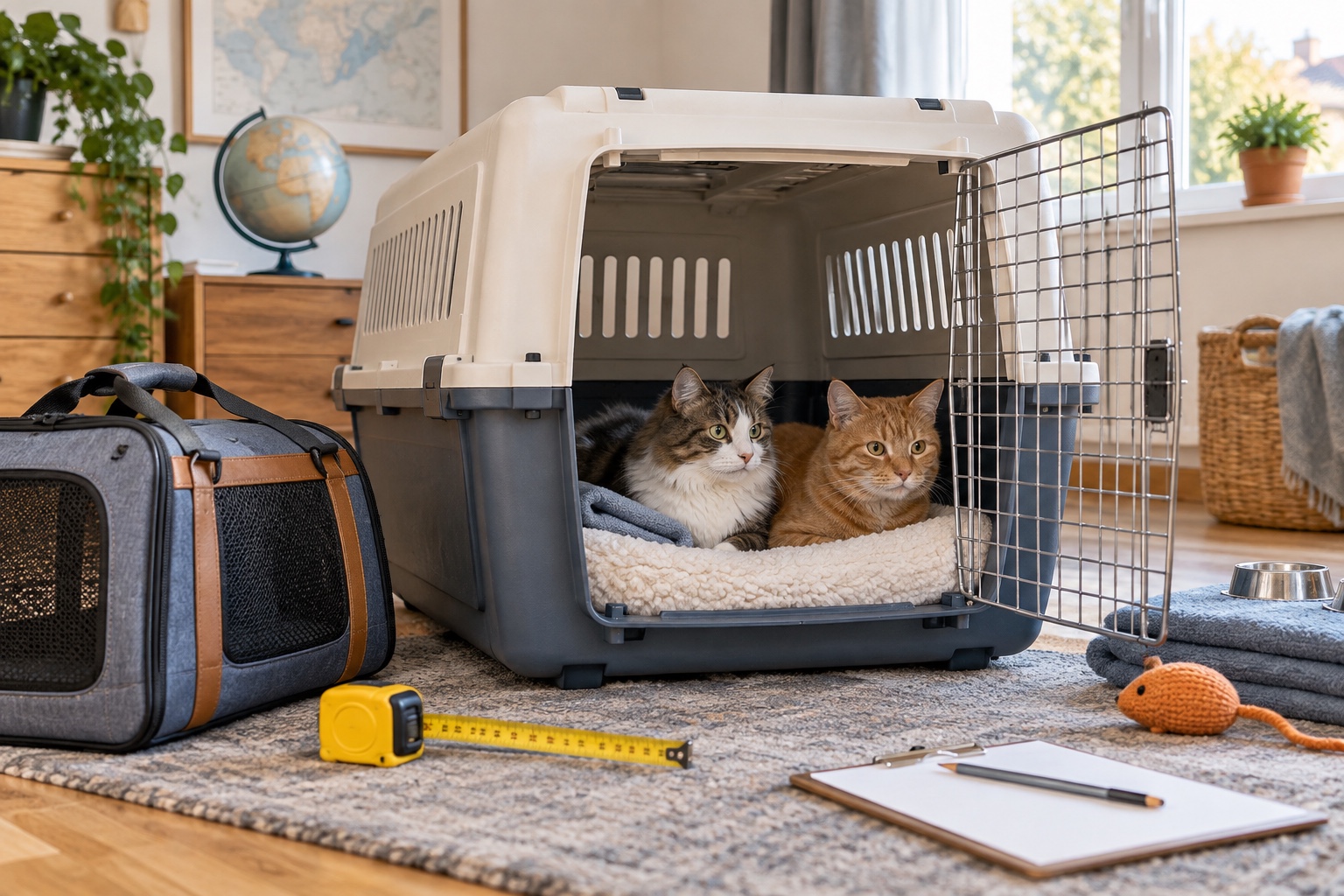
Owners of bonded pairs almost always want them together, and for a calm, closely bonded pair on a short flight that's often right. But three things push the other way. A shared crate must be big enough for both cats to stand, turn and lie down simultaneously, which pushes you into a crate size some aircraft can't take. If one cat panics or is sick in transit, the other is stuck with it for the duration. And in a delay or a missed connection, ground staff separate animals more easily when they're already in their own crates. Most experienced shippers default to individual crates on long-haul and only co-crate for short sectors or tiny cats. That's not caution for its own sake; it's what they've seen go wrong.
Two crates, one waybill. Separate crates doesn't mean separate bookings. Your cats travel as one consignment, on one air waybill, on one flight, and are loaded in the same hold compartment. They'll be side by side even if they're not in the same box.
The five-pet line
The UK, the EU and most destination countries treat pet travel as non-commercial when you're moving up to five animals per person, travelling with them or within five days of them. That's the world of pet passports, Animal Health Certificates and a signed owner declaration.
Cross five, and you're in the commercial regime — different export health certificate, an APHA-registered premises of origin in some cases, and a different set of vet endorsements — even if every animal is your own beloved pet. The only exception is animals travelling to a show, competition or training event. Six cats going to Spain is a commercial consignment; six cats going to a cat show in Spain isn't.
Whichever side you're on, each cat still needs its own microchip, its own rabies record and its own line on the certificate. One Animal Health Certificate to the EU covers up to five animals; one official-vet appointment covers all of them if you bring every cat and every record at once.
Rabies dates don't align themselves. With one cat you check one 21-day wait. With four, the newest vaccination sets the earliest travel date for the whole group — and a rescue whose paperwork predates its microchip needs revaccinating after the chip, which restarts its clock. Line all the dates up on one sheet before you book anything.
What multiple cats actually cost
The good news is that cargo costs don't scale linearly. Shipper fees, the export vet visit, airport handling and documentation are largely per shipment, not per cat; the airline charges by crate volume and weight, so a second crate adds its own rate but no new overheads. The rule of thumb from shippers is that each extra cat adds roughly 40–60% of the first cat's cost.
Two places the per-cat economics don't hold:
- Australia and New Zealand. Import permit, rabies titre test, pre-export treatments and quarantine are all charged per animal. Four cats to Melbourne is a five-figure move, and quarantine kennel capacity for a group has to be booked early.
- Cabin instead of cargo. If two passengers take two cats in the cabin to Europe, you'll pay two pet fees — under £400 in total, and the crossover point where cargo becomes cheaper never arrives. That's why the two-cats-two-people plan is worth the effort where it works.
Moving three or more cats from the UK?
Multi-cat consignments are where a specialist pays for itself: crate configuration, one air waybill for the group, a single vet appointment, and someone who has booked a five-cat move before. PetAir UK can quote your route, dates and cats — and tell you if two crates or three is the right call.
Explore PetAir’s options ↗Partner link. Route, dates, suitability and final pricing must be confirmed by PetAir.
Destination gotchas for groups
| Destination | Limit per person | What changes with more cats |
|---|---|---|
| EU / EEA | 5 non-commercial | One AHC covers all five. Over five: commercial certificate and a TRACES entry. Cabin possible on the right airline; ferry and Eurotunnel take any number in the car. |
| USA | No federal limit for cats | CDC has no cat entry requirements; individual states rarely check. No direct cabin route from the UK — see below. Easiest multi-cat cargo destination. |
| Canada | No limit, personal pets | Rabies certificate per cat at the border. Air Canada and Air Transat take cabin cats from the UK, one per passenger, 10 kg. |
| UAE | 2 per person | Import permit per animal, cargo arrival only. Three cats needs two named importers. |
| Australia | No fixed number, permit per cat | Every step costed per animal. Quarantine at Mickleham must be booked for the group. Lead time 6+ months. |
| New Zealand | No fixed number, permit per cat | As Australia; 10-day minimum quarantine per cat, RNATT per cat. |
| Singapore | 3 cats per household (HDB flats: 2) | Licence and cargo arrival; the household limit can stop the move before the airline does. |
| Japan | No limit | 180-day rabies titre wait applies to each cat individually; the slowest cat sets the date. |
The charter option for two cats
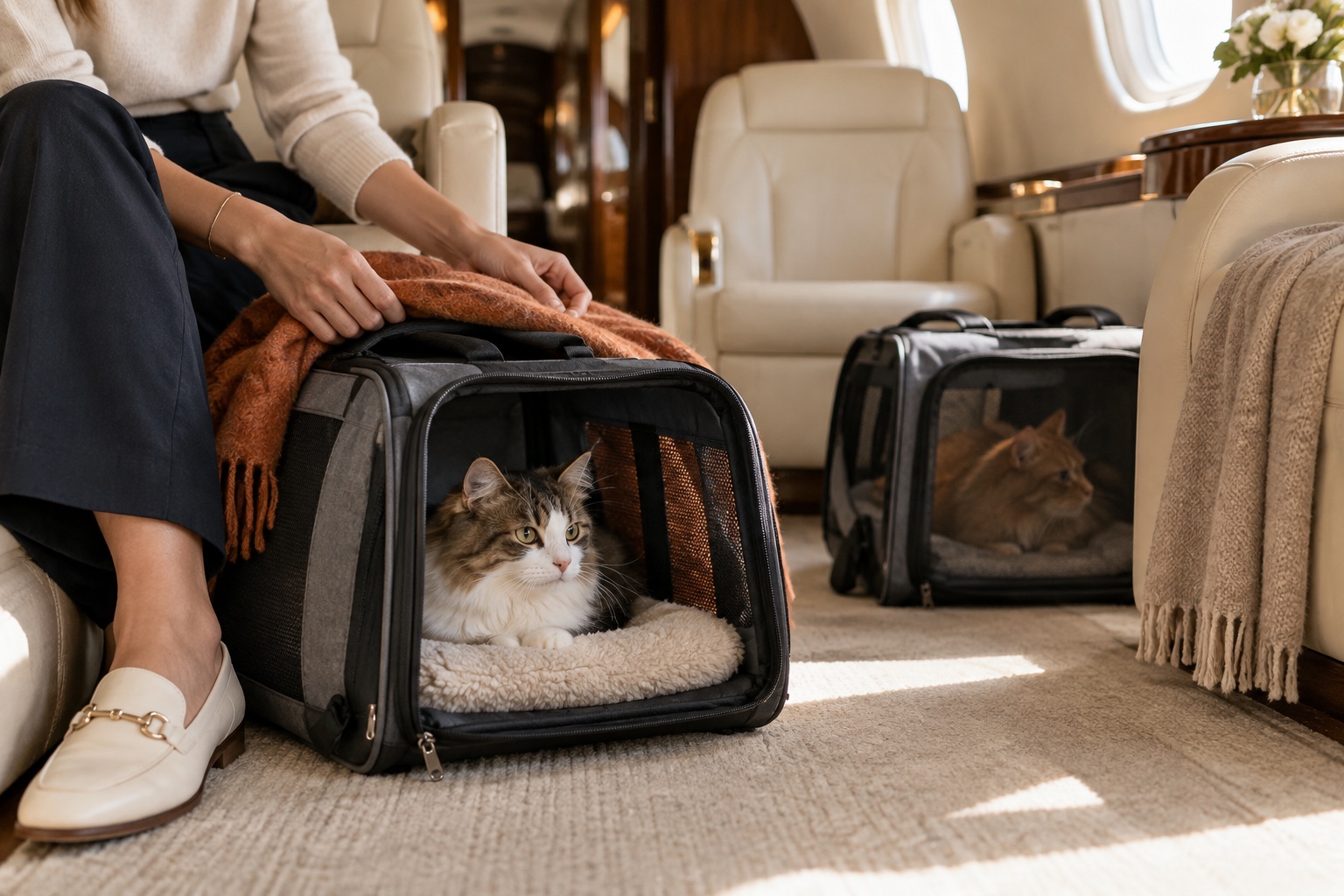
Shared pet charters run from the UK to the US East and West Coasts, Canada and Dubai. PetAir’s in-cabin private-jet option is one route to investigate when keeping the household together matters. The rule that matters here: one human seat covers up to two pets within a combined weight cap, cats in soft carriers throughout. For a two-cat household that would otherwise be looking at two crates in the hold to New York, that's one seat, both cats at your feet, no cabin caps to fight over. It costs several thousand pounds — we've set out the trade-offs here — but it's the only way two cats cross the Atlantic from the UK in the same cabin as their owner. Three cats need two seats.
A multi-cat departure checklist
- Count and classify. How many cats, how many humans, and which side of the five-pet line are you on?
- Weigh everyone. Each cat, each carrier. This decides cabin eligibility and crate sizes.
- Align the paperwork. One sheet: chip number, chip date, rabies date, booster due, for every cat. The latest date is your earliest departure.
- Pick the route by the hardest cat. The heaviest, oldest or most anxious cat sets the plan for the group.
- Decide crate-sharing with your shipper, not on your own. They've seen what a nine-hour flight does to a shared crate.
- Book the cats before the humans. Cabin slots and cargo space on a specific flight are the constraint; your own tickets are not.
- One vet appointment, all cats. Bring every animal and every record. Certificate validity runs from that visit for all of them.
- Plan arrival housing before departure. A group of cats in a hotel room for a week while you find a flat is harder than the flight.
Frequently asked questions
Can I take two cats in the cabin on one ticket?
Usually not. Most airlines allow one pet carrier per passenger. A few, Lufthansa among them, allow two small animals of the same species to share one carrier if the combined weight stays under the 8 kg limit — which rules out most adult pairs. The reliable way to fly two cats in the cabin is two passengers, each with one cat, booked together.
Can two cats share one crate in cargo?
Yes, within IATA Live Animals Regulations: up to two adult cats of comparable size, each under 14 kg, that are used to living together may share one container. Kittens under six months from the same litter can travel up to three to a crate. Airlines and shippers can still insist on separate crates, and many do for long-haul.
How many cats can I take abroad from the UK?
Up to five pets per person under the non-commercial rules for the EU and most destinations. More than five is treated as a commercial movement with different export health certificates, unless the animals are travelling to a competition or show. Each cat still needs its own microchip, rabies record and certificate entry.
Is it cheaper per cat to move three cats than one?
Yes, on the cargo route. Agent fees, vet certificate visits and airport handling are largely fixed per shipment, so the second and third cat typically add 40 to 60 percent of the first cat's cost rather than doubling it. Australia and New Zealand are the exception, because import permits and quarantine are charged per animal.
Should bonded cats fly together in one crate?
Often, but not always. Sharing calms some pairs and stresses others, and a crate for two must be large enough for both to stand, turn and lie down at once, which can exceed the airline's maximum. If one cat is anxious, elderly or a different size, separate crates loaded side by side are the safer choice.
Can cats fly on a shared pet charter from the UK?
Yes. On shared charters, one seat covers up to two pets within a combined weight cap, and cats stay in soft carriers throughout. For a two-cat household going to the USA, Canada or Dubai, one human seat carries both cats — an expensive but simple route that avoids the hold entirely.
Cabin rules from each airline's published pet policy; crate-sharing from IATA Live Animals Regulations; the five-pet threshold from GOV.UK and EU Regulation 576/2013; destination limits from the relevant national authorities. Checked September 2026. Costs are indicative mid-range figures and vary with route, season and crate size.