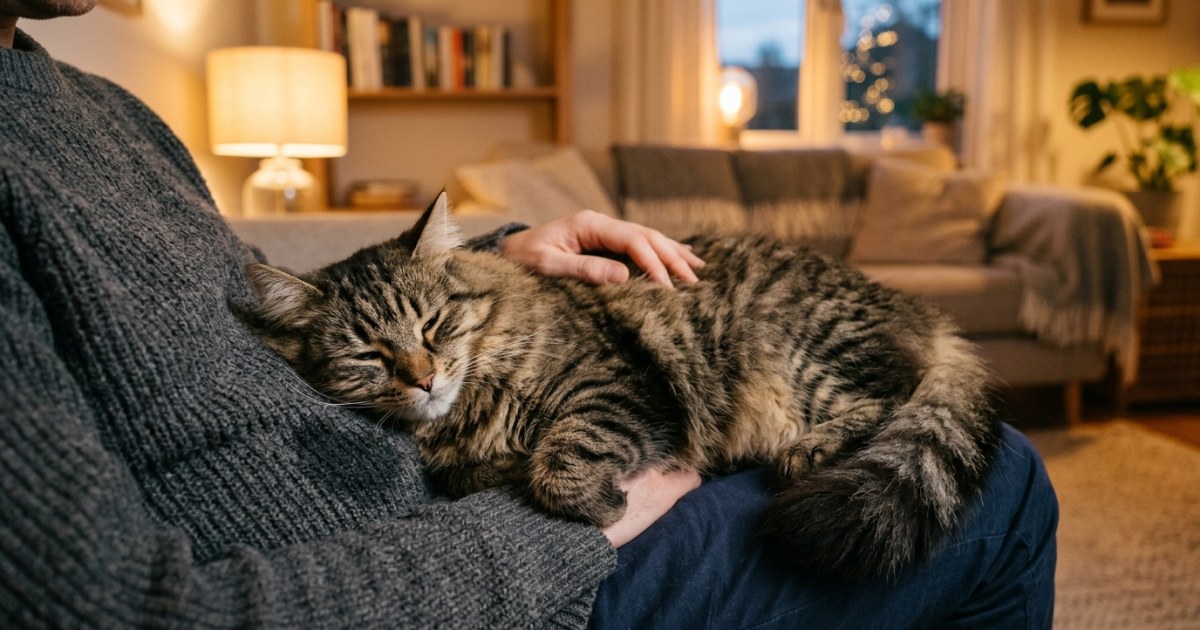
You're settled on the sofa, your cat is purring like a small diesel engine on your chest, and then you feel it — a warm, unmistakable damp patch spreading across your shoulder. Congratulations: your cat has just drooled on you. Whether you find this endearing or mildly revolting (or both, simultaneously, at midnight), you're almost certainly wondering what on earth is going on and whether you should be worried.
WHAT DOES IT ACTUALLY MEAN WHEN A CAT DROOLS?
Drooling — technically called hypersalivation or ptyalism — is not as common in cats as it is in dogs. Unlike a Labrador who will happily coat your entire forearm at the prospect of a biscuit, most cats keep their saliva firmly to themselves most of the time. So when your cat does drool, it tends to be noticeable, and it tends to prompt an immediate, slightly panicked Google search — possibly at midnight, possibly while still wearing the damp pyjamas in question.
The important thing to understand straight away is that cat drooling sits at opposite ends of a very wide spectrum. On one end, it is one of the most touching signs of trust and relaxation a cat can show you. On the other end, it can be a symptom of something that genuinely needs attention. The key — as with so many things in cat ownership — is context. How did it start? What else is going on? Has it always been this way, or is this new?
This guide will walk you through both ends of that spectrum clearly and honestly, help you figure out which camp your cat is in, and tell you exactly what to look out for if you're unsure.
Good to Know
Occasional, small amounts of drooling during obvious moments of happiness or relaxation are generally nothing to worry about. It's persistent, sudden-onset, or heavy drooling — especially accompanied by other symptoms — that warrants a vet call.
THE SWEET STUFF: BENIGN REASONS YOUR CAT DROOLS ON YOU
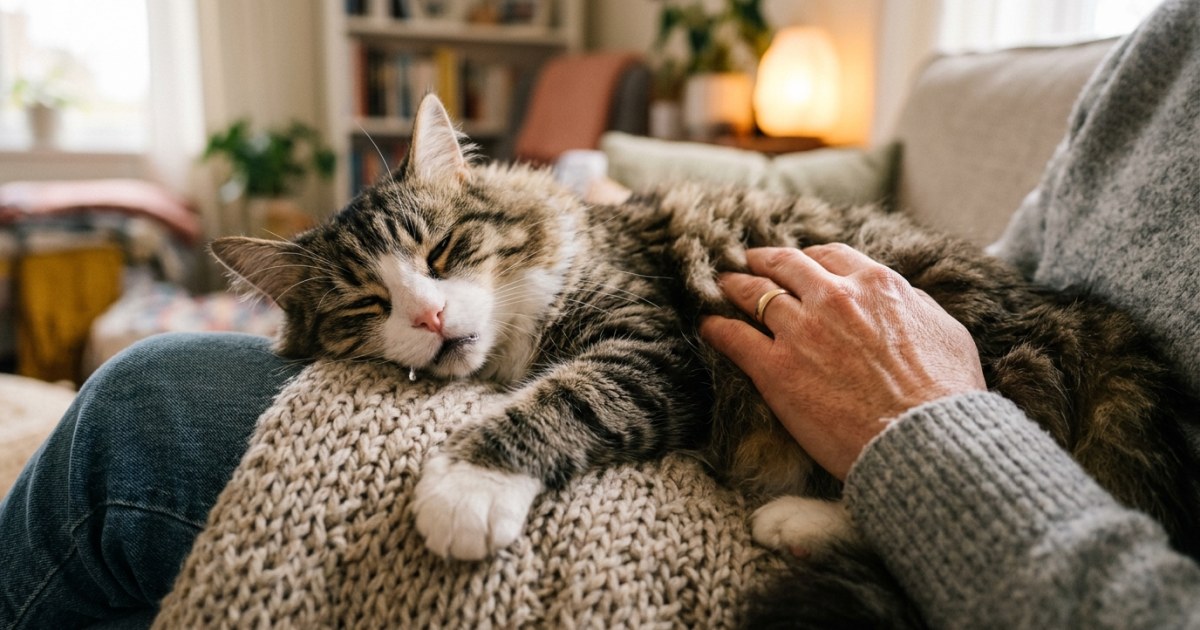
Let's start with the good news, because for the majority of cats who drool on their owners, the reason is genuinely lovely. Your cat is not broken. Your cat is not secretly unwell. Your cat is, in the most literal physiological sense, so happy and relaxed that their body is doing something slightly undignified about it.
Deep relaxation and the nursing reflex: The most common reason cats drool during cuddle sessions is rooted in kittenhood. When kittens nurse, they knead their mother's belly rhythmically with their paws — this stimulates milk flow and is associated with warmth, safety, food, and the earliest feelings of comfort a cat ever experiences. Many cats carry this behaviour into adulthood, continuing to knead on soft surfaces — blankets, pillows, and yes, your thighs — long after they've been weaned. The kneading reflex triggers a flood of positive associations so powerful that it can cause involuntary salivation. Your lap is, neurologically speaking, your cat's mum. You should probably feel honoured.
Intense purring and involuntary drooling: Purring itself involves a complex set of rapid muscular contractions in the larynx, and when a cat is purring at full intensity — that deep, rattling, whole-body rumble — the combination of physical vibration, deep breathing, and profound relaxation can simply cause the jaw to go slightly slack. A slightly slack jaw plus a lot of saliva equals a damp patch on your jumper. It's not glamorous, but it's entirely harmless.
Contentment-triggered hypersalivation: Some cats experience what veterinary behaviourists describe as contentment-triggered hypersalivation — essentially, their salivary glands respond to positive emotional states the same way a human might tear up at a soppy film. The parasympathetic nervous system, which governs the body's rest-and-digest functions, stimulates saliva production. In a deeply contented cat, this system is running at full tilt, and a little overflow is simply the result.
Individual variation: Just as some people are prone to sweating more than others, some cats are simply more liberal with their saliva than others. This is a matter of individual physiology. If your cat has been drooling occasionally since kittenhood and has always had a clean bill of health, it is almost certainly just who they are. Some cats drool. Some cats don't. It's a quirk, not a flaw.
Pro Tip
If your cat only drools during peak happiness moments — when kneading, when being stroked in their favourite spot, when curled up in a warm patch of sun — that pattern alone is a strong reassurance that it's behavioural and benign, not medical.
BREEDS MORE LIKELY TO LEAVE A DAMP PATCH: IS YOUR CAT ON THE LIST?
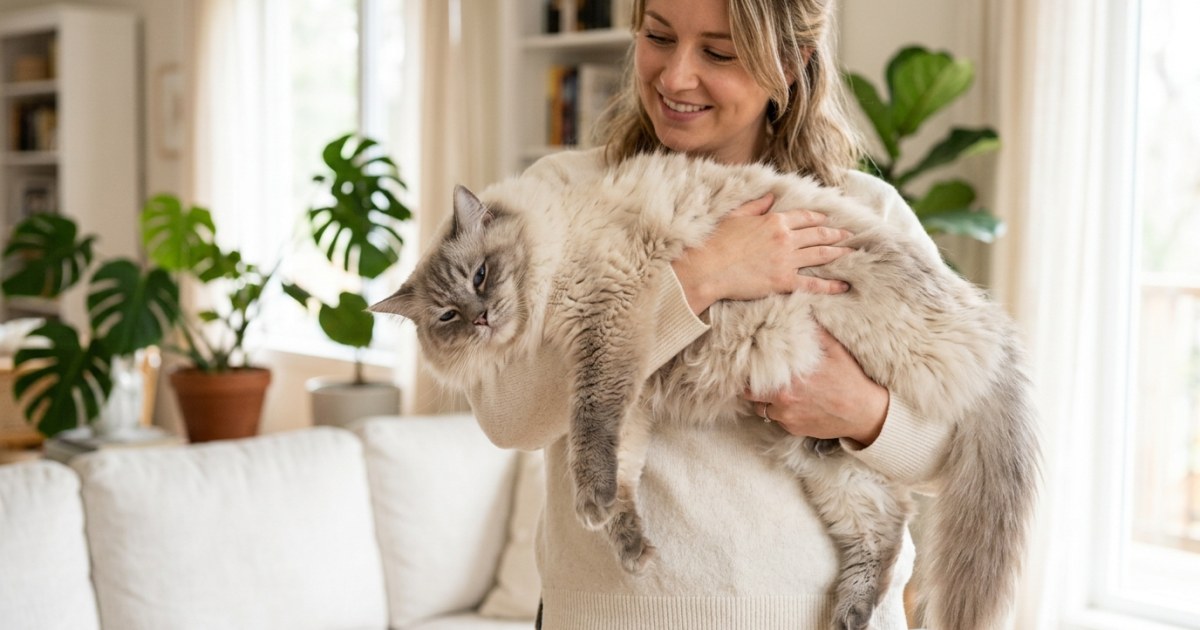
While any cat can drool from contentment, certain breeds are notably more prone to it than others, largely due to a combination of facial structure, temperament, and the sheer depth of their capacity for relaxed, boneless, absolutely-not-moving-now affection.
Ragdolls are perhaps the most famous droolers in the cat world, and it's almost entirely a compliment. These large, placid cats were practically engineered for lap-sitting. They go limp when picked up (it's literally in the name), they purr with extraordinary commitment, and they bond intensely with their people. All of this adds up to a cat who reaches states of contentment so profound that a little drooling is practically inevitable. If you share your home with a Ragdoll, a small towel draped over your shoulder during cuddle time is simply sensible accessorising.
Maine Coons are another breed that combines an enormous physical presence with a surprisingly soppy temperament. These are big, sociable, dog-like cats who follow their owners around, engage enthusiastically with human company, and purr loudly enough to be audible from the next room. Their size means they also tend to knead with considerable force, and the combination of vigorous kneading and intense purring makes drooling a fairly common accompaniment to their affection.
Persians drool for a slightly different reason: their flat (brachycephalic) face structure means their jaw alignment is different from that of a typically proportioned cat, which can make it harder for them to keep saliva contained during relaxed, open-mouthed breathing. In Persians, a small amount of drooling is often structural rather than emotional — though they are also, it must be said, exceptionally good at achieving deep relaxation.
Breeds & Their Drool Tendencies
| Ragdoll | High tendency — deep relaxation and intense bonding trigger contentment drooling regularly |
| Maine Coon | Moderate-high tendency — vigorous kneading and loud purring are frequent culprits |
| Persian | Moderate tendency — partly structural due to brachycephalic facial anatomy |
| Siamese | Lower tendency for contentment drooling, but vocal and expressive in other ways |
| Domestic shorthair/moggy | Varies by individual — some are enthusiastic droolers, most are not |
Good to Know
Brachycephalic breeds like Persians and Exotic Shorthairs may also drool slightly during sleep due to their facial structure. This is generally normal, but if it increases significantly or is accompanied by noisy breathing, a vet check is worthwhile.
WHEN DROOLING IS A WARNING SIGN: MEDICAL CAUSES TO KNOW
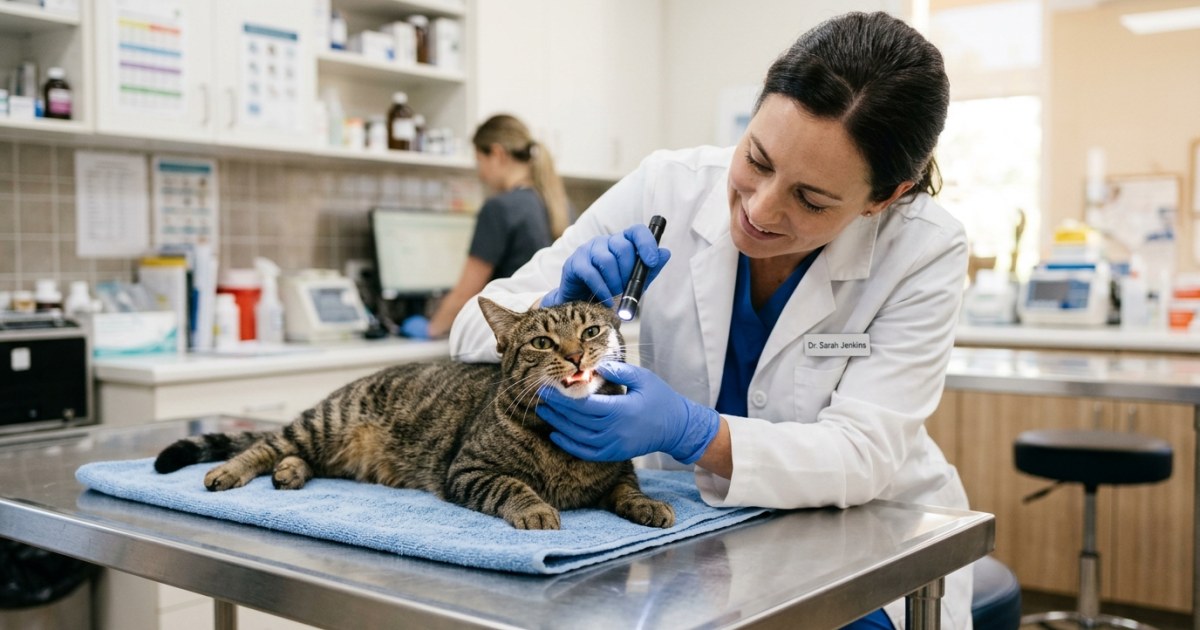
Now for the less comfortable part of the conversation — but an important one. Drooling that comes on suddenly in a cat who doesn't normally drool, or drooling that is heavy, persistent, and accompanied by other changes in behaviour or appearance, needs to be taken seriously. Here are the most common medical causes.
Dental disease and oral pain: This is, by some distance, the most common medical reason for sudden-onset drooling in adult cats. Dental disease is extraordinarily prevalent in cats — studies suggest that the majority of cats over the age of three have some degree of periodontal disease, and many have painful conditions such as tooth resorption (where the tooth structure literally breaks down from the inside) or stomatitis (severe inflammation of the mouth). Pain in the mouth causes excess salivation as the body's automatic response. If your cat has started drooling and their breath smells noticeably bad, or if they're reluctant to eat hard food, pawing at their mouth, or seem generally uncomfortable — please don't wait. A dental exam is needed.
Nausea: Cats, like humans, produce excess saliva when they feel nauseous. This can be triggered by motion sickness (very relevant for cats who travel), dietary issues, hairballs, gastrointestinal problems, or underlying systemic illness. Nausea-related drooling often comes with lip-licking, restlessness, swallowing repeatedly, and reluctance to eat. If your cat looks uncomfortable and is drooling, nausea is worth considering.
Foreign objects lodged in the mouth or throat: Cats are curious and occasionally foolish, and a small bone fragment, a piece of toy, a grass seed, or even a length of thread can become lodged in the mouth, between teeth, or at the back of the throat. This causes immediate distress — the cat will typically paw at their mouth urgently, gag, retch, or make repeated swallowing movements. Drooling in this context is often sudden, heavy, and clearly distressing. This is a same-day vet situation.
Neurological issues: Certain neurological conditions — including seizure disorders, head trauma, or problems affecting the nerves controlling the jaw and throat — can cause drooling as a symptom. This is less common, but if your cat is drooling alongside any change in coordination, facial symmetry, eye movement, or consciousness, it needs urgent veterinary attention.
Toxic plants and bitter-tasting substances: Cats who chew on toxic plants — and there are depressingly many common household and garden plants that are toxic to cats, including lilies, azaleas, and foxgloves — often drool heavily as an immediate response. Equally, if a cat licks a topical medication (including some flea treatments not designed for cats), a cleaning product, or any bitter or caustic substance, drooling is the body's rapid attempt to flush it out. If you suspect your cat has ingested something toxic, contact your vet or the Animal Poison Line immediately.
Upper respiratory infections: Cat flu and other upper respiratory infections cause inflammation and congestion that can affect the mouth and throat, leading to drooling. You'll usually see other symptoms alongside this — sneezing, runny eyes, nasal discharge, lethargy, and reduced appetite. If your cat seems under the weather in general and is drooling more than usual, a respiratory infection is a common culprit.
Warning
If your cat is drooling heavily and you can see them pawing frantically at their mouth, gagging, or retching, do not wait to see if it resolves. This could indicate a foreign body obstruction, which can become life-threatening quickly. Contact your vet or an emergency veterinary clinic straight away.
Warning
Lilies are among the most dangerous plants for cats and are unfortunately common in UK homes and gardens. Even small exposures — including brushing against pollen — can cause acute kidney failure. If your cat has been near lilies and is showing any unusual symptoms including drooling, treat it as an emergency.
CUTE OR CONCERNING? HOW TO TELL THE DIFFERENCE
Here is where we get practical, because this is the question you actually came here to answer. The good news is that in most cases, the difference between happy drooling and worried drooling is fairly clear once you know what to look for. The key is to observe your cat as a whole, not just the drooling in isolation.
What relaxed, benign drooling looks like: The cat is visibly at ease — eyes half-closed or slowly blinking, body loose and heavy, purring audibly. The drooling happens during or just after intensive stroking, kneading, or settling in. It stops when the cat becomes alert or moves away. The cat eats normally, plays normally, and shows no signs of discomfort. Their breath smells normal (or at least, like normal cat breath — not pleasant, exactly, but not alarmingly bad). This pattern has been consistent over time, possibly since kittenhood.
Red flags that suggest a vet visit is needed: The drooling is new or has recently increased. It happens regardless of the cat's emotional state — not just during happy moments. The cat is pawing at their mouth or face. There's noticeable bad breath or visible changes in the mouth. The cat is eating less, eating differently (favouring one side, dropping food), or refusing food altogether. The cat seems lethargic, withdrawn, or generally not themselves. The drooling is accompanied by vomiting, gagging, retching, or sneezing.
📋 Quick Assessment: Is My Cat's Drooling Benign?
- ☐Does the drooling only happen during cuddles, kneading, or obvious relaxation?
- ☐Is your cat eating and drinking normally?
- ☐Is their energy level and behaviour otherwise normal?
- ☐Has this been a consistent pattern over months or years (not something new)?
- ☐Is there no pawing at the mouth, gagging, or retching alongside it?
- ☐Does their breath smell broadly normal (for a cat)?
- ☐Is the amount of drooling relatively small (damp patch rather than steady drip)?
If you can tick most of those boxes, you're almost certainly in the happy camp. If several of those boxes give you pause, book a vet appointment. You don't need to treat it as a crisis, but you do need to get it looked at — especially because dental disease in cats is so common, so painful, and so easily missed by owners until it becomes severe.
Drooling At a Glance: Benign vs. Medical
| When it happens | Benign: During relaxation, kneading, cuddling | Medical: Any time, regardless of mood |
| Onset | Benign: Long-standing, consistent pattern | Medical: New or recently worsened |
| Appetite | Benign: Normal | Medical: Reduced, changed, or absent |
| Mouth behaviour | Benign: No pawing or discomfort | Medical: Pawing, jaw movements, gagging |
| Breath | Benign: Normal | Medical: Unusually bad or noticeably changed |
| Overall demeanour | Benign: Happy, active, engaged | Medical: Withdrawn, lethargic, or distressed |
Pro Tip
If you're uncertain, take a short video clip of your cat drooling on your phone before your vet appointment. Context is everything with this symptom, and being able to show your vet exactly when and how it happens is genuinely useful clinical information.
A WORD ON DENTAL HEALTH: THE CAUSE MOST OWNERS MISS
It would be remiss to write a guide to cat drooling without giving dental disease its own moment, because it is so common, so underdiagnosed, and so genuinely impactful on a cat's quality of life. The British Veterinary Dental Association estimates that the vast majority of cats show signs of dental disease by the time they reach middle age — and because cats are extraordinarily good at hiding pain, many owners have absolutely no idea anything is wrong until the problem is severe.
The reason dental issues cause drooling is straightforward: pain and inflammation in the mouth trigger the salivary glands. A cat with a severely infected tooth, a case of tooth resorption (a condition unique to cats in which the tooth essentially dissolves from the root outward), or widespread stomatitis will drool because their mouth hurts, continuously, and the body responds to that pain with saliva.
The tricky thing is that a cat with chronic dental pain will often continue to eat — because the alternative is not eating, and instinct overrides discomfort. So reduced appetite alone is not a reliable indicator. What you're more likely to notice is subtler: a slight preference for wet food over dry, a tendency to drop food from one side of the mouth, some reluctance around the food bowl, and yes, drooling that seems unrelated to happiness or relaxation.
Regular dental check-ups — ideally annually as part of your cat's routine vet visit — are the best way to catch these issues early. Some vets offer free dental health checks specifically, and it's well worth taking them up on it.
📋 Signs Your Cat May Have Dental Pain
- ☐Drooling that happens outside of cuddle or relaxation time
- ☐Noticeably bad breath (beyond normal cat-breath levels)
- ☐Dropping food from the mouth while eating
- ☐Chewing predominantly on one side
- ☐Reluctance to eat hard food or treats they previously enjoyed
- ☐Pawing at mouth or rubbing face on surfaces
- ☐Red or swollen gums visible when yawning
- ☐General withdrawal or reduced interest in play and interaction
Good to Know
Tooth resorption affects an estimated 30–70% of adult cats and is often invisible to owners — and even to vets without dental X-rays. If your cat is drooling and over five years old, it's absolutely worth asking your vet specifically about tooth resorption at their next check-up.
THE VERDICT: ENJOY IT, OR ACT ON IT?
So — back to you, sitting there at midnight with a damp patch on your pyjamas and a purring cat who is absolutely unapologetic about it. Here is the honest verdict.
If your cat has always been a bit dribbly during happy moments, if they eat well and behave normally, if this has been their way since you first brought them home — then this is a compliment of the highest feline order. Your cat trusts you so completely, finds your presence so profoundly soothing, that their body loses a small amount of dignity in response. That is genuinely lovely. Enjoy it. Perhaps keep a small cloth nearby.
If, on the other hand, this drooling is new, if it's happening outside of obviously happy moments, if anything else seems slightly off — their eating, their energy, their breath, their interest in life — then please don't sit on it. Book a vet appointment. Dental disease in particular is one of those things that is so common in cats, so easily treatable when caught early, and so unnecessarily painful when left to progress.
The question of cute versus concerning is ultimately not an either/or. Cats contain multitudes. Your cat can be a loveable drool machine who is also due a dental check. The two things are not mutually exclusive.
What matters is that you know your cat, you know what's normal for them specifically, and you know the signs that something has changed. You're clearly paying attention — after all, you're here. That already puts you firmly in the category of good cat owner.
Pro Tip
Make a quick note on your phone of when drooling happens, what your cat was doing, and whether there were any other symptoms. If you do end up at the vet, this diary of observations is more useful than you might think — it helps your vet distinguish a behavioural pattern from a medical one far more quickly.
Your Cat's Drooling: The Summary
| Long-standing, during happiness | Almost certainly benign — your cat is expressing deep contentment |
| Sudden onset, no other symptoms | Worth monitoring closely; vet check advisable if it continues |
| With bad breath or eating changes | Book a vet appointment — dental disease is likely |
| With pawing at mouth or gagging | Same-day vet visit — possible foreign body or acute pain |
| After possible toxic plant exposure | Emergency — contact vet or Animal Poison Line immediately |
| With lethargy or neurological signs | Urgent vet care needed — do not wait |
Frequently Asked Questions
why does my cat drool when I pet them?
When you pet your cat and they drool, it's almost always a sign of deep contentment. Stroking triggers a relaxation response rooted in kittenhood nursing behaviour, which can cause involuntary salivation. If your cat is purring, kneading, and clearly relaxed, the drooling is a compliment — not a health concern.
is it normal for cats to drool while purring?
Yes, it can be entirely normal. Intense purring involves rapid muscular contractions and deep relaxation that can cause the jaw to go slightly slack, resulting in some drooling. As long as your cat is otherwise healthy and happy, drooling during a particularly enthusiastic purring session is nothing to worry about.
why has my cat suddenly started drooling?
Sudden-onset drooling in a cat who doesn't normally drool is worth taking seriously. The most common causes include dental pain or disease, nausea, a foreign object in the mouth or throat, exposure to a toxic substance, or an upper respiratory infection. If the drooling is new, persistent, or accompanied by any other symptoms, book a vet appointment promptly.
cat drooling and pawing at mouth — what does it mean?
Drooling combined with pawing at the mouth is a red flag that your cat is experiencing oral discomfort or has something lodged in their mouth or throat. This combination warrants a same-day vet visit rather than a wait-and-see approach. Foreign bodies can become obstructions quickly, and dental pain left untreated is genuinely debilitating for cats.
which cat breeds drool the most?
Ragdolls, Maine Coons, and Persians are among the breeds most commonly associated with benign drooling. Ragdolls and Maine Coons tend to reach such profound levels of relaxation and contentment that drooling is almost a signature feature. Persians may drool slightly due to their flat facial structure affecting jaw alignment.
can dental disease cause cats to droo?l
Yes — dental disease is the most common medical cause of drooling in adult cats. Conditions like periodontal disease, tooth resorption, and stomatitis cause oral pain that triggers excess salivation. Because cats often continue eating despite dental pain, owners frequently miss it. Bad breath alongside drooling is a strong indicator that a dental check is overdue.
my cat drools when they knead — should I be worried?
Drooling during kneading is one of the most classic and benign forms of cat drooling. Kneading is a behaviour rooted in the nursing reflex from kittenhood, and it triggers such intense positive associations that it can cause involuntary salivation. If your cat is healthy and happy in every other way, drooling during kneading is simply them expressing deep contentment.
can toxic plants make a cat drool?
Yes — many common plants are toxic to cats and cause immediate, often heavy drooling as the body attempts to flush out the substance. Lilies are particularly dangerous and can cause acute kidney failure even from minimal exposure. If you suspect your cat has chewed on any plant and is drooling suddenly, contact your vet or the Animal Poison Line without delay.