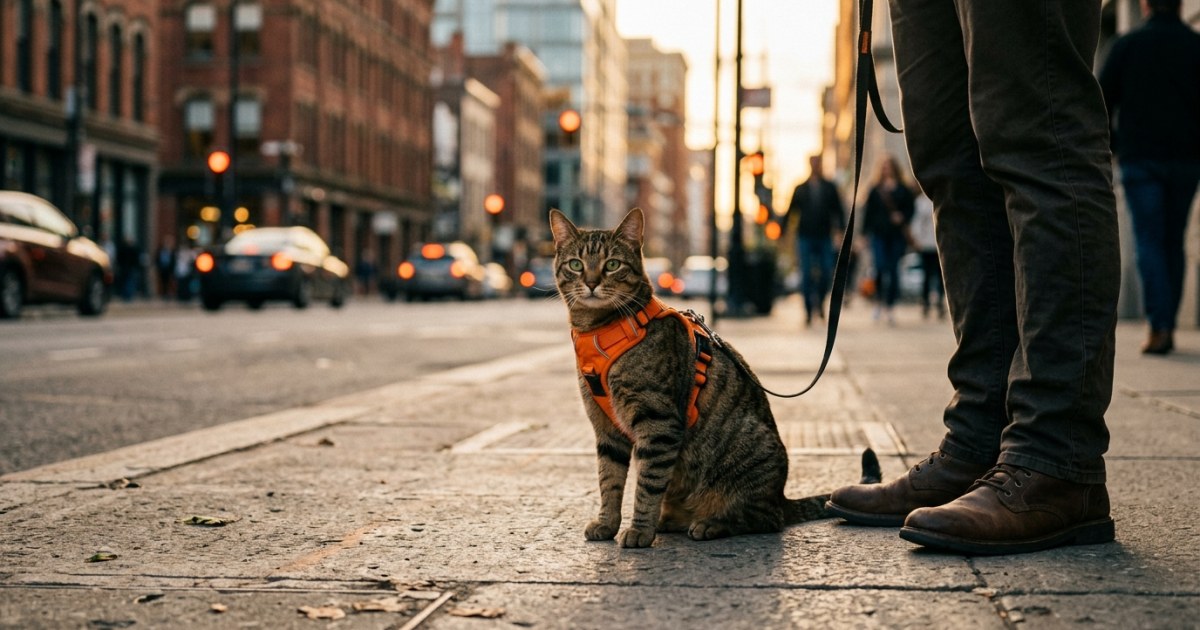
Your apartment cat isn't resigned to a life behind glass — they're simply waiting for you to become the confident guide they need. Urban environments present real sensory challenges for cats, but with the right harness, a systematic desensitisation plan, and an understanding of how felines build mental maps of space, city streets can become as familiar and enriching as a sunny windowsill. This guide gives you every tool, technique, and precaution needed to take your indoor cat outdoors safely, even in the noisiest metropolitan neighbourhood.
WHY CITY LIFE DOESN'T HAVE TO MEAN TOTAL CONFINEMENT FOR YOUR CAT

The assumption that urban environments are simply too chaotic for cats on leashes is one of the most persistent myths in feline care. It persists because it contains a grain of truth — cities are loud, unpredictable, and full of stimuli that a cat hasn't evolved to process instantly. But that same statement applies to puppies, toddlers, and adults moving to a new city for the first time. The answer has never been permanent confinement; it has always been gradual, structured exposure.
Indoor cats who receive no environmental enrichment beyond their four walls frequently develop what behaviourists now call apartment fatigue — a cluster of stress-related behaviours including excessive vocalisation at windows, destructive scratching, over-grooming, and restless pacing at dawn. If your cat sits at the window watching pigeons with an intensity that borders on desperation, that's not idle curiosity. That's an animal whose natural exploratory drive is unmet.
Good to Know
A 2024 study published in the journal Applied Animal Behaviour Science found that cats given regular controlled outdoor access — even for as little as 15 minutes per session — showed measurably lower cortisol levels and significantly reduced stress-related behaviours compared to their permanently indoor counterparts.
The secret to successful urban leash training isn't bravado or hoping your cat is "relaxed enough" to handle it. It's a methodical process that respects your cat's pace, leverages their natural scent-based cognition, and uses the city's own sensory landscape as a training tool. Everything that follows is built on that foundation.
CHOOSING THE RIGHT HARNESS AND LEASH FOR URBAN FELINE MOBILITY
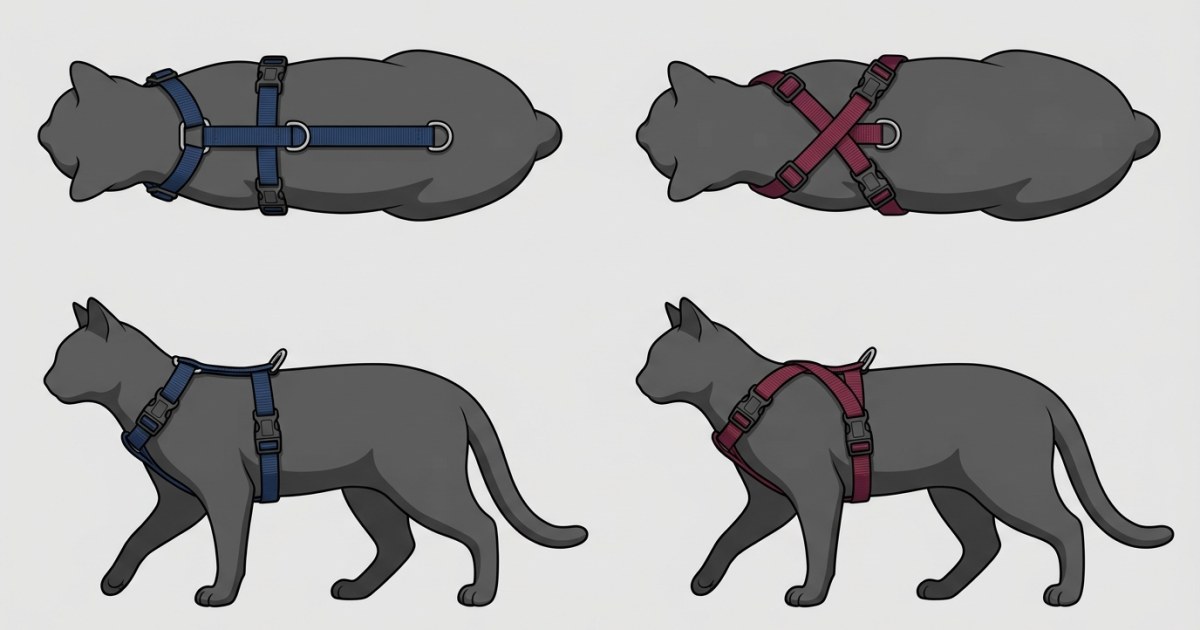
No piece of equipment matters more than the harness. A poorly fitted or unsuitable harness is not merely uncomfortable — it is a genuine escape risk on a busy street. Cats are uniquely flexible creatures, and many standard dog harnesses or older figure-eight cat designs can be slipped out of backwards with a single determined shimmy. In an urban environment, that risk is unacceptable.
The 2026 ergonomic H-style harness: The current gold standard for urban cat adventures is the H-style harness, and the 2026 generation of these designs has made significant advances specifically for feline shoulder anatomy. Unlike the Y-front or figure-eight designs, the H-style distributes pressure evenly across the chest and behind both forelegs without restricting the natural forward extension of the shoulder blade. This matters enormously on city pavements, where a cat may need to scramble, freeze, or pivot quickly. Brands such as RC Pets Adventure Kitty, Rabbitgoo, and the newer Supakit Pro Urban Edition have incorporated rigid-free chest panels and wider, padded lateral straps that sit parallel to the spine rather than crossing it — a critical distinction for a cat mid-pounce or mid-retreat.
Sizing precision is non-negotiable: Measure your cat's chest girth (the widest point behind the forelegs) and neck circumference with a fabric tape measure. The finished harness should allow two fingers to slide underneath any strap comfortably but no more. If you can pinch the fabric and pull it more than 2 cm away from the body, the fit is too loose for urban use.
Warning
Never use a collar alone for leash walking in an urban environment. A startled cat can generate enough backwards force to slip a collar in under a second, and neck-only restraint during a panic response risks serious tracheal injury. Always use a well-fitted harness as the sole point of leash attachment.
Leash length for city conditions: A 1.2–1.5 metre fixed leash gives you responsive control in tight urban spaces without the tangling hazard of a retractable lead. Retractable leads are actively dangerous in cities — they allow a cat to reach the edge of a kerb or approach an unknown dog before you can react. Choose a lightweight leash with a locking swivel clip to prevent twisting during direction changes.
Urban Harness Comparison: Key Features
| Harness Style | H-Style Ergonomic (2026 generation) |
| Escape Resistance | High — dual adjustment points, no single pull-out point |
| Shoulder Mobility | Full forward extension preserved |
| Ideal Leash Length | 1.2–1.5 m fixed, locking swivel |
| GPS Attachment Point | Dedicated D-ring on dorsal strap |
| Recommended Urban Brands | Supakit Pro Urban, RC Pets Adventure Kitty, Rabbitgoo Premium |
THE INDOOR SCENT-SOAKING METHOD: ELIMINATING GEAR FEAR BEFORE YOU BUCKLE UP
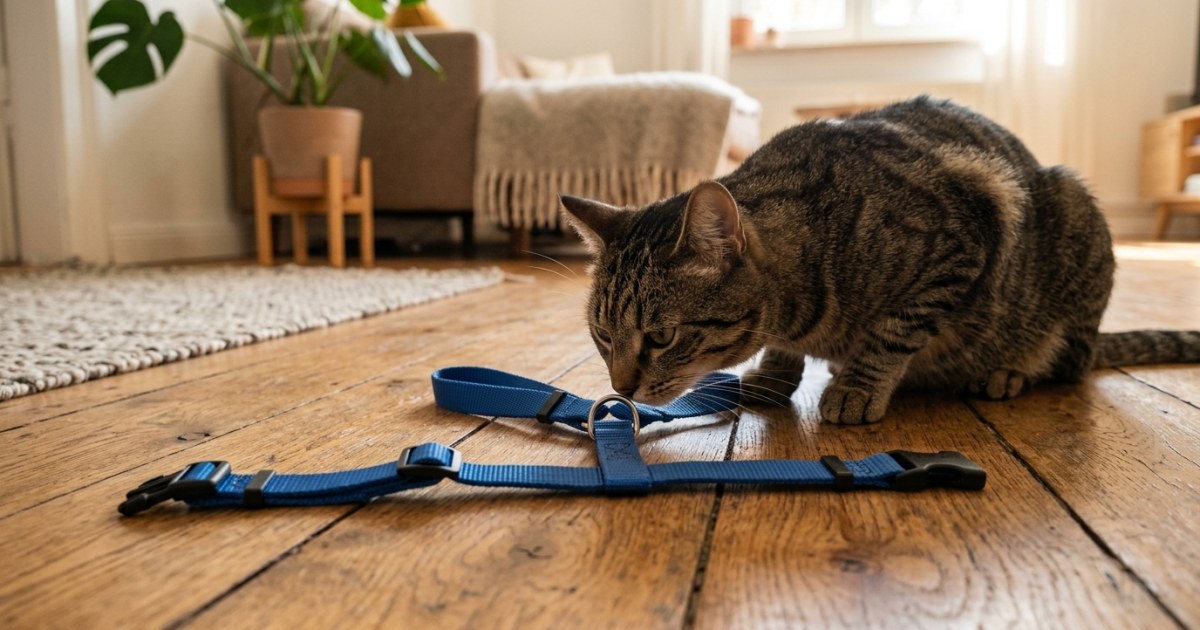
The most common mistake new cat-leash trainers make is placing a brand-new harness directly onto their cat and expecting calm compliance. From your cat's perspective, a harness fresh from the packaging smells of synthetic rubber, machine oils, and the chemical signatures of a factory — in other words, it smells like a predator's den. Before a single buckle is ever clicked, you need to transform that gear into something that smells unmistakably safe.
The scent-soaking protocol: Place the harness and leash inside a clean pillowcase or cloth bag alongside a worn item of your own clothing — a t-shirt or sock works perfectly. Leave this bundle near your cat's primary sleeping area for a minimum of 72 hours. During this time, your scent and your cat's ambient scent will permeate the gear. If your cat investigates the bag and rubs their face on it, that's facial pheromone deposition — the highest form of feline approval. This step alone reduces the initial harness rejection rate dramatically.
Floor placement and free investigation: After the scent-soaking period, remove the harness from the bag and place it flat on the floor during a period when your cat is active and relaxed — not immediately before feeding, and not during a nap. Do nothing. Allow your cat to sniff, step on, or ignore the harness entirely. Do not reach for it, do not try to drape it over them. Repeat this daily for three to five days.
Pro Tip
Lightly rub the harness against your cat's cheek glands (the corner of their mouth and the base of their ears) while they are in a relaxed, biscuit-making state. This transfers their own facial pheromones onto the gear and accelerates the acceptance process significantly.
High-value treat pairing for leash weight association: The weight of a leash clipped to a harness is a genuinely novel sensation for a cat, and novel physical sensations trigger the threat-assessment response. The treat-pairing technique addresses this with precision. Use a treat that sits well above your cat's everyday food in value — freeze-dried chicken liver, small pieces of cooked prawn, or a high-protein paste treat squeezed from a tube are all excellent candidates. The moment the harness is placed across your cat's back (not yet buckled), present the high-value treat. Remove the harness. Present no treat. Repeat this pairing ten times across two days before progressing to the buckle click. The cat's brain begins to associate the physical sensation of the harness with a dopamine reward, and that neurological link is the foundation of everything that follows.
📋 Gear Desensitisation Checklist
- ☐Harness and leash scent-soaked with owner's clothing for 72+ hours
- ☐Gear placed on the floor for free investigation — minimum 3 days
- ☐Cat's facial pheromones transferred to harness fabric
- ☐High-value treats identified and reserved exclusively for training
- ☐Harness drape + treat pairing completed 10 repetitions across 2 days
- ☐Buckle click + treat pairing completed before leash attachment
- ☐Cat walking normally with harness on indoors for 10+ minutes
THE APARTMENT THRESHOLD AND HALLWAY RECONNAISSANCE PHASE
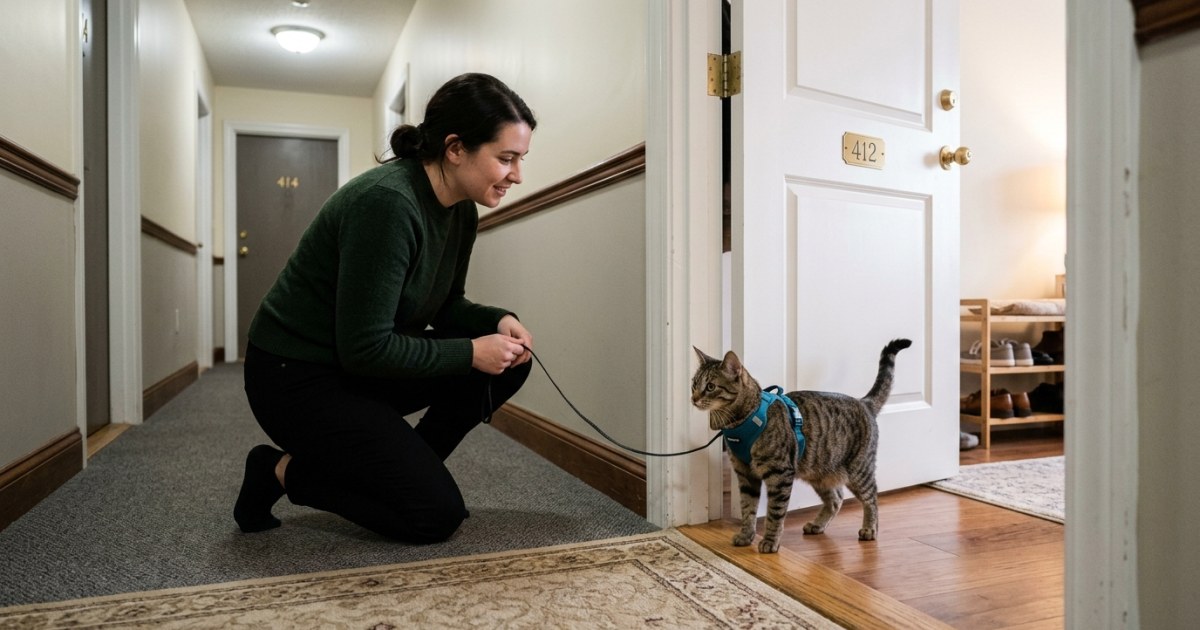
Before you ever step onto a public street, your apartment building itself is a fully equipped training facility. This phase is where the vast majority of the real work happens, and skipping it — in the excitement of wanting to get outside — is the single most common reason urban cat leash training fails.
Establishing the launchpad and preventing door darting: Door darting is a genuine urban safety hazard. A cat who bolts through an open front door into a hallway, stairwell, or lift lobby may encounter other residents, loud mechanical noises, or, in worst cases, find a route to an external exit. The solution is to establish a consistent scent-marked "launchpad" — a defined spot, such as a specific mat or a low scratching pad placed 60–90 cm back from the front door. Train your cat to go to this spot before the door opens by rewarding any engagement with it during normal daily life. Over time, combine this with a consistent verbal cue such as "wait" or "base". The launchpad uses your cat's own territorial scent instincts to create a safe holding position that becomes habitual before gear even enters the equation.
Using hallways as a controlled training environment: Once your cat is comfortable wearing the harness indoors and the leash clip no longer produces any tension response, introduce your apartment hallway as the first "outside" space. Hallways are ideal: they are enclosed, familiar-smelling (your building's ambient scent is already background noise to your cat), relatively quiet, and they provide a direct retreat route back to the flat. Begin by simply opening the front door and allowing your cat to make the choice to step out or not. Do not carry them over the threshold. Agency is critical — a cat who walks out voluntarily is neurologically in a completely different state from one who has been placed outside.
Pro Tip
Practice leash tension management in the hallway by allowing the leash to go slack and gently taking up tension as your cat moves. The goal is for your cat to feel the leash as a background presence rather than a restraint — like a loose tether, not a boundary. Reward forward movement and voluntary stopping equally.
Reading stress signals before you hit the pavement: Your cat's body is a real-time readout of their emotional state, and developing fluency in that language is the difference between a productive training session and a setback that takes two weeks to undo. Low-level stress signals — what behaviourists call displacement behaviours — include tail-flicking (a single sharp flick is different from a loose, slow wag), belly-crawling (flattening the body toward the floor while moving), ear rotation toward a sound without the rest of the body following, and excessive lip-licking. These are the signals to end a session calmly, return to the flat, and treat generously. High-stress signals — a puffed tail, a fully flattened body, vocalisation, or attempts to reverse out of the harness — mean the session has already gone one step too far. Note where in the hallway the signal occurred and make that your new endpoint for the next three sessions.
Good to Know
Most cats require between two and six weeks of consistent hallway and stairwell work before they are genuinely ready for a public pavement. The timeline varies enormously by individual temperament, prior socialisation history, and the specific noise profile of your building. There is no "late" in this process — only appropriate pacing.
NAVIGATING CONCRETE JUNGLE SENSORY OVERLOAD: TRIGGERS, HIERARCHIES, AND REDIRECTS
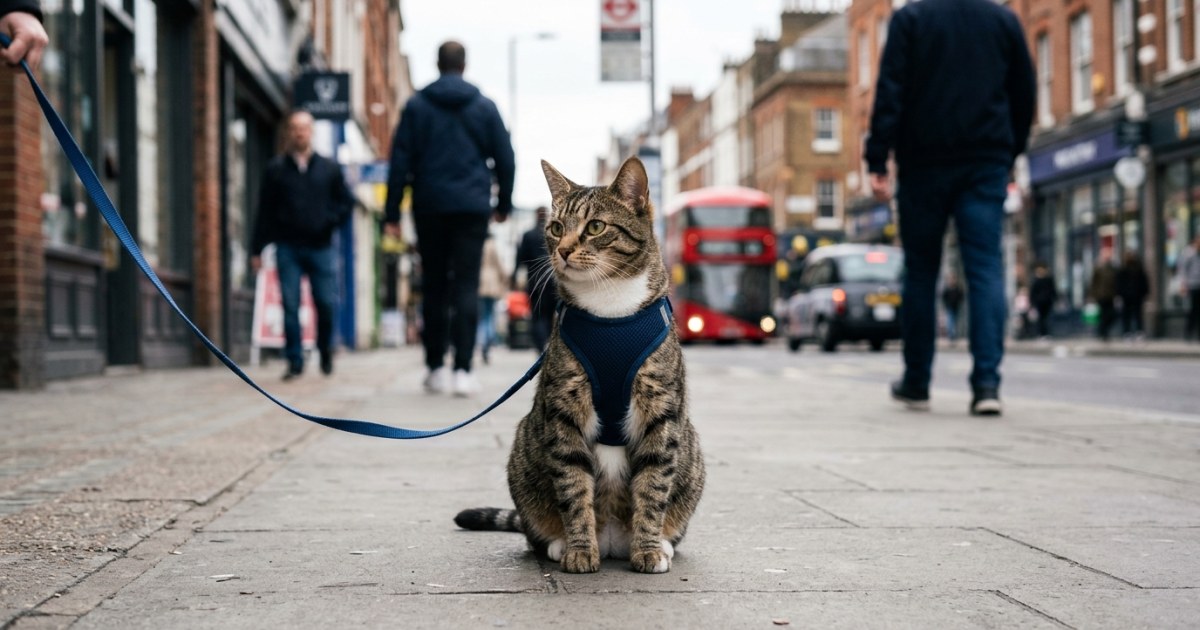
The urban environment presents a layered sensory landscape that most cats have never encountered: the high-frequency whine of delivery drones, the irregular percussion of skateboards on paving, the smell of diesel and food waste, the visual chaos of fast-moving pedestrians, and the sudden doppler shriek of emergency sirens. Understanding that your cat cannot process all of these at once — and that trying to force it will produce a traumatised animal, not a confident one — is the philosophical cornerstone of this entire phase.
Creating a categorised urban trigger hierarchy: Not all urban stimuli are equal in their threat-perception impact on your cat. Categorise the triggers your specific neighbourhood produces by intensity. Tier one triggers are low-impact, predictable, and ambient: distant traffic noise, the smell of a café, pigeons on a ledge. Tier two are moderate, intermittent, and slightly unpredictable: cyclists passing, a pram rattling over a drain cover, construction work from a distance. Tier three are high-intensity, sudden, and percussive: emergency sirens, a van backfiring, a dog barking directly at your cat, a drone passing at low altitude. Begin all outdoor sessions in environments dominated by tier one stimuli only. Progress to tier two environments only after your cat demonstrates sustained calm — slow blinking, relaxed ears, a tail held neutrally — through three consecutive tier one sessions.
The perch-and-observe strategy: One of the most powerful tools in the urban cat trainer's kit is elevation. Cats are hard-wired to feel safer when they can survey their environment from above rather than at ground level, where every approaching shoe is a potential threat. Carry a compact, padded cat backpack with a mesh window — the 2026 models from brands like Petnative and Lollimeow incorporate ventilated perch platforms that convert quickly to a stable, portable high-ground position. When your cat encounters a tier two or three stimulus for the first time, picking them up and placing them on a park bench, a low wall, or offering the elevated backpack position immediately reduces the perceived threat level. From height, the same stimulus (a passing cyclist, a large dog across the street) registers as less immediately dangerous, and your cat can observe and habituate rather than panic and retreat.
Pro Tip
Before your first pavement session, sit on a bench near your intended route — without your cat — and observe the trigger frequency for 10 minutes. Count siren occurrences, note where cyclists tend to come from, identify the noisiest 20-metre stretches. Use this intelligence to plan a route that begins in the quietest section and only gradually approaches higher-trigger areas.
The interactive treat-dispensing redirect: The moment a sudden loud noise occurs — and in any city, it will — you have approximately 0.8 seconds before your cat's stress response fully activates. The treat-dispensing redirect technique exploits this window. Using a squeeze tube of high-value paste treat (which can be administered instantly, without fumbling), present the tube to your cat's nose the moment the noise occurs. The olfactory stimulus of the treat competes with the auditory threat signal at the brain's attention-allocation level. With repeated practice, your cat begins to associate sudden loud noises not with danger but with the anticipation of a reward — a counter-conditioning effect that genuinely reshapes their emotional response over time. The key is consistency and immediacy; a treat delivered five seconds after the noise is processed as a reward for the anxiety response, not a redirect away from it.
Warning
Never attempt to push through a high-stress response by continuing the walk. A cat in active panic is operating from the brain's survival circuits, and any training attempted in that state will be encoded as a threat memory, not a learning opportunity. End the session, return home calmly, and reassess your trigger hierarchy.
SCENT MAPPING AND URBAN TERRITORY BUILDING: MAKING THE PAVEMENT FEEL LIKE HOME
Cats do not experience the world primarily through vision, as humans do. They experience it through scent. Every surface your cat sniffs on a walk is a data-rich communication node — who has been there, when, and whether they represented a threat or a safe neighbour. Understanding this means understanding that a "successful" walk is not measured in metres covered but in the quality and density of scent information your cat is allowed to collect and deposit. This is the foundation of the scent-mapping approach to urban territory building.
Micro-pacing and the scent trail method: Micro-pacing is the deliberate practice of walking the same short route — initially no more than 20–30 metres — repeatedly across multiple sessions before extending it. Each repetition allows your cat to refresh and layer their own scent markings via paw pads and cheek rubs, creating what behaviourists describe as a "scent trail" — a continuous corridor of familiar chemical information that extends the perceived boundary of home territory outward from the apartment entrance. Within three to four sessions on the same micro-route, you will observe a noticeable change in your cat's body language: they will begin to move with more purposeful curiosity and less cautious hesitation, sniffing specific posts or corners with the confident intensity of an animal re-reading its own notes.
Pheromone-integrated gear and safe zones: Several 2026 harness designs now incorporate micro-porous panels into the chest pad that can be pre-treated with synthetic feline facial pheromone products such as Feliway Classic or the newer Feliway Optimum. These pheromones, which mimic the calming cheek-gland secretions a cat produces when it rubs against a familiar surface, are released gradually through body heat during the walk. This creates a portable "safe zone" that travels with your cat, reducing baseline anxiety in unfamiliar sections of the route. For the stationary safe zone near your apartment entrance, apply synthetic pheromone spray to a specific feature — a bollard, a wall corner, a doorstep — at the same point before each walk. Your cat will begin to associate that scent signature with the beginning and end of safe territory, creating a reliable emotional anchor point.
Good to Know
Consistent route repetition is not boring for a cat — it is neurologically enriching. Each repetition of the same path provides the opportunity to detect scent changes since the previous visit: new animals, new humans, changed environmental conditions. To your cat, a familiar route is not monotonous but perpetually updated, like checking a message board.
The importance of route consistency for the mental map: Resist the temptation to introduce variety too early. Humans find novelty stimulating; cats find familiarity safe. Your cat is building a detailed spatial and sensory map of the neighbourhood's predictable patterns — where the recycling lorry parks, which corner always has pigeon activity, which section of pavement is usually quiet at the time of your walk. This mental map is the cognitive architecture of confidence. Once it is established on a consistent route — typically after four to eight weeks of regular walks — you can begin to extend it by adding a new section at the end of the familiar route, always with the option to retreat to the known section if stress signals appear.
📋 Scent Mapping Progress Checklist
- ☐Initial micro-route of 20–30 metres selected and walked 3+ times
- ☐Cat observed refreshing scent markings at familiar points
- ☐Pheromone spray applied to apartment entrance anchor point before each walk
- ☐Harness panels pre-treated with synthetic facial pheromone product
- ☐Body language shift observed: more purposeful, less hesitant movement
- ☐Route extension introduced only after 4+ weeks of consistent micro-route walks
SAFETY AUDITS, GPS TRACKING, AND URBAN EXIT STRATEGIES FOR EVERY WALK
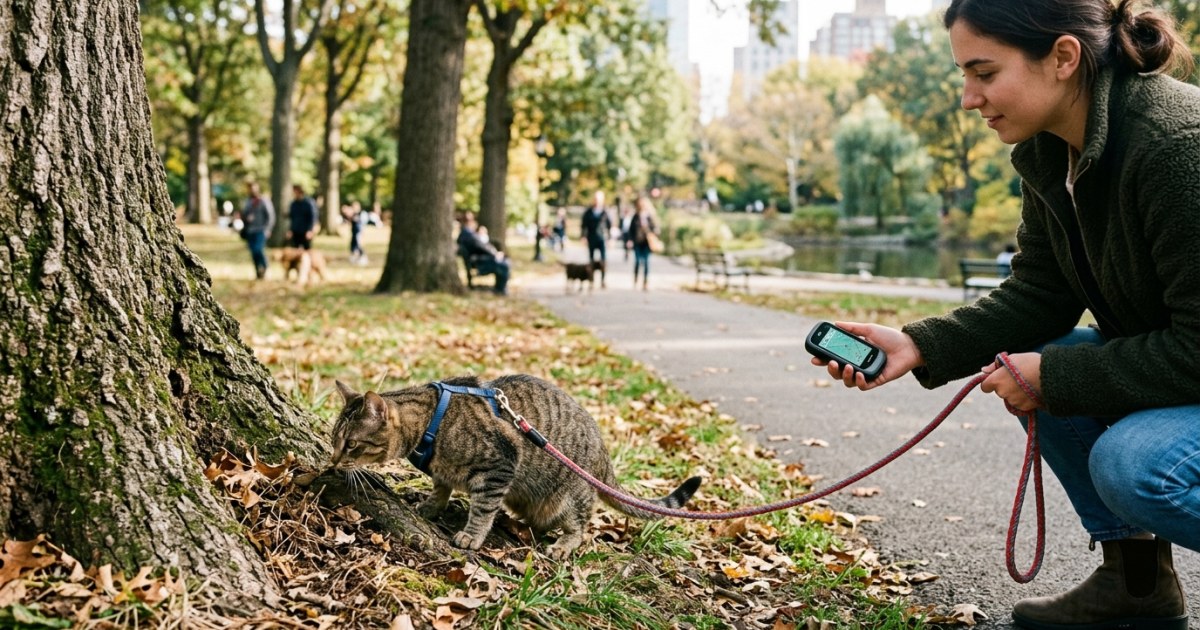
Every urban cat walk should begin with a two-minute safety audit. This is not pedantry — it is the operational discipline that ensures every single session is recoverable from any situation the city chooses to throw at you. Urban environments are unpredictable by nature, and your preparation is the only variable entirely within your control.
The daily gear check: Inspect every buckle and adjustment point on the harness before clipping the leash. Run your fingers along each strap to check for fraying, stress marks, or loosened thread near the buckle housing — these are failure points under load. Check that the GPS tracker (non-negotiable for any urban cat walk) is charged to a minimum of 80% battery and that its app is open on your phone and showing your cat's location before you leave the flat. Compact, lightweight GPS trackers such as the Tractive Mini or the Pawfit 3 weigh under 30g and attach cleanly to the dorsal D-ring of most H-style harnesses without affecting the fit or creating a snagging point. Test the clip attachment and the leash swivel before departure, every time.
📋 Pre-Walk Safety Audit Checklist
- ☐All harness buckles clicked, checked for full engagement
- ☐Strap fit verified — two-finger rule on all panels
- ☐Strap integrity checked for fraying or buckle stress marks
- ☐GPS tracker charged to 80%+ and live location confirmed on app
- ☐Leash swivel clip tested and free of twist
- ☐High-value treat tube loaded and accessible without bag fumbling
- ☐Portable backpack or carry bag accessible for emergency pick-up
Training the pick-up emergency cue: The pick-up cue is a specific, consistent signal that tells your cat that they are about to be lifted and carried, and that this is safe rather than threatening. Train it indoors first: say your chosen cue word ("up" or "safe" work well), scoop your cat smoothly under the chest with one hand supporting the hindquarters, treat immediately once settled against you. Repeat daily until your cat relaxes immediately upon hearing the cue rather than stiffening. In an urban emergency — an unleashed dog approaching, a sudden crowd surge, a bicycle losing control nearby — this cue allows you to remove your cat from danger in under three seconds without triggering a secondary panic response. Without it, a sudden unexpected lift in a stressful context can cause your cat to scratch, thrash, and potentially escape the harness in their panic to get free.
Pro Tip
Practise your pick-up emergency technique while your cat is harness-wearing at home. The muscle memory of scooping cleanly and confidently is a trainable skill for the human as much as for the cat. Hesitant or awkward handling in an emergency situation transmits anxiety directly to your cat.
Redefining a successful walk: Perhaps the most important mindset shift in this entire guide is this: a successful urban cat walk is not defined by how far you go. It is defined entirely by the quality of sensory engagement your cat demonstrates and the emotional state in which they return home. A cat who walked 15 metres to a lamp post, sniffed intensively, rubbed their cheek against the base, watched a passing cyclist with ears forward and tail neutral, then walked calmly back inside and settled immediately without signs of stress — that cat had a profoundly successful walk. A cat dragged two blocks who returned home wide-eyed, hiding under the bed for the rest of the afternoon — that walk, regardless of distance, was a net negative for the training programme. Measure success in calm minutes, confident postures, and voluntary re-engagement with the harness before the next session. Those metrics will tell you everything.
Good to Know
Many experienced urban cat walkers find that their cats begin to indicate readiness for a walk through consistent pre-walk behaviours: sitting by the front door, approaching the spot where the harness is stored, or vocalising near the launchpad mat. These unsolicited requests for outdoor time are the ultimate validation that the training programme has succeeded — your cat now associates going outside with something worth asking for.
Urban Cat Walk Training: Phase Timeline
| Week 1–2 | Gear desensitisation: scent soaking, floor investigation, treat pairing |
| Week 3–4 | Indoor harness wearing, launchpad training, hallway exploration |
| Week 5–6 | Building entrance and doorstep exposure, pick-up cue training |
| Week 7–8 | First pavement micro-routes (20–30 m), tier one stimulus exposure |
| Week 9–12 | Route consolidation, scent mapping, tier two stimulus introduction |
| Month 4+ | Route extension, perch-and-observe sessions, confident neighbourhood exploration |
Frequently Asked Questions
Can you leash train an older indoor cat or is it only for kittens?
Older cats can absolutely be leash trained, though the process typically requires more patience and a slower desensitisation timeline than with kittens. Adult cats have more established stress responses, but they are equally capable of forming new positive associations through consistent reward-based training. Many owners report successfully leash training cats aged five to ten years with excellent results.
How long does it take to leash train a cat for city walks?
For a genuinely confident urban walker, expect a realistic minimum of eight to twelve weeks of consistent daily training before your cat is ready for public pavement sessions. The indoor and hallway phases alone typically take four to six weeks when done properly. Rushing this process is the most common cause of failure — a cat that is pushed outdoors before they are ready may take months to rebuild confidence.
What is the best harness for a cat in the city?
The 2026 generation of ergonomic H-style harnesses are the current recommendation for urban environments due to their escape resistance, shoulder mobility preservation, and even pressure distribution. Brands such as Supakit Pro Urban, RC Pets Adventure Kitty, and Rabbitgoo Premium are well regarded. The most important factor is precise fit — two fingers comfortably under each strap with no excess slack.
My cat hates wearing a harness — how do I get them to accept it?
Harness rejection is almost always a result of the introduction moving too quickly. Start completely fresh with the scent-soaking protocol: place the harness near your cat's sleeping area inside a bag with your worn clothing for 72 hours. Then follow a strict treat-pairing sequence — drape without buckling, treat, remove, repeat — before any buckle is clicked. The entire process from first introduction to confident wearing typically takes two weeks when done at the cat's pace.
Is it safe to walk a cat in a city with traffic and other dogs?
Urban cat walking is safe when the correct equipment, training, and protocols are in place — specifically a well-fitted escape-proof H-style harness, a GPS tracker, a trained emergency pick-up cue, and a progressive desensitisation programme that prepares your cat for the specific stimuli of your neighbourhood. No walk should begin without a full gear safety audit, and routes should be planned to minimise high-traffic and high-dog-density areas, particularly during early training phases.
How do I stop my cat from panicking when they hear a siren on a walk?
The treat-dispensing redirect technique is the most effective tool: present a high-value squeeze tube treat to your cat's nose the moment the siren sounds, before the stress response fully activates. With consistent repetition, your cat begins to associate the sound of sirens with the anticipation of a reward rather than threat — this is counter-conditioning, and it genuinely changes the emotional response over time. In the short term, having a portable elevated perch position (backpack or bench) also significantly reduces the perceived threat level.
Do cats need GPS trackers for city walks on a leash?
Yes — a GPS tracker is strongly recommended as a non-negotiable safety layer for urban cat walks, not as a paranoia measure but as a practical backup for an improbable but possible worst-case scenario. Harness buckles can fail, leash clips can degrade, and a genuinely startled cat may wriggle free in seconds. A lightweight tracker such as the Tractive Mini or Pawfit 3 weighs under 30g, attaches to the dorsal D-ring of an H-style harness, and provides real-time location data via smartphone app.
How do I know when my cat is ready to go outside on a leash?
Your cat is ready for their first pavement session when they demonstrate three consistent behaviours indoors: walking normally with the harness on for at least ten minutes without any harness-oriented behaviours (biting at straps, freezing, rolling), tolerating the leash clip and a small amount of leash tension without a stress response, and approaching the harness voluntarily or at least without avoidance. Confirmation signals include slow blinking while wearing the gear and relaxed exploratory sniffing during hallway sessions.