Your cat has 276 distinct facial expressions, recognises your voice from a stranger’s, can identify you by smell alone, and forms the same kind of emotional attachment to you that a human infant does to its mother. And yet people still say cats are aloof. The science says otherwise — emphatically. Here is what researchers have actually discovered about how your cat communicates with you, and what they are really saying.
Your Cat Knows When You’re Baby-Talking Them
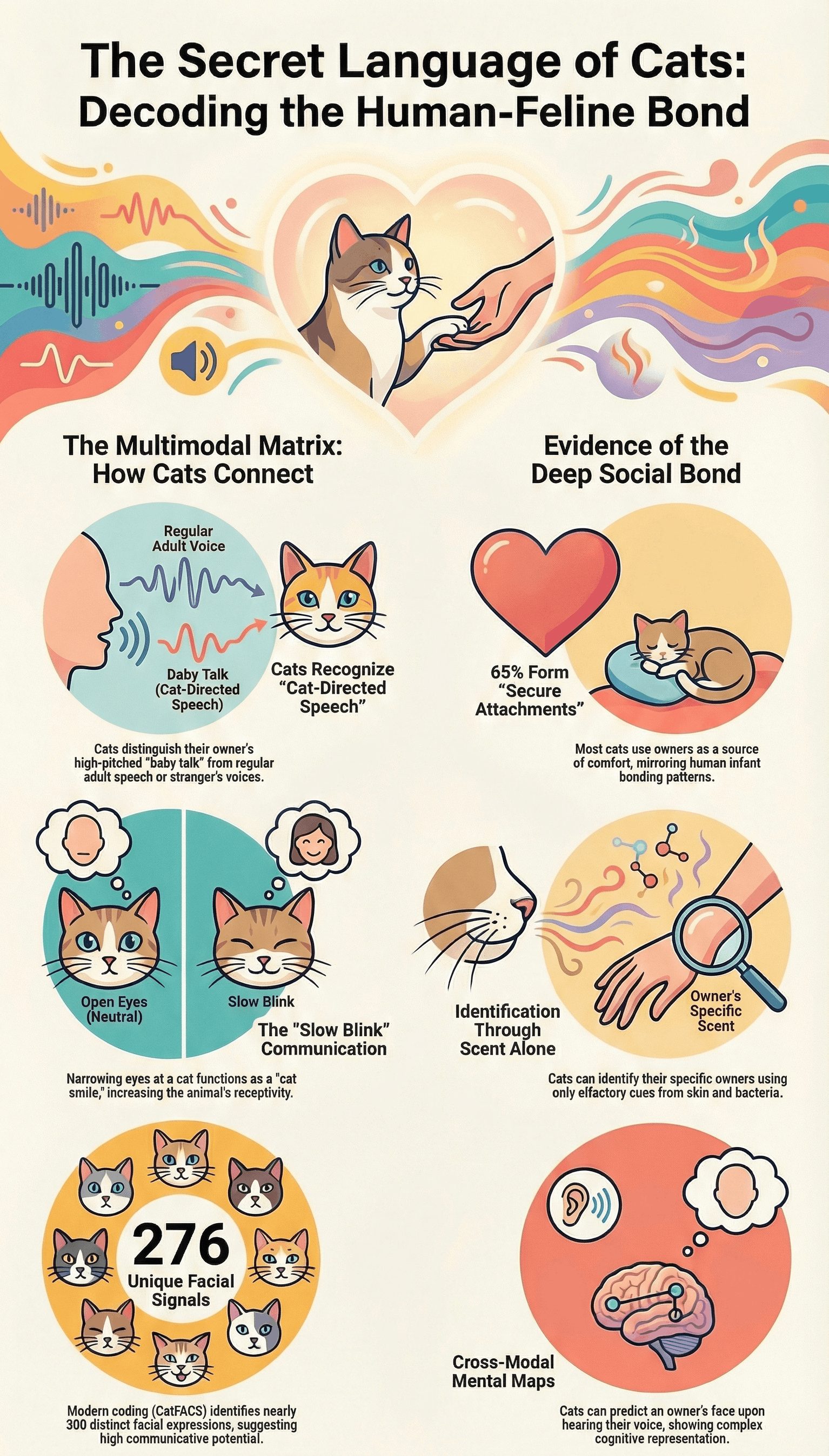
You know that voice. The one you use when nobody else is around. Higher pitched, sing-song, slightly ridiculous. Researchers call it “cat-directed speech” and yes, your cat absolutely notices it.
A 2022 study published in Animal Cognition by a team at Paris Nanterre University found that cats can distinguish between their owner using cat-directed speech (the baby voice) and their owner using regular adult speech. They can also tell the difference between their owner’s voice and a stranger’s voice. When cats heard their owner’s baby talk, they showed significantly increased attention behaviours — ear rotation, pupil dilation, pausing mid-activity to listen.
Here is the twist: cats did not react the same way to a stranger using the same baby voice. It is not just the pitch that gets their attention — it is the combination of familiar voice plus affectionate tone. Your cat has learned that when you sound like that, good things tend to follow. They have essentially trained you to use a specific vocal register, and then they reward you by paying attention when you do it.
So the next time someone catches you cooing at your cat in a voice three octaves above normal, you can tell them it is a scientifically validated communication protocol. They will not believe you, but your cat will appreciate the effort.
65% of Cats Form ‘Secure Attachments’ to Their Owners
The biggest myth about cats is that they do not bond with their owners. A 2019 study at Oregon State University put this to bed permanently.
Researchers adapted the Ainsworth Strange Situation Test — a classic psychology experiment originally designed to measure attachment between human infants and their caregivers — for use with cats. The cat and owner entered an unfamiliar room together. The owner left. The owner returned. The researchers observed the cat’s behaviour during reunion.
65.8% of cats displayed “secure attachment” — meaning they used their owner as a source of safety and comfort when stressed, relaxed visibly when the owner returned, and balanced exploration of the new environment with returning to their owner for reassurance. This is almost identical to the 65% secure attachment rate found in human infants.
The remaining cats showed “insecure attachment” styles — either clingy and anxious or avoidant. Just like humans. The study also found that this attachment style was stable over time and not affected by socialisation training, suggesting it forms early and runs deep.
In practical terms: your cat genuinely sees you as their safe person. That is not anthropomorphism. That is peer-reviewed behavioural science.
Why This Matters for Travel
The Slow Blink: A Cat Smile You Can Learn
You have probably noticed your cat looking at you and slowly closing and opening their eyes. This is not sleepiness. It is a deliberate social signal, and it is one of the few cat communication behaviours that humans can successfully replicate.
Research from the University of Sussex published in Scientific Reports confirmed that slow blinking functions as a positive emotional signal between cats and humans. In the study, cats were significantly more likely to slow-blink back at humans who slow-blinked at them first. They were also more likely to approach an unfamiliar person who slow-blinked compared to one who maintained a neutral expression.
The mechanism is elegantly simple: in cat body language, prolonged direct eye contact is a threat. A slow blink breaks the stare, signalling “I am not a threat, I trust you enough to close my eyes in your presence.” When you slow-blink back, your cat receives the same message in return. It is a two-way conversation conducted entirely through eyelids.
Try it. Next time your cat is relaxed and looking in your direction, slowly close your eyes for a second or two, then open them. Watch what happens. It is the closest thing to saying “I love you” in fluent cat.
Your Cat Recognises You by Smell (Even When You’re Not There)
Cats have approximately 200 million scent receptors in their nasal tissue — 40 times more than the roughly 5 million in a human nose. But it is not just volume; it is specificity. Research has shown that cats can identify their specific owner using olfactory cues alone — the unique combination of skin oils, bacteria, and chemical compounds that make up your personal scent signature.
This is why your cat rubs their face on your shoes when you come home (scent investigation and re-marking), why they sleep on your worn clothes (comfort through familiar scent), and why they seem unsettled when you come back smelling of another cat (territorial alert).
It also explains something every travelling cat owner has noticed: putting a worn t-shirt in your cat’s carrier dramatically reduces travel stress. Your scent activates the same neural comfort pathways as your physical presence. To your cat’s brain, your smell is you.
276 Facial Expressions (and Counting)
For decades, people assumed cats had relatively blank faces compared to dogs. Then researchers applied CatFACS (Cat Facial Action Coding System) — a rigorous methodology for cataloguing facial muscle movements — and discovered something remarkable.
A 2023 study published in Behavioural Processes identified 276 distinct facial signals in domestic cats. To put that in context, dogs have approximately 27 facial action units, and previous estimates for cats were in the low dozens. The 276 figure was derived from observing cats interacting with each other in a cat café in Los Angeles, coding every visible combination of ear position, eye aperture, whisker orientation, lip movement, and nose wrinkling.
Of these 276 expressions, roughly 45% were classified as “friendly,” 37% as “aggressive,” and 18% as ambiguous. The friendly expressions typically involved forward-facing ears, relaxed whiskers, and — there it is again — slow blinking. Aggressive signals involved flattened ears, constricted pupils, and bared teeth.
The implication is staggering: cats have a facial communication system nearly as complex as some primates. We just were not paying close enough attention to see it.
Cross-Modal Mental Maps: Your Cat Pictures Your Face
This is perhaps the most extraordinary finding of all. A study from Kyoto University published in Animal Cognition demonstrated that cats form cross-modal mental representations of their owners — meaning when they hear your voice, they mentally picture your face.
The researchers played recordings of owners’ voices from a speaker while simultaneously showing the cats either a photo of their owner or a photo of a stranger on a screen. When the voice and face matched, cats behaved normally. When the voice played but a stranger’s face appeared, cats showed prolonged staring and signs of confusion — a violation-of-expectation response that demonstrates they had predicted what face should go with that voice.
This is the same cognitive process humans use when hearing a friend’s voice on the phone and automatically picturing their face. It requires the brain to store integrated, multi-sensory representations of specific individuals — a sophisticated cognitive feat previously confirmed only in humans and a handful of great apes.
Your cat does not just know you. Your cat has a mental model of you — your voice, your face, your smell — integrated into a single cognitive representation that their brain can access from any one of those inputs. When you call from another room, your cat does not just hear a sound. They see you in their mind.
What All of This Really Means
The old narrative — that cats are solitary, indifferent, barely domesticated creatures who tolerate humans for food — is scientifically dead. What the research consistently shows is something cat owners have known intuitively for centuries: cats form deep, specific, emotionally significant bonds with individual humans. They communicate those bonds through a rich, multimodal language system that most humans simply never learned to read.
They know your voice. They know your face. They know your smell. They watch your facial expressions more carefully than you realise. They adjust their vocalisations specifically for you. And 65% of them are as emotionally attached to you as a human toddler is to its mother.
The only difference between cats and dogs is that cats express all of this with the quiet dignity of someone who is never going to roll over on command for a biscuit. And honestly, can you blame them?
 United Kingdom
 Spain
Spain France
 Australia