Ferry travel is the great unsung option for UK cat owners heading to Europe. While everyone fixates on the no-cabin-flights rule, experienced cat travellers know that a ferry crossing — whether it is 90 minutes on the Dover–Calais route or 24 hours to Santander — lets your cat stay with you the entire time. No cargo hold, no hours of separation, no strangers handling your pet. But there is a maze of paperwork, cabin rules, and timing windows that catch people out every single crossing. Here is everything you need to know.
Why Ferries Are the Best-Kept Secret for UK Cat Travel
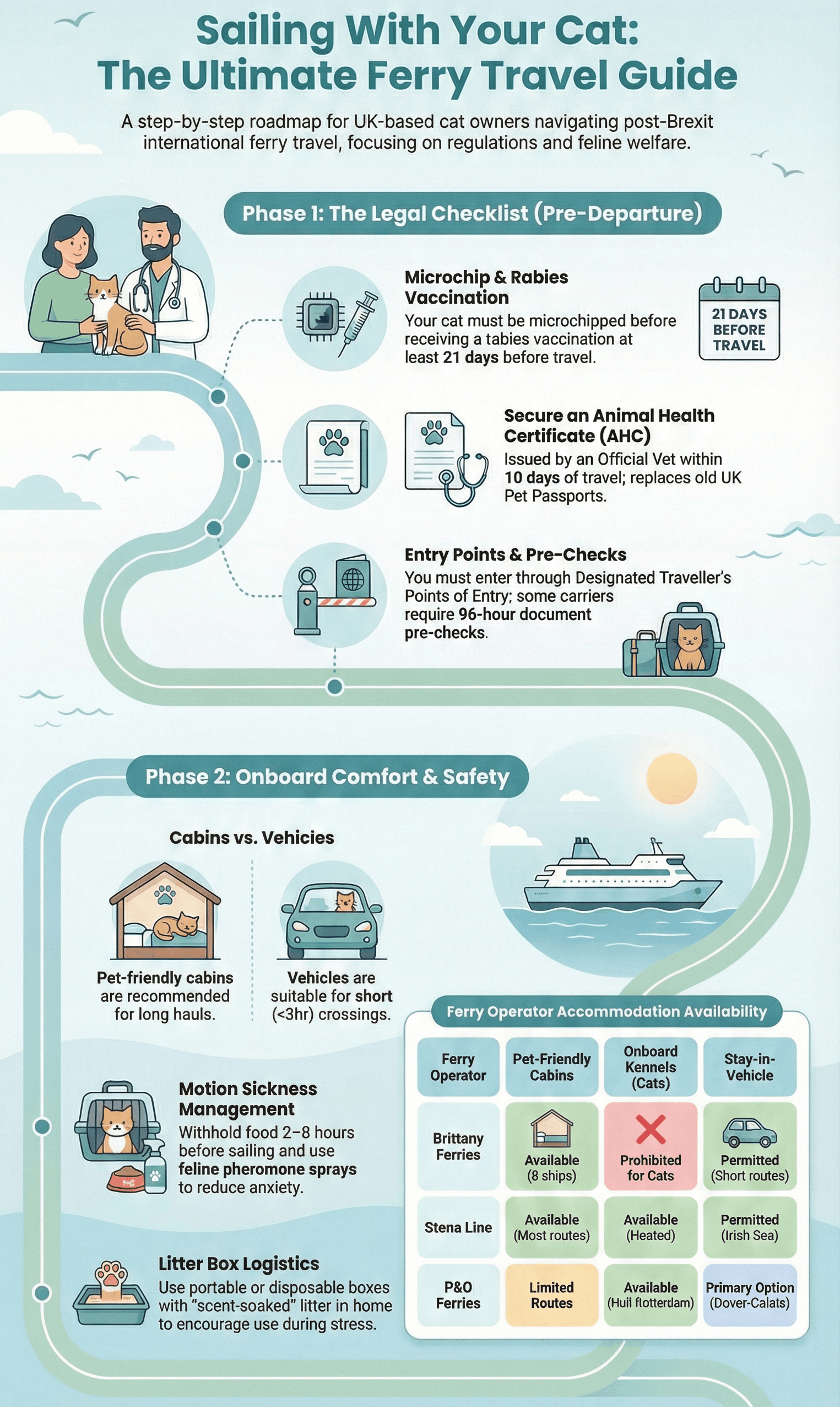
Since Brexit, UK pet owners have lost access to the EU Pet Passport system for outbound travel. Every trip to Europe now requires a fresh Animal Health Certificate, issued within 10 days of departure. That is the same paperwork whether you fly cargo or take a ferry — but on a ferry, your cat travels in your cabin or your vehicle, within arm’s reach for the entire journey.
For cats specifically, this matters enormously. Cats are territorial animals that find unfamiliar environments deeply stressful. A cargo hold with engine noise, pressure changes, and zero human contact is about as far from their comfort zone as possible. A ferry cabin — even a basic one — gives them your scent, your voice, and the ability to settle into their carrier in relative calm.
The three main operators serving UK cat owners are Brittany Ferries (Portsmouth and Plymouth to France and Spain), Stena Line (Irish Sea routes plus Harwich–Hook of Holland), and P&O Ferries (Dover–Calais and Hull–Rotterdam). Each has different rules for cats, and the differences matter.
Phase 1: The Legal Checklist
The Microchip-First Rule
This trips up more pet owners than any other single requirement. Your cat must be microchipped before the rabies vaccination — not after, not at the same appointment if the chip is scanned after the jab. The microchip must be a 15-digit ISO 11784/11785 compliant chip, and the vet must scan it and record the number before administering the vaccine.
If this sequence is wrong, the vaccination is legally void for travel purposes. You will need to revaccinate after the chip is implanted and wait another 21 days. USDA/APHIS is explicit: the date of microchip implantation must be on or before the date of the primary rabies vaccination.
The Correct Medical Sequence
Step 2: Rabies vaccination administered (vet scans and records chip number first)
Step 3: Wait 21 days after primary vaccination (boosters are valid immediately if given before the previous jab expires)
Step 4: Animal Health Certificate issued by Official Veterinarian within 10 days of travel
The Animal Health Certificate
Post-Brexit, every UK cat travelling to the EU needs an Animal Health Certificate (AHC) issued by an Official Veterinarian (OV) within 10 days of your departure. This is a multi-page document costing £100–£250 depending on your vet practice. Not all vets are OVs, so check in advance and book early — summer appointments fill up fast.
The AHC replaces the old EU Pet Passport for outbound UK travel. Once inside the EU, it covers onward travel between EU countries for up to 4 months. So if you ferry to France and then drive to Spain, you do not need separate paperwork for each country.
The Five-Day Rule and the Designated Person
For your cat’s movement to qualify as “non-commercial,” you must travel within five days before or after your pet. This is straightforward if you are on the same ferry — but it matters if, say, you send your cat with a friend on an earlier crossing.
A detail many owners miss: you can authorise a Designated Person to travel with your cat instead of you. As long as they travel within the five-day window of your own journey, it still qualifies as non-commercial. This is useful if you need to fly separately while a partner drives the car and cat onto the ferry.
If the gap exceeds five days, the movement is reclassified as commercial. The health certificate must then be issued within 48 hours of departure (instead of 10 days), and your cat must enter through a Border Control Post. Costs and complexity increase significantly.
Entry Points and Pre-Checks
You must enter the EU through a Designated Travellers’ Point of Entry. All major ferry ports (Calais, Dunkirk, Cherbourg, Santander, Hook of Holland, Rotterdam) qualify. Some operators require a 96-hour document pre-check — Brittany Ferries is particularly strict about this. Submit your documents early to avoid last-minute refusals at check-in.
Phase 2: Onboard Comfort and Safety
Cabins vs Vehicles: Where Should Your Cat Travel?
This depends entirely on the crossing length. For short crossings under 3 hours (Dover–Calais, Cairnryan–Belfast), your cat can comfortably stay in your vehicle on the car deck. For longer crossings — especially overnight routes like Portsmouth–Santander (24–28 hours) or Hull–Rotterdam (11 hours) — a pet-friendly cabin is strongly recommended.
Pet-friendly cabins are functional, not luxurious. Stena Line cabins typically have vinyl flooring, water bottles, and pee pads. Brittany Ferries offers pet-friendly cabins on 8 ships. But do not expect hotel amenities for your cat — cabin towels and toiletries are strictly for passenger use, and you must bring your own pet supplies.
Strictly Forbidden
Ferry Operator Comparison
Brittany Ferries: Pet-friendly cabins on 8 ships. Cats are prohibited from onboard kennels — cabin or vehicle only. Pet exercise areas on deck (cats should stay in their carrier). Pet fee approximately €45 each way. 96-hour document pre-check required.
Stena Line: Pet-friendly cabins on most routes. Heated onboard kennels available for cats on Irish Sea routes — the only major operator offering this. Stay-in-vehicle permitted on Irish Sea crossings. Vinyl flooring in pet cabins for easy cleaning.
P&O Ferries: Limited pet-friendly cabin availability. Onboard kennels available on the Hull–Rotterdam route. Stay-in-vehicle is the primary option on Dover–Calais (90-minute crossing). Short crossing time makes vehicle travel perfectly reasonable for cats.
Motion Sickness and Stress Management
About 1 in 6 cats experiences motion sickness, and ferry crossings — especially in rough seas — can be worse than car travel. The combination of unfamiliar movement, engine vibration, and confinement creates a perfect storm for feline anxiety.
Withhold food for 2–8 hours before sailing to reduce vomiting risk. Water should remain available. If your cat has a history of travel sickness, ask your vet about maropitant (Cerenia) — the only anti-nausea medication licensed for cats and highly effective.
For stress, Feliway spray applied inside the carrier 15–20 minutes before travel can significantly calm your cat. The synthetic pheromone mimics the facial pheromone cats use to mark familiar, safe spaces. It is not a sedative — it simply signals “this space is safe” to your cat’s brain.
Carrier Conditioning: Start Weeks Early
On the day, place a t-shirt that smells like you inside the carrier. Your scent is one of the most powerful calming signals for a bonded cat.
Litter Box Logistics
Cats in stressful travel situations often “hold it” for surprisingly long periods — 12 hours or more is not unusual. This is a natural feline stress response, not a health concern for a single journey. For longer crossings (overnight routes), you should still provide a litter option.
Use a disposable portable litter box or shallow container lined with a bin bag. Fill it with litter from your cat’s home box — the familiar scent encourages use even under stress. Place it in the cabin bathroom on a towel or pee pad to catch scatter, and give your cat private access with the door ajar.
The Return Journey: What Changes?
Coming back to the UK from the EU is slightly different. Your AHC covers the return if it is still within the 4-month validity window. However, there is one important distinction.
The tapeworm treatment rule applies to dogs only, not cats. Dogs entering the UK must be treated for Echinococcus multilocularis with a Praziquantel-based product between 24 and 120 hours before scheduled arrival. Brands like Stronghold, Advocate, and Frontline are not accepted as they lack Praziquantel.
For cats, there is no tapeworm treatment requirement for UK re-entry. You still need valid documentation (AHC within validity, current rabies vaccination, microchip). Border officials at the UK port will check these before you board.
The Short Trip Loophole (Dogs Only)
What to Pack: The Cat Ferry Travel Kit
Essential Packing List
• Animal Health Certificate (original, not a copy)
• Rabies vaccination certificate
• Microchip documentation
• Ferry booking confirmation with pet add-on
• Your own ID/passport
For your cat:
• Secure travel carrier (IATA-approved or equivalent)
• Familiar blanket or t-shirt with your scent
• Water bowl and bottled water
• Small amount of food (longer crossings only)
• Disposable litter tray + home litter
• Pee pads (at least 4)
• Poop bags and kitchen roll
• Feliway spray
• Any prescribed medication (Cerenia, etc.)
• Harness and lead (for supervised time in cabin)
• Treats
Booking Tips
Book pet-friendly cabins early. Every ferry has a limited number of pet cabins that sell out weeks ahead during summer. On Brittany Ferries’ Santander routes, pet cabins for August often sell out by May.
Add your pet at booking time, not as an afterthought. Some operators require pet details (microchip number, breed, weight) at booking. Adding a pet later can be difficult or impossible if pet cabins are full.
Arrive early. Pet check-in takes longer than regular check-in. Brittany Ferries recommends at least 90 minutes before departure. Staff will check documentation and may scan the microchip at the port.
Check the 96-hour pre-check requirement. Brittany Ferries requires documents submitted for verification at least 96 hours before sailing. If rejected, you have time to fix the issue. Do not leave this until the day.
The Bottom Line
Ferry travel from the UK to Europe is the most cat-friendly international travel option available to British pet owners. Your cat stays with you, there is no cargo hold separation, and the crossing — especially with proper carrier conditioning and Feliway — is far less stressful than any air travel alternative.
The paperwork is identical to flying (AHC, microchip, rabies vaccination), but the experience is incomparably better for your cat. A 90-minute Dover–Calais crossing with your cat dozing in their carrier beside you is a world apart from handing them over at a cargo terminal and not seeing them for 14 hours.
Get the medical sequence right (chip → jab → 21-day wait → AHC), book a pet cabin for longer crossings, condition the carrier in advance, and pack Feliway. The rest is just enjoying the crossing together.
 Spain
Spain France
 Ireland
 Netherlands
 Belgium