
Moving to Germany with a cat is entirely achievable without quarantine — but only if you follow the EU's strict microchip, rabies vaccination and health documentation rules in exactly the right order. Germany processes over 200,000 pet imports per year through its designated border inspection posts, and a single sequencing mistake — such as vaccinating before microchipping — can invalidate your entire application and force a repeat vaccination cycle. This guide walks you through every official requirement for 2026, from the ISO-compliant microchip to the government-endorsed health certificate, with exact costs, approved entry ports and a step-by-step timeline so your cat arrives safely and legally. For a complete overview, see our full De cat import guide.
In This Guide
Germany — At a Glance
Germany — At a Glance
| Difficulty | Moderate — strict EU rules but no quarantine if compliant |
| Quarantine | None — provided all requirements are met in correct order |
| Microchip | ISO 11784/11785 — 15-digit FDXB chip mandatory before vaccination |
| Rabies Vaccine | Required — administered after microchip, at least 21 days before travel |
| Import Permit | No formal permit — EU Pet Passport or official health certificate required |
| Typical Cost | £350–£900 / $440–$1,130 (DIY); £1,200–£3,500 / $1,500–$4,400 (full relocation service) |
| Processing Time | Start 7–8 months before travel date |
| Governing Body | Bundesministerium für Ernährung und Landwirtschaft (BMEL) |
| Key Regulation | EU Regulation 576/2013 (non-commercial pet movement) |
Good to Know
Germany is a member of the European Union and follows EU Regulation 576/2013 for non-commercial movement of pet animals. This means cats travelling from other EU member states face a simpler process than those arriving from non-EU ("third") countries such as the UK, USA, Australia or Canada. The rules differ significantly between these two pathways, and this guide covers both in full detail.
Step-by-Step: Germany Cat Import Requirements for 2026
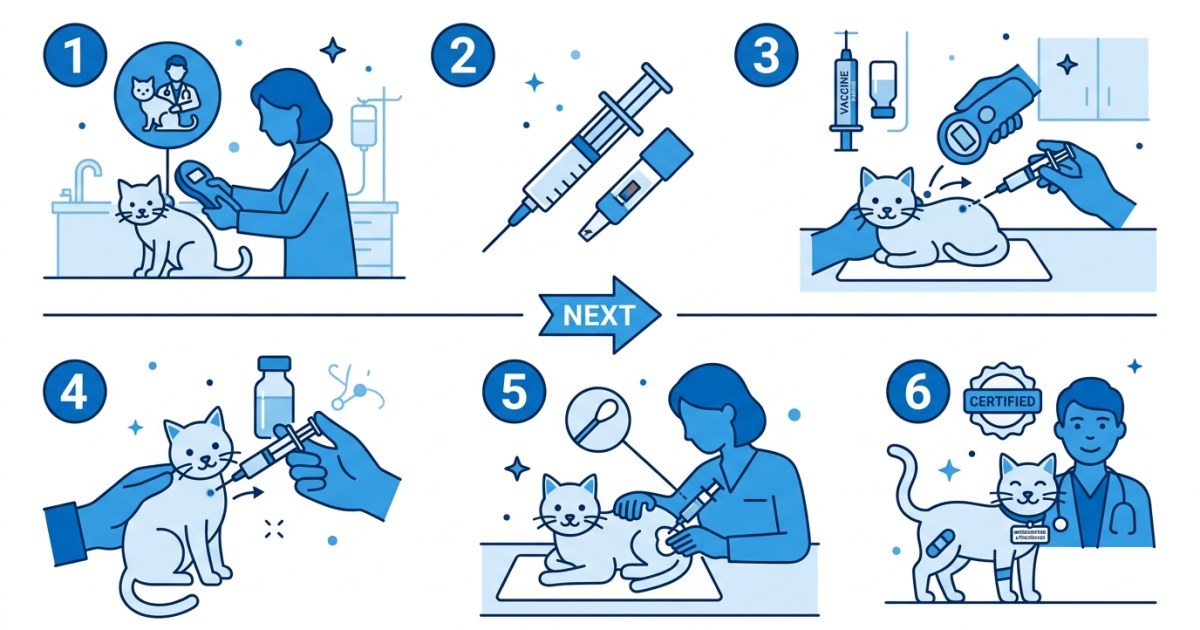
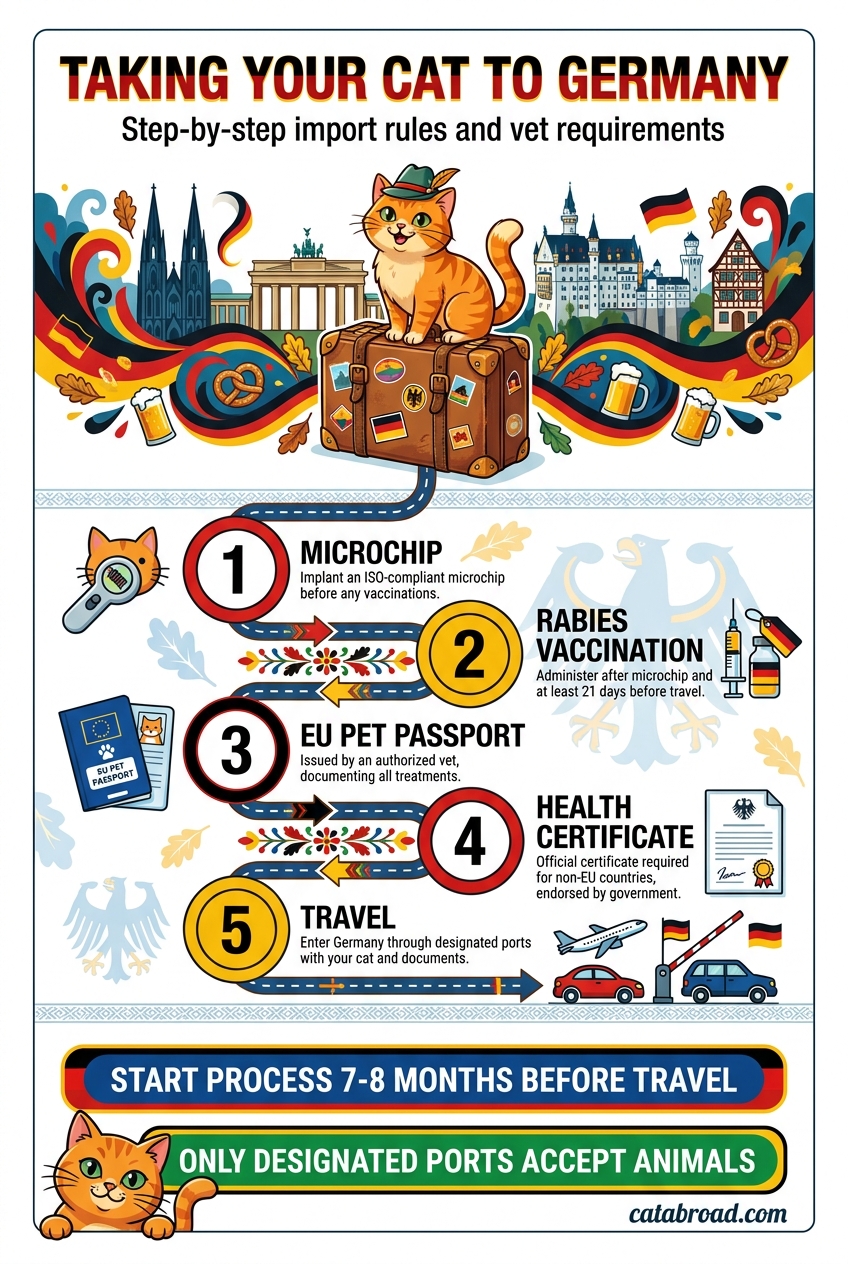
Bringing your cat to Germany requires completing five official steps in a precise sequence. Skipping a step or completing them out of order — particularly vaccinating before microchipping — will invalidate your documentation and reset your 21-day waiting period. Below is the complete process whether you are travelling from within the EU or from a non-EU third country such as the UK, USA, or Australia.
Step 1: Implant an ISO-Compliant Microchip
The very first step — before any vaccination — is to have your vet implant an ISO 11784/11785-compliant 15-digit FDXB microchip. This is a non-negotiable requirement under EU Regulation 576/2013. The chip must be implanted subcutaneously, typically between the shoulder blades. If your cat already has a chip that does not read on an ISO-standard scanner, you must either implant a new ISO-compliant chip or carry a compatible reader with you at all times. Ask your vet to record the microchip number and implantation date on all paperwork — the chip number must appear identically on every subsequent document.
Pro Tip
Ask your vet to scan the microchip immediately after implantation and record the confirmed read number in writing. Defective chips that fail to scan at the German border can result in your cat being refused entry or held at the airport until the issue is resolved — sometimes at your cost.
Step 2: Administer the Rabies Vaccination
Only after the microchip has been confirmed working may your vet administer the rabies vaccination. The vaccine must be an inactivated (killed) or recombinant vaccine — live attenuated rabies vaccines are not accepted by Germany. Your cat must be at least 12 weeks old at the time of vaccination. Critically, there is a mandatory 21-day waiting period from the date of vaccination before your cat is legally permitted to enter Germany. This means your travel date must be no earlier than 22 days after the vaccination date. If you are travelling from a non-EU country, a rabies antibody titre test (FAVN test) may also be required — see the Import Permit & Health Certificate section below for full details.
Step 3: Obtain an EU Pet Passport (EU Travellers) or Prepare for Health Certificate (Non-EU)
If you are travelling from within the EU, your authorised vet will issue an EU Pet Passport (model established under Commission Implementing Regulation 577/2013). This blue booklet records your cat's microchip number, all vaccinations, vet details and owner information. It is the single document that replaces all other import paperwork for intra-EU travel. If you are travelling from a non-EU country — including the United Kingdom post-Brexit — you do not use a Pet Passport. Instead, you will need an official health certificate endorsed by your national government authority (see Step 4).
Step 4: Obtain the Official Health Certificate (Non-EU Countries)
Cats entering Germany from non-EU countries must be accompanied by an official health certificate in the format prescribed by EU Implementing Regulation 2021/1938 (for entry into the EU from third countries). In the UK, the relevant form is the official GB-to-EU health certificate for cats (form available from the Animal and Plant Health Agency, APHA). This certificate must be completed by an Official Veterinarian (OV) — a privately licensed vet alone is not sufficient — and then endorsed by the relevant government authority: APHA in the UK, USDA APHIS in the USA, or CFIA in Canada. The health certificate is valid for 10 days from the date of issue to the date of entry into Germany, and for 4 months of onward travel within the EU.
Warning
The 10-day window between health certificate issue and German entry is one of the most commonly missed deadlines in Germany cat import. APHA and USDA endorsement can take 3–7 working days, so you must time your vet appointment carefully. If your certificate expires before your travel date, you will need a new one.
Step 5: Book Approved Entry Through a Designated Border Post
You must enter Germany through one of the EU's officially designated Border Inspection Posts (BIPs) that is listed as authorised for live animals (category "live animals — cats and dogs"). Not every airport or port handles live animal imports. Frankfurt Airport (FRA) and Munich Airport (MUC) are the two primary BIPs for cats arriving in Germany by air. If you are driving from a non-EU country such as the UK, you must cross at an approved road border inspection post. See the Approved Entry Points section of this guide for the full list.
Step 6: Present All Documents at the Border
On arrival in Germany, a customs or border veterinary officer will scan your cat's microchip, verify it matches the documentation, check the rabies vaccination date against your travel date (confirming the 21-day wait has elapsed), and inspect your EU Pet Passport or government-endorsed health certificate. For cats arriving from non-EU countries, this inspection is mandatory under EU Regulation 576/2013 Article 34. Carry physical copies of all documents; do not rely solely on digital versions. The officer may also check your cat's TRACES NT (Trade Control and Expert System New Technology) pre-notification if applicable.
Good News
If your cat travels from another EU member state with a valid EU Pet Passport and up-to-date vaccinations, the border process is typically straightforward and completed in under 30 minutes. Germany does not impose additional national requirements beyond the EU baseline for intra-EU pet travel.
Microchip & Vaccination Requirements When Moving to Germany with a Cat
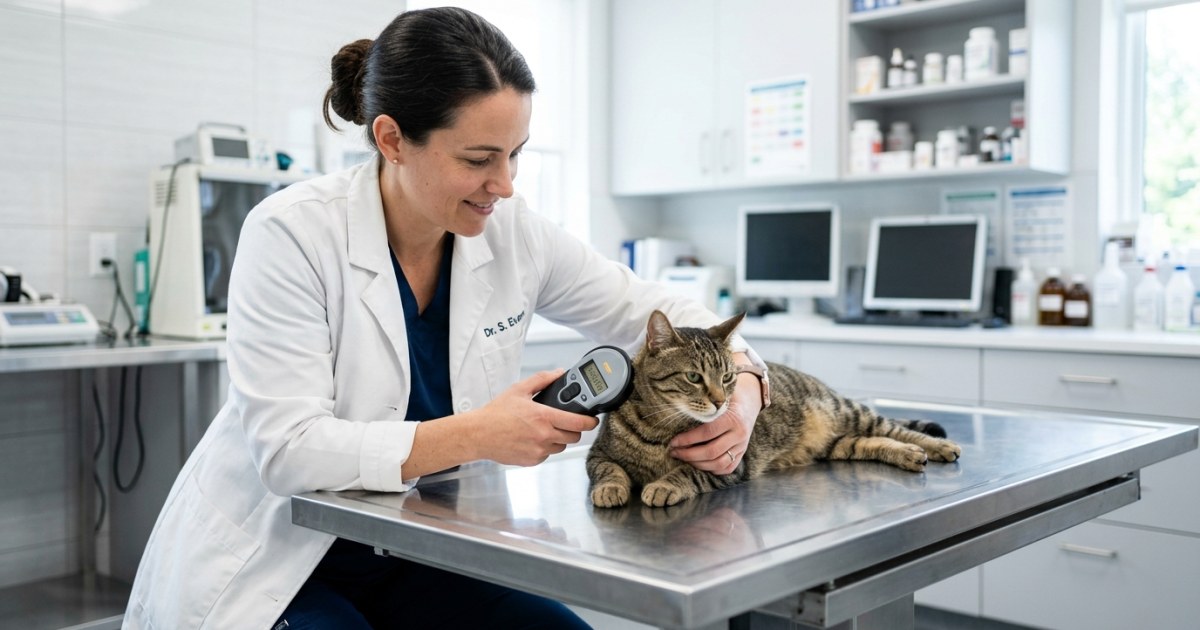
Germany's microchip and vaccination rules are governed by EU Regulation 576/2013 and enforced by the Bundesministerium für Ernährung und Landwirtschaft (BMEL — Federal Ministry of Food and Agriculture). There is zero flexibility on these requirements; border officers have the authority to refuse entry to any cat whose documentation does not comply.
Microchip Specifications
The microchip must conform to ISO standards 11784 and 11785. This means it must be a 15-digit FDXB (Full Duplex B) transponder operating at 134.2 kHz. Older 9-digit or 10-digit chips, and chips using the HDX (Half Duplex) standard, are not acceptable. The implantation must be carried out or supervised by a vet, and the date of implantation must be recorded in the EU Pet Passport or health certificate. The chip number must be legible and consistent across every piece of documentation — even a single digit discrepancy can cause problems at the border.
Rabies Vaccination Requirements
A valid rabies vaccination is compulsory for all cats entering Germany from any country, including other EU member states. The key rules are:
- The vaccine must be administered after the microchip has been implanted and confirmed working.
- Your cat must be at least 12 weeks old on the date of vaccination.
- There must be a gap of at least 21 days between the vaccination date and the date of entry into Germany.
- Booster vaccinations must be administered within the validity window stated by the manufacturer (typically 1 or 3 years). An overdue booster is treated as a first vaccination, restarting the 21-day wait.
- Only inactivated (killed) or recombinant vaccines are accepted — not live attenuated.
Pro Tip
If your cat's rabies booster is due within a few weeks of your travel date, get it done early — ideally at least 25 days before departure to build in a buffer. A booster administered after the expiry date is counted as a primary vaccination and restarts the full 21-day waiting period from scratch.
Rabies Antibody Titre Test (RNATT) — When Is It Required?
The Rabies Neutralising Antibody Titre Test (RNATT), also known as the FAVN test, is required when travelling to Germany from certain non-EU countries that are classified as having a higher rabies risk. As of 2026, this includes countries such as India, Brazil, Thailand, South Africa and many others listed in EU Implementing Decision 2013/519/EU (Annex II). Cats travelling from the UK, USA, Canada, Australia and New Zealand are exempt from the titre test, as these countries are listed on the EU's approved third-country list (EU Implementing Regulation 2021/1938, Annex IX Part 1).
If your cat does require a titre test, the blood sample must be taken at least 30 days after the primary rabies vaccination and tested at an EU-approved laboratory. In the UK, the approved lab is the Animal and Plant Health Agency (APHA) Weybridge laboratory. In the USA, approved labs include Kansas State University Veterinary Diagnostic Laboratory and LSU Diagnostic Lab. A minimum titre of 0.5 IU/mL is required. After a passing titre test result, you must wait an additional 3 months before entering Germany (this waiting period does not apply if travelling from an approved third country).
Good to Know
Other vaccinations such as feline herpesvirus, calicivirus, and panleukopenia (the "tricat" or FVRCP combination) are not required by German import rules but are strongly recommended by the Bundestierärztekammer (Federal Chamber of Veterinary Surgeons) as standard preventive care. Your vet in Germany will likely ask about these at your first appointment post-arrival.
Import Permit & Health Certificate for Germany Cat Import
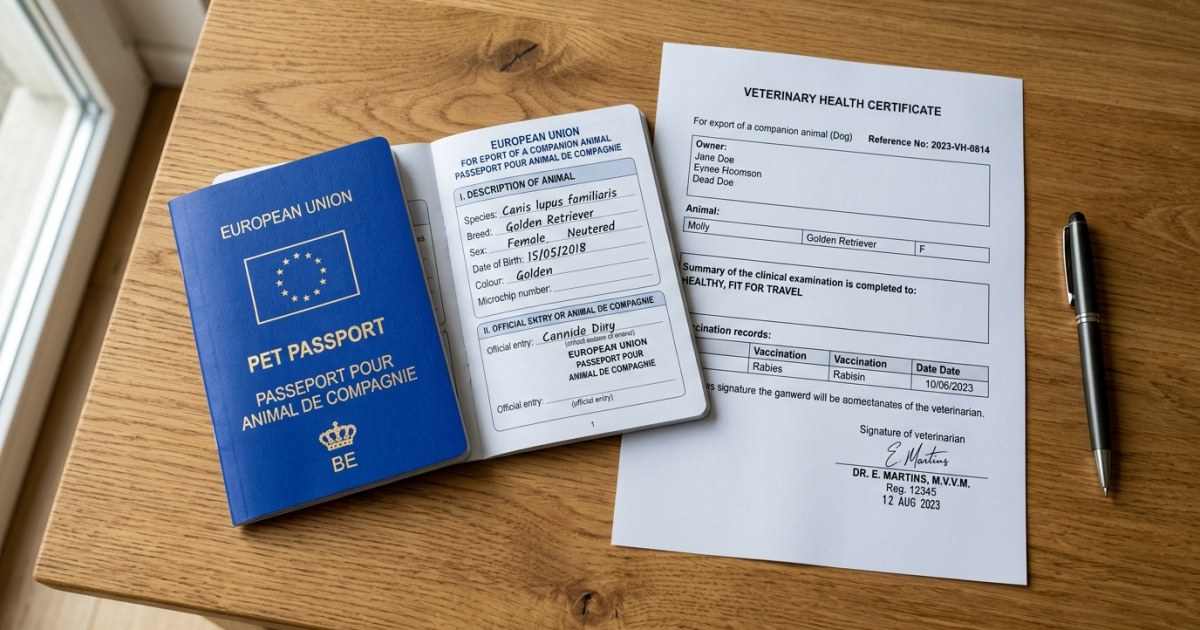
Germany does not require a separate import permit for cats brought in under the non-commercial pet movement rules (EU Regulation 576/2013), meaning you are travelling with your own companion animal and not importing for sale or rehoming. However, the documentation requirements differ significantly depending on where you are travelling from.
Travelling from Within the EU
An EU Pet Passport is your only required travel document. It must be issued by an authorised vet in an EU member state, must record the correct 15-digit ISO microchip number, and must show a valid rabies vaccination entry. The passport format is standardised under Commission Implementing Regulation 577/2013. You do not need a separate health certificate, titre test, or any additional permit. For our full overview of travelling within the EU, see our full Germany guide.
Travelling from the UK (Post-Brexit)
Since 1 January 2021, the UK is a third country for EU pet travel purposes. UK-issued EU Pet Passports are no longer valid for travel to Germany. Instead, you need the official GB-to-EU health certificate, officially titled the "Official health certificate for non-commercial movement of dogs, cats and ferrets from Great Britain into a Member State of the European Union" (TRACES model GB-CATS-EU). This is available from APHA (Animal and Plant Health Agency). The certificate must be completed by an Official Veterinarian (OV) and endorsed by APHA. APHA endorsement costs £30–£98 (approximately $38–$123) and typically takes 3–5 working days. The 10-day validity window begins on the date the OV signs the certificate.
Warning
UK pet owners frequently confuse "Official Veterinarian" with their regular vet. An OV is a vet who holds a specific government certification to sign official export health certificates. Not all vets are OVs. You can find your nearest OV using the APHA OV Finder at gov.uk/government/publications/find-an-official-veterinarian. Book your OV appointment well in advance — popular OVs are often booked 2–3 weeks ahead.
Travelling from the USA
Cats travelling from the USA to Germany require a USDA-endorsed health certificate. Your private vet completes the USDA APHIS form 7001 ("United States Interstate and International Certificate of Health Examination for Small Animals"), which is then endorsed by your regional USDA APHIS Veterinary Services office. USDA accreditation costs $38 (€35) for the endorsement. The USA is on the EU's approved third-country list, so no titre test is required. The health certificate is valid for 10 days from issue to German entry. Note that USDA APHIS offices can take 1–3 business days to endorse documents and some accept appointments only — check your regional office at aphis.usda.gov.
TRACES NT Pre-Notification
For non-commercial pet movement from non-EU countries into Germany, you are required to pre-notify the border inspection post of your arrival using the EU's TRACES NT system (traces.ec.europa.eu). You or your pet relocation company must submit a CHED-A (Common Health Entry Document for Animals) notification at least 24 hours before your expected arrival. Failure to pre-notify can result in delays at the border of 2–6 hours while the documentation is processed retrospectively.
Good News
Germany does not require an import permit, import licence, or advance approval from BMEL for standard non-commercial cat imports. As long as your microchip, vaccination, and health certificate documents are in order, there is no separate application to submit to German authorities before your travel date.
Quarantine Rules: Does Moving to Germany with a Cat Mean Quarantine?
This is the question most owners ask first: there is no mandatory quarantine for cats entering Germany, provided all requirements are met in full and in the correct sequence. Germany, as an EU member state, operates a documentation-based import system rather than a quarantine-based one. Your cat can travel directly from your origin country to your new home in Germany without any period of detention — as long as your paperwork is complete and valid.
When Quarantine Can Be Triggered
While quarantine is not standard, it can be imposed in the following specific circumstances:
- Microchip was implanted after vaccination: The entire vaccination record is invalidated. The cat may be held at the border pending re-vaccination and re-documentation, or refused entry.
- 21-day rabies waiting period not elapsed: The cat cannot legally enter Germany. The owner must arrange alternative temporary accommodation (typically a registered quarantine facility or approved boarding kennel) until the waiting period is satisfied.
- Health certificate expired: If the 10-day validity window has passed, the cat cannot be cleared. A new certificate must be obtained, potentially requiring the cat to remain outside Germany.
- Arriving from a non-approved third country without a passing titre test: The cat may be placed in official quarantine for the duration of the outstanding waiting period.
- Suspected disease or injury at the border: If a border veterinary officer has reason to suspect infectious disease, the cat can be held for observation under Tiergesundheitsgesetz (Animal Health Act) provisions.
Good to Know
Germany's cat quarantine Germany provisions fall under EU Regulation 576/2013 Article 28 (isolation measures) and the national Tiergesundheitsgesetz (Animal Health Act 2016). Quarantine facilities in Germany are privately operated and charge between €30–€60 (approximately $33–$67) per day. Any quarantine costs are the owner's responsibility — they are not covered by standard pet travel insurance policies, so double-check your policy wording.
The 21-Day Rule Is Not Quarantine
It is important to distinguish the mandatory 21-day post-vaccination waiting period from quarantine. The 21 days must pass before your travel date, but your cat spends them at home with you — not in a detention facility. Think of it as a calendar requirement rather than a quarantine. You simply cannot book a travel date fewer than 22 days after the rabies vaccination appointment. For our Germany cat import overview with a visual timeline, see our full Germany guide.
Approved Entry Points for Bringing Your Cat to Germany
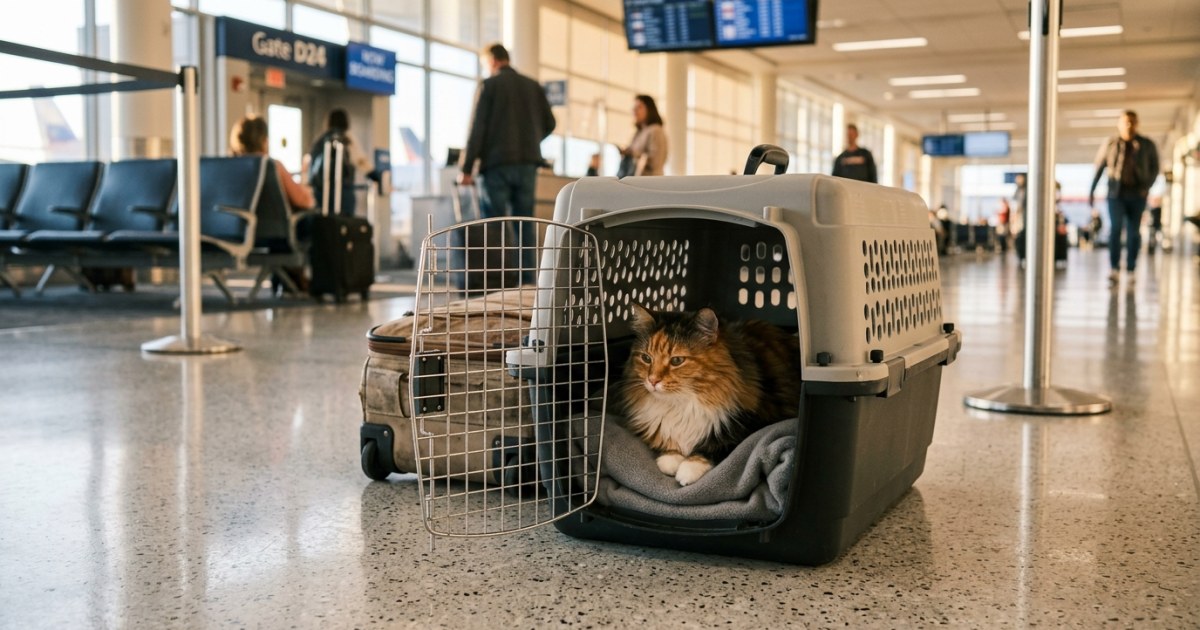
Germany can only be entered with a cat through officially designated Border Inspection Posts (BIPs) that hold authorisation for live animals (category: "live animals — companion animals"). Attempting to bring your cat through a non-designated crossing — even a busy international one — will result in your cat being refused entry and returned to the country of origin at your expense. The full list of EU BIPs is published by the European Commission at ec.europa.eu/food/animals/live-animals/pet-movement_en.
Approved German BIPs for Cats (Air)
- Frankfurt Airport (FRA) — Frankfurt am Main; the busiest BIP for live animal imports in Germany. Operated by Fraport AG. 24-hour veterinary inspection available.
- Munich Airport (MUC) — Franz Josef Strauss Airport. Full live animal BIP services available. Veterinary office: Tierärztlicher Grenzdienst München.
- Hamburg Airport (HAM) — Limited live animal handling; confirm in advance with the airport's Veterinary Border Inspection Post (Grenztierärztlicher Dienst Hamburg).
- Düsseldorf Airport (DUS) — Authorised for companion animals as cargo; confirm live animal acceptance with the airline in advance.
Road and Rail Entry (from Non-EU Countries)
If you are driving from the UK via the Channel Tunnel or ferry and entering Germany by road through France, Belgium or the Netherlands, the live animal border inspection happens at your EU port of entry — typically Calais (France) or the Hook of Holland (Netherlands). By the time you cross into Germany from another EU member state by road, your documentation will already have been cleared at the EU's external border.
Pro Tip
Always telephone your chosen BIP at least 48 hours before arrival to confirm that veterinary inspection services will be available at the time your flight lands or your vehicle arrives. Inspection office hours vary, and if you arrive outside staffed hours without a pre-booked appointment, your cat may be held in a holding facility overnight at an additional cost of €50–€120 ($56–$134).
Notify via TRACES NT Before You Fly
For all non-EU arrivals, submit your CHED-A pre-notification through the TRACES NT portal (traces.ec.europa.eu) at least 24 hours before your expected arrival time. You will need your cat's microchip number, health certificate details, flight number and arrival time. The BIP veterinary team will use this pre-notification to schedule your inspection slot. Most Frankfurt and Munich BIP teams respond to pre-notifications within 4 hours during business hours.
Cost Breakdown: Moving to Germany with a Cat in 2026

The cost of bringing your cat to Germany varies considerably depending on your origin country, whether you use a professional pet relocation service, and how your cat travels (cabin, hold, or as cargo). Below is a detailed breakdown of every cost you are likely to incur. All USD figures use an exchange rate of €1 = $1.12 and £1 = $1.26 (2026 indicative rates).
Cost Breakdown — Germany Cat Import 2026
| Item | Cost (EUR / GBP) | Cost (USD) |
|---|---|---|
| ISO microchip implantation | €30–€60 / £25–£50 | $34–$67 |
| Rabies vaccination (primary) | €35–€70 / £30–£60 | $38–$78 |
| EU Pet Passport (EU travellers) | €20–€50 | $22–$56 |
| Official health certificate (OV fee, UK) | £60–£150 | $76–$189 |
| APHA government endorsement (UK) | £30–£98 | $38–$123 |
| USDA APHIS endorsement (USA) | $38 | $38 |
| Rabies titre test / FAVN (if required) | €100–€200 / £80–£170 | $112–$224 |
| IATA-compliant travel carrier | €40–€120 / £35–£100 | $45–$134 |
| In-cabin pet fee (airline) | €50–€150 / £40–£120 | $56–$168 |
| Hold/cargo pet fee (airline) | €150–€400 / £120–£320 | $168–$448 |
| BIP border inspection fee | €55–€110 | $62–$123 |
| TRACES NT CHED-A pre-notification | Free (self-service) | Free |
| Professional pet relocation service | €1,100–€3,100 / £950–£2,750 | $1,232–$3,472 |
| DIY TOTAL (UK to Germany, one cat) | £280–£720 | $353–$907 |
| Full service TOTAL (UK to Germany) | £1,200–£3,500 | $1,512–$4,410 |
Good to Know
The BIP border inspection fee (€55–€110) is charged under EU Regulation 2017/625 and covers the mandatory official veterinary check at the border. This fee is paid at the BIP on the day of arrival and cannot be waived. It applies to all cats arriving from non-EU countries — not to cats travelling within the EU.
Document Checklist for Germany Cat Import
Use this checklist to ensure you have every document ready before you travel. Physical originals are required for all government-endorsed certificates — photocopies and digital versions are not accepted at German BIPs as primary documents, though carrying digital backups as secondary copies is advisable.
📋 Document Checklist — Travelling from the UK to Germany
- ☐ISO 11784/11785 microchip certificate (with chip number matching all other documents)
- ☐Rabies vaccination record showing date, vaccine brand, batch number and expiry (administered after microchip)
- ☐GB-to-EU official health certificate signed by an Official Veterinarian (OV) and endorsed by APHA
- ☐TRACES NT CHED-A pre-notification confirmation (submitted at least 24 hours before arrival)
- ☐Owner's passport or national ID (matching owner name on health certificate)
- ☐IATA-compliant travel carrier with adequate ventilation, food and water access for journey duration
- ☐Airline pet fee receipt and booking confirmation confirming cat is listed on your reservation
- ☐Veterinary clinical records (not required at border but useful if BIP vet asks questions about health history)
- ☐German address / proof of accommodation in Germany (some BIP officers request this)
- ☐Emergency vet contact number in Germany (Tierärztlicher Notdienst of your destination Bundesland)
📋 Additional Items if Titre Test Was Required
- ☐Rabies Neutralising Antibody Titre Test (RNATT/FAVN) results from an EU-approved laboratory showing ≥0.5 IU/mL
- ☐Evidence that the blood sample was taken at least 30 days after the primary rabies vaccination
- ☐Confirmation that the 3-month waiting period after titre test has elapsed before travel date
Choosing a Pet Relocation Company for Moving to Germany with a Cat
Germany cat import paperwork is manageable for a confident and organised owner — but the consequences of an error are significant, including your cat being refused entry or held at the border. Many expats moving to Germany choose to use a professional IPATA-accredited pet relocation company to handle the entire process, particularly when travelling from non-EU countries where the documentation chain is more complex.
What a Pet Relocation Company Does
A full-service pet relocation company will coordinate every step: scheduling your vet appointments in the correct sequence, managing the health certificate and government endorsement process, booking an IATA-compliant carrier, booking your cat onto an approved flight with appropriate airline pet policies, submitting the TRACES NT pre-notification, liaising with the BIP on your arrival day, and arranging collection or transport to your new German address. Companies such as Munich BIP staff.
What to Look For
- IPATA membership (International Pet and Animal Transportation Association) — the industry's primary quality standard
- Documented experience with Germany / EU routes specifically
- Clear itemised quote with no hidden fees
- Dedicated case manager (not a call centre)
- Door-to-door service options including veterinary coordination
- Insurance options for the cat during transit
Common Mistakes to Avoid When Bringing Your Cat to Germany
The majority of problems at German BIPs are caused by a small number of preventable errors. Here are the most frequently encountered mistakes and how to avoid each one.
Warning — Vaccinating Before Microchipping
This is the single most common error and it is irreversible. If your cat received a rabies vaccination before the ISO microchip was implanted, that vaccination does not count for EU import purposes — the entire vaccination record from before the chip is invalid. You must re-vaccinate after the chip is confirmed working and restart the 21-day waiting period from the new vaccination date. Always confirm the correct sequence with your vet before any appointment: microchip first, vaccination second, no exceptions.
Warning — Booking Travel Fewer Than 22 Days After Vaccination
The 21-day post-vaccination waiting period is calculated from the date of vaccination injection to the date of entry into Germany — not the date of departure from your origin country. If your flight departs on Day 20 and arrives in Germany on Day 21, your cat will be refused entry because the full 21-day period has not elapsed on the day of German arrival. Always book your travel date to land on Day 22 at the earliest, and build in a 2–3 day buffer in case of flight delays.
Warning — Health Certificate Expiry (10-Day Window)
The official health certificate for non-EU arrivals is only valid for 10 days from the date the Official Veterinarian signs it — not from the date of APHA/USDA endorsement. If your flight is delayed, rescheduled, or you miss your connection and your entry into Germany falls on Day 11 or later, your certificate is expired and will not be accepted. Do not book the OV appointment too far in advance. Sign the certificate as close to your departure date as the 10-day window and government endorsement processing time allow — typically 5–7 days before departure.
Warning — Arriving at a Non-Designated Border Post
Not all airports and crossings in Germany handle live animal imports. Arriving at a German airport or border crossing that is not a designated BIP will result in your cat being refused entry and held pending transport to an approved facility — at your cost. Always confirm with your airline and the relevant airport authority that live animal handling is available on your specific route and date before you book. Do not assume that a major airport automatically has BIP facilities for companion animals.
Warning — Forgetting TRACES NT Pre-Notification
Failing to submit the CHED-A pre-notification on TRACES NT (traces.ec.europa.eu) at least 24 hours before arrival is a regulatory breach under EU Regulation 2017/625. BIP staff at Frankfurt and Munich have the authority to refuse to process your cat's entry if no pre-notification is on file, requiring you to wait until a slot can be arranged — which can take 4–12 hours and may require overnight holding. Set a calendar reminder to complete the TRACES NT notification 48 hours before your departure, not 24 hours.
Pro Tip — Start 7–8 Months Before Travel
As highlighted in the official Germany import infographic, the entire process — from microchipping through to travel — should begin 7–8 months before your intended move date. This timeline accommodates the 21-day post-vaccination wait, any titre test waiting periods, APHA or USDA endorsement queues, and time to source an IATA-compliant carrier and book approved flights. Starting late is the root cause of most Germany cat import problems.
At a Glance: Germany Cat Import Requirements
Frequently Asked Questions
Is there cat quarantine in Germany for cats from the UK?
There is no mandatory quarantine for cats entering Germany from the UK, provided all EU import requirements are met in the correct order: ISO microchip before vaccination, rabies vaccination at least 21 days before travel, and a valid APHA-endorsed official health certificate. If any requirement is missing or out of sequence, German border authorities can impose a temporary hold or refuse entry. The 21-day post-vaccination period is a waiting requirement completed at home — not a quarantine period in a facility.
How long does it take to bring a cat to Germany from the USA?
The process takes a minimum of 7–8 months when planned correctly. The key milestones are: ISO microchip implantation, rabies vaccination (after chip), 21-day waiting period, USDA APHIS-endorsed health certificate (allow 7–10 days for scheduling and endorsement), and TRACES NT pre-notification 24 hours before arrival. The USA is on the EU's approved third-country list, so no rabies titre test is required. Total DIY cost from the USA is approximately $440–$900 depending on flight fees and carrier costs.
Do I need an import permit to bring a cat to Germany?
No — Germany does not require a separate import permit or import licence for cats entering under the non-commercial pet movement rules (EU Regulation 576/2013), meaning you are moving with your own companion animal. What you do need is either an EU Pet Passport (for intra-EU travel) or a government-endorsed official health certificate (for non-EU travel). No advance application to the Bundesministerium für Ernährung und Landwirtschaft (BMEL) or German embassy is required.
Which airports in Germany accept cats on arrival?
The primary airports authorised as Border Inspection Posts (BIPs) for live companion animals are Frankfurt Airport (FRA) and Munich Airport (MUC), both of which offer 24-hour veterinary inspection services. Hamburg (HAM) and Düsseldorf (DUS) also handle companion animal arrivals in some circumstances, but must be confirmed directly with the airport's Grenztierärztlicher Dienst (border veterinary service) before booking. Always telephone the BIP at least 48 hours in advance to confirm your inspection slot.
What vaccinations does my cat need to enter Germany?
The only vaccination required by German import law is a valid rabies vaccination administered after ISO microchip implantation, with the cat being at least 12 weeks old at the time of vaccination. The vaccine must be an inactivated (killed) or recombinant product — not a live attenuated vaccine. Boosters must be kept up to date within the manufacturer's validity period (1 or 3 years). Other vaccinations such as FVRCP are not required for import but are recommended as standard preventive care by German vets.
How much does it cost to bring a cat to Germany from the UK?
The DIY cost of bringing a cat to Germany from the UK ranges from approximately £280–£720 ($353–$907), covering the ISO microchip (£25–£50), rabies vaccination (£30–£60), Official Veterinarian health certificate fee (£60–£150), APHA endorsement (£30–£98), an IATA-compliant carrier (£35–£100) and airline pet fee (£40–£120). The BIP border inspection fee adds approximately €55–€110 ($62–$123) on arrival. A full-service professional pet relocation from the UK to Germany costs £1,200–£3,500 ($1,512–$4,410) including all of the above plus coordination and transport.
Can my cat travel in the cabin on a flight to Germany?
It depends on the airline and your cat's carrier weight. Lufthansa, for example, allows cats in the cabin on flights to Germany if the cat plus carrier weighs under 8 kg (17.6 lbs) and the carrier fits under the seat in front of you; the in-cabin pet fee on Lufthansa is €70–€150 one-way depending on route. British Airways, Ryanair and easyJet do not allow pets in the cabin on any routes. For cats over the weight limit or on airlines that don't permit cabin travel, your cat travels as accompanied excess baggage in the aircraft hold. Always confirm your specific airline's policy at the time of booking, as policies change.
 France
 Netherlands
 Austria
 Switzerland
 United Kingdom