
Successfully moving to United States with a cat in 2026 requires meticulous planning and adherence to specific import regulations. The United States, unlike many other nations, does not impose a mandatory quarantine period for cats, making the process relatively straightforward provided all health and documentation requirements are met. This comprehensive guide will walk you through every essential step, from microchipping and vaccinations to health certificates and approved entry points, ensuring a smooth and stress-free relocation for your feline companion.
United States — At a Glance
United States — At a Glance
| Difficulty | Easy |
| Quarantine | No |
| Microchip | Not required, but highly recommended |
| Rabies Vaccine | Required for cats from high-risk rabies countries |
| Import Permit | No |
| Typical Cost | £250–£1,000 / $300–$1,200 (excluding flight) |
| Processing Time | 2-4 weeks (preparation) |
Step-by-Step Import Requirements for Moving to United States with a Cat
Navigating the import process for your cat into the United States can seem daunting, but by following a clear, sequential plan, you can ensure a smooth journey. The United States Department of Agriculture (USDA) and the Centers for Disease Control and Prevention (CDC) are the primary governing bodies for pet imports. Here’s a detailed step-by-step guide for moving to United States with a cat.
Step 1: Microchip Your Cat (Recommended)
While not a mandatory requirement for cats entering the United States, microchipping is highly recommended for identification purposes. If your cat already has a microchip, ensure it is an ISO-compliant 15-digit chip. If not, consider getting one implanted by your vet. This is crucial for international travel as it links your cat to its health records and provides a permanent form of identification should your cat become lost. Ensure the microchip is scanned at every vet visit to confirm it is still readable.
Step 2: Rabies Vaccination and Waiting Period
For cats arriving from countries not considered high-risk for rabies, a rabies vaccination is not strictly required by the CDC. However, individual states within the US may have their own requirements, and it is always prudent to vaccinate your cat against rabies. If your cat is arriving from a high-risk rabies country (as designated by the CDC), a valid rabies vaccination is mandatory. The vaccine must be administered by a licensed vet when the cat is at least 12 weeks old. A waiting period of at least 28 days must pass after the primary vaccination before travel. Booster vaccinations must be administered before the previous one expires to maintain validity.
Step 3: Obtain a Health Certificate
A health certificate, issued by a licensed and accredited vet in the country of origin, is a critical document. This certificate must attest that your cat is healthy, free from infectious diseases, and fit for travel. The certificate must be issued within 10 days of your cat's arrival in the United States. For cats from high-risk rabies countries, the health certificate must specifically state the cat’s rabies vaccination details, including the vaccine manufacturer, lot number, date of administration, and expiration date. The vet must also confirm that the cat has been inspected for external parasites.
Step 4: USDA Endorsement (if required)
Depending on your country of origin, the health certificate may need to be endorsed by the government authority responsible for animal health in that country (e.g., the USDA equivalent). This endorsement verifies the authenticity of the vet's signature and licence. Check the specific requirements for your departure country on the USDA APHIS website (www.aphis.usda.gov). The endorsement typically costs between £20-£40 / $25-$50 and can take several business days to process, so plan accordingly.
Step 5: Arrange Travel Logistics
Book your cat's flight well in advance, ensuring the airline you choose has experience with live animal transport and adheres to IATA Live Animal Regulations. Research airline-specific crate requirements, which typically involve an IATA-compliant travel crate that allows the cat to stand, turn around, and lie down comfortably. Ensure the crate is labelled clearly with 'LIVE ANIMAL', your contact information, and the destination address. Consider direct flights to minimise stress for your cat.
Step 6: Arrival and Customs Clearance
Upon arrival at a US port of entry, your cat and its documentation will be inspected by US Customs and Border Protection (CBP) and potentially a CDC officer. Have all original documents readily available. If all paperwork is in order and your cat appears healthy, it will be cleared for entry. There are no import duties for personal pets. For more detailed information, consult our full United States guide.
Microchip & Vaccination Requirements for United States Cat Import
Understanding the specific microchip and vaccination requirements is paramount for a smooth United States cat import process. While the US has a generally relaxed approach compared to some other nations, certain conditions apply, particularly concerning rabies.
Microchip Requirements
The United States federal government, specifically the CDC, does not mandate microchipping for cats entering the country. However, this is a critical point of divergence from many other international pet travel regulations. Despite not being federally required, we at CatAbroad.com strongly advocate for microchipping your cat with an ISO-compliant 15-digit microchip. This standard is globally recognised and ensures compatibility with scanners worldwide. The benefits extend beyond mere compliance; a microchip is your cat's permanent identification, invaluable if they become separated from you during travel or after arrival. Many US states and local municipalities do have their own microchip requirements for pet registration, so having one already implanted will simplify future administrative tasks.
Pro Tip
Even if not federally required, microchip your cat with an ISO 15-digit chip. It's a small investment (typically £20-£30 / $25-$40) that provides invaluable peace of mind and is often a prerequisite for local pet registration in the US.
Rabies Vaccination Requirements
The CDC's stance on rabies vaccination for cats depends on the country of origin. Cats arriving from countries NOT considered high-risk for rabies by the CDC generally do not require a rabies vaccination for entry. This is a significant relief for many pet owners. However, it's crucial to verify your country's status on the CDC website (www.cdc.gov/importation/bringing-an-animal-into-the-united-states/cats.html) as this list can change.
For cats arriving from countries designated as high-risk for rabies, a valid rabies vaccination is mandatory. The vaccination must meet the following criteria:
- The cat must be at least 12 weeks (3 months) old at the time of initial vaccination.
- The vaccine must be administered by a licensed vet.
- A waiting period of at least 28 days must pass after the primary vaccination before the cat is eligible to travel.
- Booster vaccinations must be administered before the previous vaccine's expiration date to maintain continuous protection and validity.
Warning
Even if your country of origin is not high-risk for rabies, some US states (e.g., Hawaii) and territories (e.g., Puerto Rico) have stricter rabies vaccination and import requirements. Always check the specific regulations for your final destination state or territory well in advance of travel. Failure to comply can result in denial of entry or mandatory quarantine at your expense.
Other Vaccinations
While not federally mandated for entry, it is highly recommended that your cat is up-to-date on all other routine vaccinations, such as FVRCP (Feline Viral Rhinotracheitis, Calicivirus, and Panleukopenia). These vaccinations protect your cat's health and are often required by boarding facilities or pet sitters in the US. Discuss a comprehensive vaccination plan with your vet before travel.
Import Permit & Health Certificate for Bring Cat to United States
Understanding the documentation required is crucial when you bring cat to United States. While an import permit is generally not needed, a specific health certificate is a cornerstone of the process.
Import Permit: Generally Not Required
One of the most favourable aspects of moving to United States with a cat is the absence of a federal import permit requirement for personal pet cats. This significantly streamlines the administrative burden compared to many other countries that demand pre-approval and permits. This 'no permit' policy applies to most cats entering the US, provided they meet the health certificate and vaccination criteria (if applicable). However, as always, there are nuances.
Good to Know
While a federal import permit is not required for personal pet cats, commercial importers or those bringing in large numbers of animals may have different regulations. Always confirm your specific situation with the USDA APHIS if you are not importing a personal pet.
Health Certificate: A Mandatory Document
The health certificate is the single most important document for your cat's entry into the United States. This official document serves as proof that your cat is healthy and meets all necessary import conditions. It must be completed by a licensed and accredited (or official government) vet in the country of origin. The specific form required is often the USDA APHIS Form 7001, or an equivalent international health certificate recognised by the USDA.
Key details that must be included on the health certificate:
- Cat's Identification: Breed, gender, age, colour, and any distinguishing marks. While not federally required, including a microchip number (if present) is highly recommended.
- Owner Information: Your full name, address, and contact details.
- Rabies Vaccination Details: If required (from high-risk countries), this must include the date of vaccination, vaccine product name, manufacturer, lot/serial number, and expiration date. The vet must also state that the cat was at least 12 weeks old when vaccinated and that the 28-day post-vaccination waiting period has passed.
- General Health Statement: A declaration by the vet stating that the cat was examined within a specific timeframe (typically 10 days prior to travel) and found to be free of clinical signs of communicable diseases and fit for travel.
- Parasite Treatment: While not universally mandated, some airlines or states may recommend or require a statement regarding treatment for internal and external parasites.
- Vet's Information: Full name, address, licence number, and official signature.
Warning
The health certificate must be issued within 10 days of your cat's arrival in the United States. An older certificate will be deemed invalid, potentially leading to delays, re-examination, or even denial of entry. Plan your vet appointment carefully within this narrow window.
USDA Endorsement (APHIS)
For many countries, the health certificate must be endorsed by the veterinary authority of the exporting country. This is often the USDA's Animal and Plant Health Inspection Service (APHIS) equivalent in that country. This endorsement confirms that the issuing vet is licensed and that the certificate meets the required standards. You will need to submit the completed health certificate to this authority for official stamping or signing. The cost for endorsement typically ranges from £20-£40 / $25-$50 and can take 1-3 business days, depending on the country's processing times. Always check the specific requirements for your departure country on the USDA APHIS website (www.aphis.usda.gov/aphis/pet-travel/by-country) to determine if endorsement is necessary.
Pro Tip
Make multiple copies of all documents – physical and digital. Keep originals with you, a copy in your cat's travel crate, and digital copies on your phone and cloud storage. This redundancy can be a lifesaver if documents are lost or damaged.
Cat Quarantine United States Rules
A common concern for pet owners is the possibility of quarantine. When considering cat quarantine United States, the good news is that the federal government does not impose a mandatory quarantine period for cats entering the mainland US, provided all import requirements are met. This makes the United States one of the more accessible destinations for international cat travel.
Good News
No federal quarantine for cats entering the mainland United States! As long as your cat meets all health and documentation requirements, it will be cleared for entry upon arrival.
Exceptions and State-Specific Rules
While federal quarantine is not an issue, it is absolutely critical to be aware of state-specific regulations, as these can vary significantly. The most notable exception is Hawaii, which has stringent quarantine laws due to its rabies-free status. Cats entering Hawaii typically undergo a 5-day or 120-day quarantine, depending on pre-arrival preparations, including rabies titre tests and specific waiting periods. Other US territories, such as Puerto Rico, may also have unique requirements.
Always check the specific pet import regulations for your final destination state or territory well in advance of your travel date. You can usually find this information on the state's Department of Agriculture or Department of Health website. For example, Hawaii's Animal Industry Division website (hdoa.hawaii.gov/ai/aqs/info) provides comprehensive details on their 5-day-or-less programme.
Warning
Failure to comply with state-specific requirements, especially for destinations like Hawaii, will result in mandatory quarantine at your expense, which can range from £1,600-£4,000 / $2,000-$5,000 for a 120-day stay, plus daily care fees. This is a significant financial and emotional burden.
Reasons for Potential Quarantine or Denial of Entry
Even without a federal quarantine, your cat could face issues upon arrival if:
- Incomplete or Incorrect Documentation: Missing health certificates, expired vaccinations, or unendorsed documents (if required) are common culprits.
- Signs of Illness: If your cat shows signs of a communicable disease upon inspection by a CDC or CBP officer, they may be denied entry or subjected to further examination and potential quarantine at a veterinary facility.
- Arrival from High-Risk Rabies Country Without Vaccination: Cats from high-risk countries without a valid rabies vaccination will be denied entry.
Pro Tip
Always carry the original copies of all your cat's health documents with you, along with several photocopies. Keep them easily accessible for inspection by customs and border officials upon arrival.
In summary, while the concept of cat quarantine United States is largely non-existent at the federal level, due diligence regarding state-specific rules and meticulous preparation of all required documentation are essential to ensure your cat walks straight into your new home without any unforeseen delays or complications.
Approved Entry Points for United States Pet Import
When planning your United States pet import, understanding the approved entry points is crucial. While the US is vast and has numerous international airports, certain ports of entry are better equipped and more accustomed to processing live animal imports, particularly for commercial shipments or those requiring specific inspections. For personal pet cats, the process is generally more flexible.
Major International Airports
For personal pet cats, you can generally enter the United States through any international airport that has US Customs and Border Protection (CBP) services. The most common and recommended entry points due to their high volume of international flights and established pet handling facilities include:
- John F. Kennedy International Airport (JFK), New York: A major hub with extensive pet handling services.
- Los Angeles International Airport (LAX), California: A primary gateway on the West Coast.
- Miami International Airport (MIA), Florida: A key entry point, especially for flights from Central and South America.
- Chicago O'Hare International Airport (ORD), Illinois: A central US hub.
- Dallas/Fort Worth International Airport (DFW), Texas: Another large, centrally located airport.
- Atlanta Hartsfield-Jackson International Airport (ATL), Georgia: The world's busiest airport by passenger traffic, also handles significant cargo, including pets.
These airports are well-versed in pet import procedures, and their staff (CBP, CDC, and airline cargo personnel) are generally experienced in handling live animals. While smaller international airports can also process pet entries, they may have less frequent inspections or fewer dedicated facilities, potentially leading to longer processing times.
Pro Tip
When booking your flight, consider flying into one of the major international airports listed. These airports typically have more efficient pet processing, reducing potential delays and stress for your cat. Direct flights are always preferable to minimise transit time.
Specific Requirements for Certain Ports
While most ports of entry follow the same federal guidelines, it's worth noting that if your cat requires a CDC inspection (e.g., from a high-risk rabies country), these inspections are typically conducted at designated ports. However, for most cats from non-high-risk countries, the inspection is primarily handled by CBP officers who verify documentation and the cat's apparent health.
Good to Know
The CDC maintains a list of designated ports of entry for animals requiring specific health inspections. While cats from low-risk rabies countries typically don't need these, it's always wise to consult the CDC website (www.cdc.gov/importation/bringing-an-animal-into-the-united-states/ports-of-entry.html) for the most current information.
Arrival Process at the Port of Entry
Upon arrival, your cat will be processed either as accompanied baggage (if travelling in the cabin or as checked baggage) or as manifest cargo. If travelling as cargo, you will need to clear customs at the airline's cargo facility. This involves presenting all original documentation to the CBP officer. They will review the health certificate, vaccination records (if applicable), and visually inspect your cat. If everything is in order, your cat will be cleared for entry. There are no import duties or taxes for personal pets entering the United States.
Warning
Attempting to bypass official entry points or misrepresenting your cat's health status or origin can lead to severe penalties, including denial of entry, confiscation of your cat, and substantial fines. Always be transparent and follow all regulations precisely.
By choosing a well-equipped international airport and ensuring all your paperwork is meticulously prepared, your cat's arrival in the United States should be a straightforward and positive experience.
Cost Breakdown of Moving to United States with a Cat
Understanding the financial implications is a vital part of planning when moving to United States with a cat. The total cost can vary significantly based on your cat's size, your country of origin, whether you use a pet relocation company, and the airline chosen. Here's a breakdown of typical expenses:
Cost Breakdown
| Item | Cost (local) | Cost (USD) |
|---|---|---|
| Microchip (if needed) | £20-£30 | $25-$40 |
| Rabies Vaccination (if needed) | £30-£60 | $40-$75 |
| Health Certificate Exam | £80-£150 | $100-$180 |
| USDA Endorsement (if required) | £20-£40 | $25-$50 |
| IATA-compliant Travel Crate | £50-£200 | $60-$250 |
| Airline Cargo Fees (international) | £200-£800 | $250-$1,000 |
| Pet Relocation Company (optional) | £1,000-£3,000+ | $1,200-$4,000+ |
| Estimated Total (Self-managed, excluding flight) | £400-£1,280 | $500-$1,600 |
| Estimated Total (With Relocation Company) | £1,400-£4,280+ | $1,700-$5,600+ |
Detailed Cost Breakdown Explanations:
- Microchip: If your cat isn't already microchipped, this is a one-time cost. Prices typically range from £20-£30 / $25-$40, including implantation by a vet.
- Rabies Vaccination: If your cat requires a rabies vaccine (from high-risk countries), the cost is usually £30-£60 / $40-$75 per shot. This does not include any potential rabies titre test, which is not required for US cat imports.
- Health Certificate Exam: A licensed vet must perform a health check and complete the health certificate within 10 days of travel. This examination and paperwork typically cost between £80-£150 / $100-$180.
- USDA Endorsement: If your country of origin requires the health certificate to be endorsed by its government veterinary authority, there will be a fee. This is usually £20-£40 / $25-$50.
- IATA-compliant Travel Crate: The cost of an airline-approved travel crate varies significantly based on size and brand. Expect to pay £50-£200 / $60-$250 for a sturdy, compliant carrier.
- Airline Cargo Fees: This is often the most substantial single cost. If your cat travels as manifest cargo (which is common for international flights), fees are based on the crate's volumetric weight and the distance. Prices typically range from £200-£800 / $250-$1,000 for international routes. If your cat is small enough and the airline permits, travelling in the cabin may cost less, around £80-£120 / $100-$150, but cabin space is very limited.
- Pet Relocation Company: Opting for a professional pet relocation service can significantly increase the cost, but it removes much of the stress and administrative burden. Services can range from £1,000-£3,000+ / $1,200-$4,000+, depending on the level of service (door-to-door, paperwork only, etc.) and the complexity of the journey.
Good to Know
These costs do not include potential expenses such as pre-travel vet check-ups beyond the health certificate, calming supplements, or any unforeseen veterinary care upon arrival. Always budget an additional 10-20% for contingencies.
By carefully planning and understanding each component of the cost, you can budget effectively for moving to United States with a cat and ensure a smooth financial journey for your feline friend.
Document Checklist for United States Cat Import
A meticulous approach to documentation is key for a successful United States cat import. Use this checklist to ensure you have every required paper in order before your cat's journey.
📋 Document Checklist
- ☐Rabies Vaccination Certificate: Original certificate showing vaccine manufacturer, lot number, date of administration, and expiration. Required for cats from high-risk rabies countries.
- ☐International Health Certificate (APHIS Form 7001 or equivalent): Completed and signed by a licensed, accredited vet within 10 days of arrival. Must attest to cat's health and fitness for travel.
- ☐USDA Endorsement (if required by country of origin): Official stamp or signature from the veterinary authority in the departure country.
- ☐Microchip Documentation (if applicable): Record of ISO 15-digit microchip number and implantation date. Highly recommended, even if not federally required.
- ☐Airline Booking Confirmation: Proof of your cat's reservation, especially if travelling as cargo.
- ☐Owner's Passport/ID: For identification at customs.
- ☐Copies of all documents: Keep multiple physical and digital copies.
Warning
Do not laminate any original documents. Laminated documents are often considered invalid by customs officials as they cannot be stamped or officially marked. Always present original, unlaminated certificates.
Choosing a Pet Relocation Company for United States
While moving to United States with a cat is relatively straightforward compared to some other destinations, the process still involves intricate paperwork, strict timelines, and complex logistics. For many pet owners, the peace of mind and expertise offered by a professional pet relocation company are invaluable. These companies specialise in handling all aspects of international pet travel, ensuring compliance with all regulations and a stress-free journey for your feline companion.
Benefits of Using a Pet Relocation Company:
- Expert Knowledge: They are up-to-date on all the latest United States cat import requirements, including federal and state-specific rules, and can navigate complex situations.
- Paperwork Management: They handle all the documentation, including health certificates, endorsements, and airline forms, ensuring everything is correctly filled out and submitted on time.
- Logistics Coordination: From booking flights with pet-friendly airlines to arranging ground transport and customs clearance, they manage the entire travel itinerary.
- Crate Selection: They can advise on or provide IATA-compliant travel crates, ensuring your cat travels safely and comfortably.
- Reduced Stress: For both you and your cat, outsourcing the complexities of international travel can significantly reduce anxiety.
What to Look for in a Pet Relocation Company:
- IPATA Membership: Ensure the company is a member of the International Pet and Animal Transportation Association (IPATA). This signifies adherence to ethical standards and best practices in animal transport.
- Experience with United States: Choose a company with a proven track record of successfully relocating pets to the United States.
- Transparent Pricing: Get a detailed quote that outlines all services included and any potential additional costs.
- Communication: A good company will provide regular updates and be responsive to your queries.
- Customised Service: Look for a company that offers tailored solutions based on your specific needs and your cat's requirements.
Recommended Partner
Get Expert Help Moving to United States
Starwood Animal Transport specialises in cat relocations to United States and handles all paperwork, permits and logistics.
Get a Free Quote from Starwood →While the cost of using a relocation company is an investment, it often saves time, reduces stress, and minimises the risk of costly errors or delays, making it a worthwhile consideration for many pet owners embarking on a move to the United States with a cat.
Common Mistakes to Avoid When Moving to United States with a Cat
Even with seemingly straightforward United States pet import requirements, common pitfalls can lead to significant delays, stress, or even denial of entry. Being aware of these mistakes is crucial for a smooth journey when moving to United States with a cat.
Warning
Mistake 1: Not Checking State-Specific Requirements. While federal rules are lenient, states like Hawaii have very strict, mandatory quarantine laws. Failing to research your final destination state's Department of Agriculture or Health website can lead to unexpected quarantine periods (up to 120 days) and significant costs (thousands of USD).
Warning
Mistake 2: Incorrectly Timed Health Certificate. The International Health Certificate must be issued by a licensed vet within 10 days of your cat's arrival in the US. Getting it too early or too late will render it invalid, requiring a last-minute, stressful vet visit or risking entry issues.
Warning
Mistake 3: Incomplete or Expired Rabies Vaccination. If your cat is from a high-risk rabies country, a valid rabies vaccination is non-negotiable. Ensure the vaccine is current, administered after 12 weeks of age, and the 28-day waiting period has passed. An expired or improperly administered vaccine means denial of entry.
Warning
Mistake 4: Non-IATA Compliant Travel Crate. Airlines strictly enforce IATA (International Air Transport Association) Live Animal Regulations for pet carriers. Using a crate that is too small, flimsy, or lacks proper ventilation can result in your cat being denied boarding, even if all other paperwork is in order.
Warning
Mistake 5: Not Verifying Airline Pet Policies. Each airline has its own specific rules regarding pet travel, including breed restrictions, temperature embargoes, and cabin vs. cargo policies. Always confirm your chosen airline's pet policy well in advance, as these can change without much notice.
Warning
Mistake 6: Overlooking USDA Endorsement (if applicable). For some countries, the health certificate requires endorsement by the country's official veterinary authority (e.g., the USDA equivalent). Skipping this step or not allowing enough time for processing can invalidate your health certificate upon arrival.
By meticulously reviewing these common mistakes and taking proactive steps to avoid them, you can significantly increase the likelihood of a smooth and successful United States cat import experience.
At a Glance: United States Cat Import Requirements
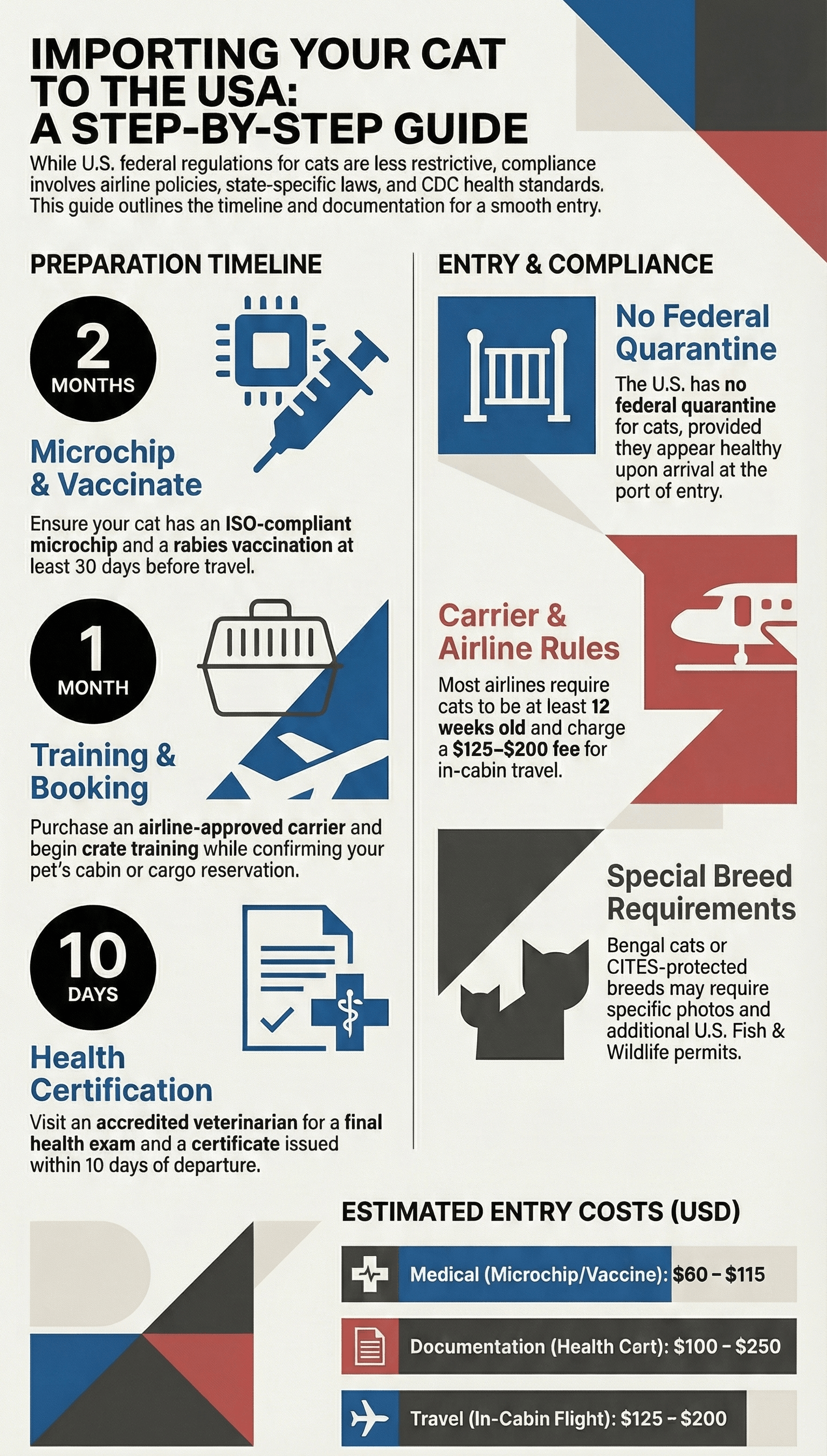
Frequently Asked Questions
Do cats need a rabies shot to enter the US?
Cats entering the US from countries NOT considered high-risk for rabies by the CDC generally do not require a rabies vaccination. However, cats from high-risk rabies countries must have a valid rabies vaccination administered at least 28 days prior to travel, when the cat was at least 12 weeks old. State-specific rules, like Hawaii's, may also mandate rabies vaccinations regardless of origin.
Is there quarantine for cats entering the United States?
No, the federal government of the United States does not impose a mandatory quarantine period for cats entering the mainland US, provided all import requirements are met. The only major exception is the state of Hawaii, which has strict quarantine laws (5-day or 120-day) due to its rabies-free status. Always check state-specific regulations for your final destination.
What documents do I need to bring my cat to the US?
You will primarily need an International Health Certificate (APHIS Form 7001 or equivalent) issued by a licensed vet within 10 days of arrival. If your cat is from a high-risk rabies country, a valid rabies vaccination certificate is also mandatory. Depending on your country of origin, the health certificate may also require endorsement by your country's official veterinary authority.
How much does it cost to bring a cat to the United States?
The cost to bring a cat to the United States can range from £400-£1,280 / $500-$1,600 if self-managed, excluding the flight. This covers vet fees, health certificates, and travel crates. If using a pet relocation company, the total cost can be significantly higher, typically ranging from £1,400-£4,280+ / $1,700-$5,600+, including professional services and flight arrangements.
Does my cat need a microchip for US entry?
No, a microchip is not a mandatory federal requirement for cats entering the United States. However, it is highly recommended to microchip your cat with an ISO-compliant 15-digit chip for permanent identification and to comply with potential state or local pet registration laws after arrival. Many airlines also prefer microchipped pets.
How long does the cat import process to the US take?
The preparation process for moving to United States with a cat typically takes 2-4 weeks, primarily for vet visits, health certificate issuance, and any required waiting periods after vaccinations. The actual travel day and customs clearance usually take a few hours upon arrival, provided all documentation is correct and complete.
 Canada
 Mexico
 United Kingdom
 Germany
 France