
Moving to Portugal with a cat is refreshingly straightforward compared with many countries, because Portugal follows standard EU pet travel rules with no quarantine for compliant animals. In 2026, roughly 40% of pet import rejections at EU borders are still caused by rabies vaccinations given too close to the travel date — a mistake that is entirely avoidable with correct timing. This guide walks through every requirement, cost and deadline so your cat clears Portuguese border control without delay.
PORTUGAL CAT IMPORT AT A GLANCE
Portugal — At a Glance
| Difficulty | Easy (EU/listed third countries) / Moderate (unlisted third countries) |
| Quarantine | No, for cats meeting entry requirements |
| Microchip | ISO 11784/11785 15-digit chip required, implanted before rabies vaccine |
| Rabies Vaccine | Required; 21-day wait after primary vaccination before travel |
| Import Permit | Not required for non-commercial movement of up to 5 cats |
| Typical Cost | €400–€1,500 / $440–$1,650 depending on origin country |
| Processing Time | 3 weeks (EU-origin) to 7 months (unlisted third countries requiring titre test) |
STEP-BY-STEP GUIDE TO MOVING TO PORTUGAL WITH A CAT
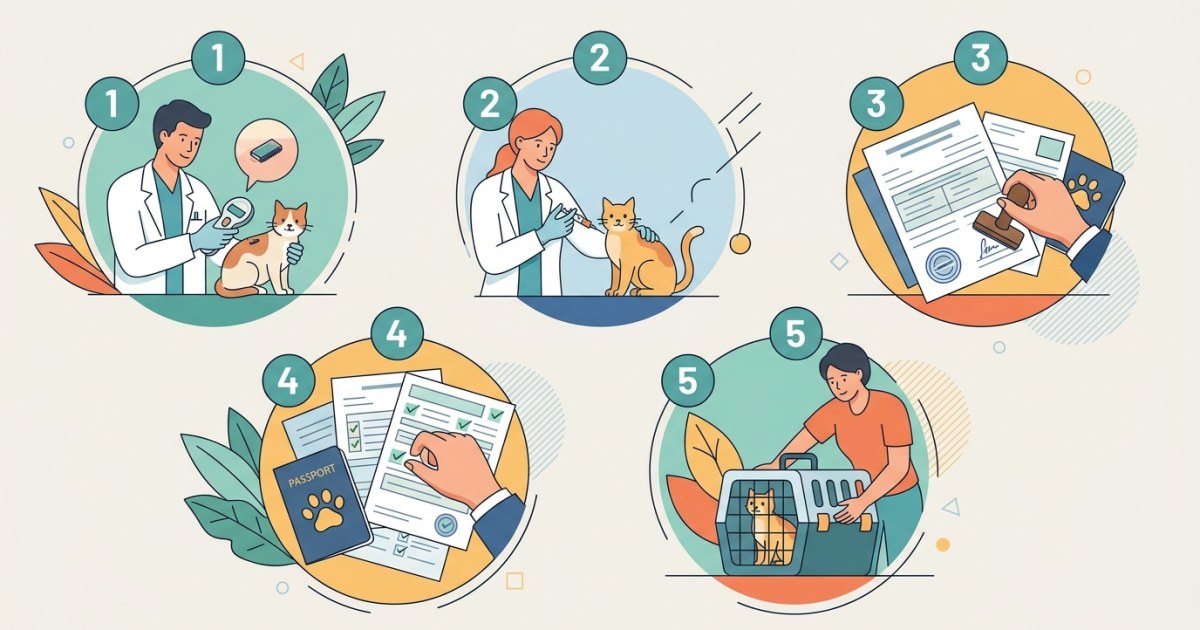
Step 1: Microchip your cat
Your cat must be fitted with an ISO 11784/11785-compliant 15-digit microchip by a licensed vet before, or on the same day as, the rabies vaccination. If the chip is not ISO-compliant, bring your own compatible scanner, as Portuguese border officials may not be able to read older 9- or 10-digit chips. This step must happen before any vaccination counts towards the entry requirements.
Step 2: Vaccinate against rabies
Your cat must be at least 12 weeks old at the time of the primary rabies vaccination. If this is your cat's first-ever rabies shot, you must wait a minimum of 21 days from the vaccination date before travelling — meaning the earliest possible travel age is 15 weeks. If the vaccine is a booster given within the validity window of a previous vaccination, your cat can travel immediately with no waiting period.
Step 3: Check if a rabies titre (FAVN) test is required
If you're travelling from an EU-listed third country (USA, Canada, Australia, Japan, UAE and others on the EU's Annex II list), no blood test is needed. If your country is unlisted or high-risk, your cat needs a Fluorescent Antibody Virus Neutralisation (FAVN) titre test at an EU-approved laboratory, with blood drawn at least 30 days after the rabies vaccination. You must then wait a further 3 months from the date the blood sample was taken before entering Portugal.
Step 4: Obtain an EU Pet Passport or Animal Health Certificate
Cats already resident in the EU (or Northern Ireland, Switzerland, Norway) travel on an EU Pet Passport issued by an authorised vet. Cats coming from any other third country — including the UK, USA, Canada and Australia — need an EU Animal Health Certificate (Annex IV, Implementing Regulation (EU) 577/2013), issued by an official government vet no more than 10 days before arrival in Portugal. In the US, the certificate must be endorsed by a USDA APHIS office; in the UK, by an Official Veterinarian registered with APHA.
Step 5: Book pet-approved travel and a compliant carrier
Choose an airline that accepts cats in the cabin or as manifest cargo — TAP Air Portugal, British Airways, Lufthansa and Air France all carry pets under specific weight and carrier limits. Your carrier must meet IATA Live Animal Regulations if travelling in the hold, and you must confirm your flight lands at a Portuguese airport designated as a Traveller's Point of Entry.
Step 6: Clear border checks on arrival
At the airport, present your cat's microchip, EU Pet Passport or Animal Health Certificate, and (if applicable) titre test results to the border veterinary post or customs officer. Documentary and identity checks are done on a risk basis for EU-origin pets; non-EU arrivals are checked at the designated Traveller's Point of Entry (TPE) veterinary control point.
Step 7: Register your cat in Portugal's SIAC database
Within 30 days of taking up residence, register your cat's microchip with SIAC (Sistema de Informação de Animais de Companhia), Portugal's national companion animal database managed by DGAV. Most local vets can complete this registration electronically during your cat's first check-up, at a cost of roughly €5–€15 ($5–$16).
MICROCHIP & VACCINATION REQUIREMENTS FOR PORTUGAL CAT IMPORT
Portugal follows EU Regulation (EU) No 576/2013 on the non-commercial movement of pet animals, enforced domestically by DGAV — Direção-Geral de Alimentação e Veterinária (www.dgav.pt). The two non-negotiable identity and health requirements are the ISO microchip and rabies vaccination, and the order in which you do them matters enormously.
Warning
If your cat was vaccinated against rabies before being microchipped, the vaccination is not valid for Portugal cat import purposes. Border officials will require a fresh vaccination administered after microchipping, restarting the 21-day waiting clock.
Rabies vaccines must be non-adjuvanted or inactivated products administered according to manufacturer guidelines, and boosters must never lapse — if you miss the revaccination window shown on your cat's certificate, the vaccine legally reverts to "primary" status and the 21-day wait applies again.
Good News
Unlike the UK, Ireland, Finland, Norway and Malta, Portugal does NOT require tapeworm (Echinococcus multilocularis) treatment before entry. If Portugal is your final destination, you can skip this step and the associated vet visit entirely.
IMPORT PERMIT & HEALTH CERTIFICATE: PORTUGAL PET IMPORT REQUIREMENTS 2026
For private owners bringing up to five cats for personal, non-commercial reasons, Portugal does not require a separate import permit or TRACES pre-notification — this is one of the biggest advantages of Portugal cat import compared with countries outside the EU framework. What you do need is the correct paperwork matched to your cat's country of origin.
Good to Know
EU Pet Passports are only issued to pets resident in the EU, Northern Ireland, Switzerland, Liechtenstein, Norway or San Marino, and must be issued by an authorised vet registered with the relevant national authority. Once outside this zone (including the UK post-Brexit), your cat needs a new Animal Health Certificate for every single trip.
The Animal Health Certificate follows the model set out in Annex IV of Implementing Regulation (EU) 577/2013, and is valid for 10 days from issue to entry into the EU, then for onward intra-EU travel for 4 months from issue, or until the rabies vaccination expires — whichever comes first. This is why timing your vet appointment close to your flight date is critical; book it no earlier than 10 days before departure.
Pro Tip
US owners must have their Animal Health Certificate electronically endorsed via USDA APHIS's VEHCS system before travel. Book your USDA endorsement appointment as soon as your vet issues the certificate, since some regional offices need 2–3 business days to process it.
CAT QUARANTINE PORTUGAL: WHAT ACTUALLY HAPPENS AT THE BORDER

There is no routine cat quarantine Portugal enforces for pets arriving with complete, correct documentation. Portugal, as an EU member state, is classed as rabies-controlled and does not impose the fixed quarantine periods seen historically in places like the UK or Australia.
Good News
If your cat's microchip, rabies vaccination and certificate all meet the requirements above, it walks through Portuguese border control the same day it lands — no isolation period, no boarding facility, no additional waiting.
Quarantine only becomes a risk if your paperwork is incomplete or incorrect. In that scenario, Portuguese authorities have three options under EU rules: return the animal to its country of origin at the owner's expense, hold it in an approved quarantine facility until compliance is achieved, or in the most serious cases, humane destruction as a last resort where re-export is not possible. These outcomes are rare and almost always avoidable with correct planning.
Warning
Cats travelling from unlisted third countries without a valid FAVN titre test and the mandatory 3-month post-sample wait will be refused entry or quarantined at the airport. There is no way to shortcut this waiting period once the blood sample has been taken.
APPROVED ENTRY POINTS FOR CATS TRAVELLING TO PORTUGAL
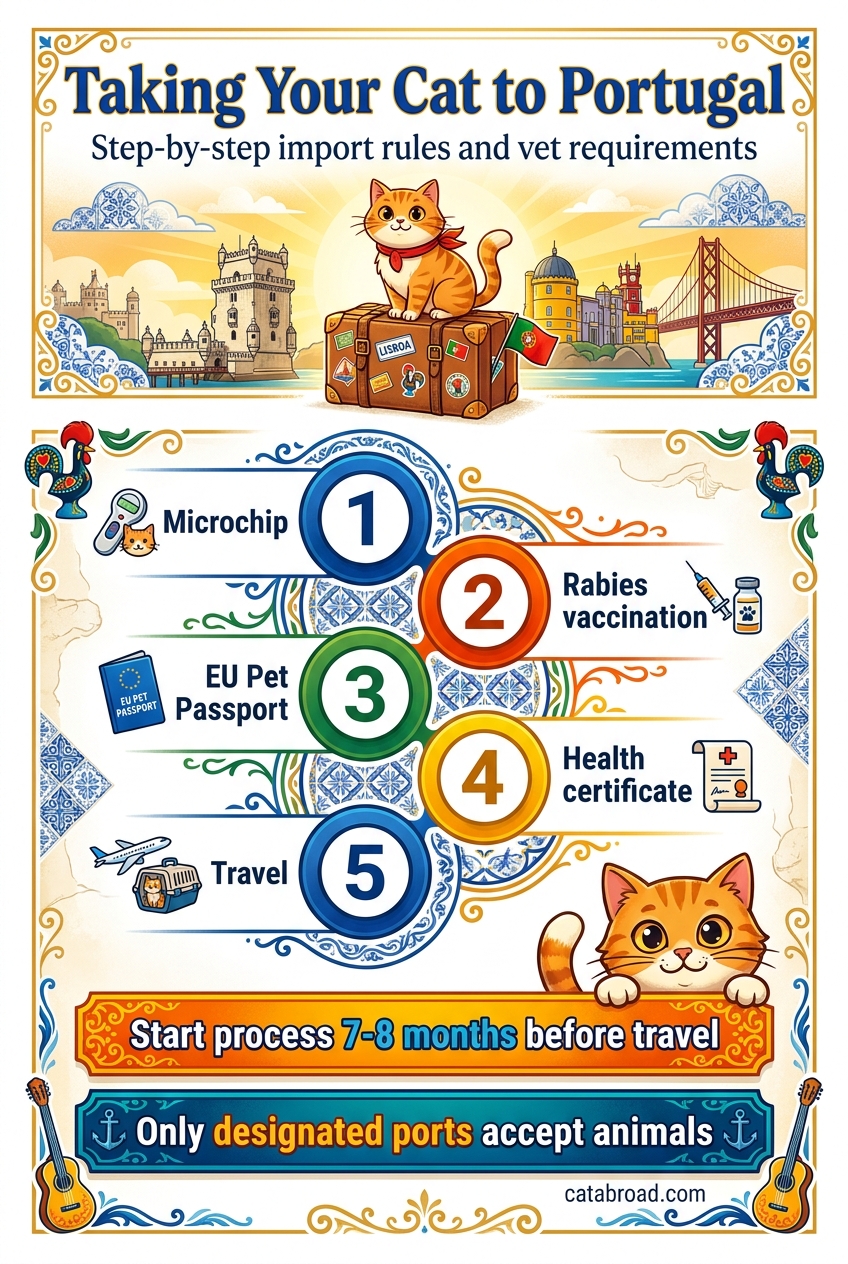
Only designated ports and airports accept animals arriving from outside the EU. Portugal's Traveller's Points of Entry (TPEs) for pets from third countries are:
- Lisbon — Humberto Delgado Airport
- Porto — Francisco Sá Carneiro Airport
- Faro Airport
- Funchal Airport, Madeira
- Ponta Delgada Airport, Azores
- Port of Lisbon (Alcântara terminal), for pets arriving by sea
If you're driving into Portugal from Spain or arriving from another Schengen/EU country, there is no border checkpoint requirement since internal EU/Schengen borders don't carry routine pet inspections — though you should still carry your cat's EU Pet Passport in case of a spot check by GNR or customs.
Good to Know
Smaller regional Portuguese airports without a designated veterinary control point cannot legally accept pets travelling from non-EU countries — always route your booking through Lisbon, Porto or Faro if you're coming from outside the EU.
COST BREAKDOWN: MOVING TO PORTUGAL WITH A CAT
Costs vary significantly depending on whether your cat is coming from within the EU (cheaper, faster) or from an unlisted third country requiring a titre test and cargo shipping (more expensive, slower). Below is a realistic breakdown for 2026.
Cost Breakdown
| Item | Cost (local) | Cost (USD) |
|---|---|---|
| ISO microchip | €30–€50 | $33–$55 |
| Rabies vaccination | €25–€45 | $27–$49 |
| FAVN rabies titre test (unlisted countries only) | €150–€250 | $165–$275 |
| EU Pet Passport (EU-origin pets) | €40–€70 | $44–$77 |
| Animal Health Certificate incl. vet exam (non-EU) | €100–€200 | $110–$220 |
| USDA APHIS endorsement (US only) | $38 flat fee | $38 |
| SIAC registration in Portugal | €5–€15 | $5–$16 |
| IATA-compliant travel carrier | €50–€150 | $55–$165 |
| Airline in-cabin pet fee | €80–€150 | $90–$165 |
| Cargo/IPATA-managed shipping (long-haul) | €600–€2,000+ | $650–$2,200+ |
In total, expect to pay €400–€900 ($440–$1,000) for a cat moving from within the EU, and €700–€1,500+ ($770–$1,650+) for a cat coming from an unlisted third country needing a titre test and cargo transport. See our full Portugal guide for country-specific cost comparisons across common origin countries.
DOCUMENT CHECKLIST FOR PORTUGAL CAT IMPORT

📋 Document Checklist
- ☐ISO 11784/11785 15-digit microchip certificate, dated before the rabies vaccination
- ☐Rabies vaccination certificate showing batch number, date, and vet's signature/stamp
- ☐FAVN titre test result (only if travelling from an unlisted third country)
- ☐EU Pet Passport (EU-resident pets) OR Animal Health Certificate issued within 10 days of travel (non-EU pets)
- ☐USDA APHIS or equivalent government endorsement of the health certificate, where applicable
- ☐Proof of airline pet booking/confirmation and IATA-compliant carrier
- ☐Owner's ID/passport matching the name on the pet documentation
- ☐SIAC registration confirmation, arranged within 30 days of arrival in Portugal
CHOOSING A PET RELOCATION COMPANY FOR YOUR PORTUGAL CAT IMPORT
If your move involves cargo shipping, a long-haul flight, or an unlisted third country requiring a titre test, a professional pet relocation company can save considerable stress. When evaluating providers, check for IPATA (International Pet and Animal Transportation Association) membership, which confirms they're vetted against industry standards for animal welfare and documentation accuracy.
Ask any company for a written, itemised quote covering every stage — export paperwork, crate, airline booking, import clearance at the Portuguese TPE, and any layover pet-relief arrangements. Request references from clients who have specifically completed cat import to Portugal in the last 12 months, since rules and airline policies change frequently. A reputable relocator will never guarantee an outcome that contradicts EU regulation — for example, promising to skip the FAVN titre test or the 3-month wait for an unlisted country is a red flag, not a shortcut.
Pro Tip
Get at least three quotes and compare what's actually included — some relocators quote a low headline price that excludes the government-endorsed health certificate, crate purchase, or destination customs clearance fees, which can add hundreds of dollars later.
COMMON MISTAKES TO AVOID WHEN MOVING TO PORTUGAL WITH A CAT

Warning
Vaccinating before microchipping is the single most common reason cats are refused entry at Portuguese airports. Always confirm the microchip is scanned and recorded on the vaccination certificate before the vet administers the rabies shot.
Warning
Booking your Animal Health Certificate appointment too early is a costly error — the certificate is only valid for 10 days before entry into the EU. If your flight is delayed beyond that window, you'll need an entirely new certificate and vet visit.
Warning
Underestimating the FAVN titre test timeline is a frequent planning failure. Between the vaccination, the 30-day wait to draw blood, lab processing (2–4 weeks), and the mandatory 3-month wait after the sample date, owners from unlisted countries should start the process 7–8 months before their planned travel date, exactly as flagged in Portugal's own import guidance.
Warning
Flying into a regional Portuguese airport without a designated veterinary control point will get your cat's arrival rejected if you're coming from a non-EU country. Always book flights that land at Lisbon, Porto or Faro when travelling from outside the EU.
For a country-by-country comparison of documents and timelines, see our full Portugal guide, which is updated whenever DGAV or the European Commission revise the underlying regulations.
At a Glance: Portugal Cat Import Requirements
Frequently Asked Questions
Does Portugal require cat quarantine?
No. Portugal does not impose routine quarantine on cats that arrive with a valid microchip, rabies vaccination and EU Pet Passport or Animal Health Certificate. Quarantine or refusal of entry only applies to animals with missing, incorrect or expired documentation, and is handled case-by-case by the border veterinary authority.
How long before travel do I need to start the process for a cat import to Portugal?
If you're coming from an EU country, allow at least 3 weeks to microchip, vaccinate and obtain a passport. If you're coming from an unlisted third country requiring a rabies titre test, start the process 7–8 months in advance to account for the 30-day post-vaccination blood draw, lab processing time and the mandatory 3-month wait after sampling.
Can I bring my cat to Portugal from the UK after Brexit?
Yes, but since Brexit the UK is treated as a third country, so your cat needs an EU Animal Health Certificate issued by an APHA-registered Official Veterinarian within 10 days of travel, rather than an EU Pet Passport. The rabies vaccination must have been given at least 21 days before travel if it's your cat's first dose.
How much does it cost to bring a cat to Portugal?
For a cat moving from within the EU, budget €400–€900 ($440–$1,000) covering microchip, vaccination, passport and travel fees. For a cat coming from an unlisted third country requiring a titre test and cargo shipping, budget €700–€1,500+ ($770–$1,650+).
Which airports can I fly my cat into in Portugal?
Cats arriving from outside the EU must land at a designated Traveller's Point of Entry: Lisbon Humberto Delgado Airport, Porto Francisco Sá Carneiro Airport, Faro Airport, Funchal Airport in Madeira, or Ponta Delgada Airport in the Azores. Pets arriving by sea can also enter via the Port of Lisbon.
Does my cat need a tapeworm treatment to enter Portugal?
No. Unlike the UK, Ireland, Finland, Norway and Malta, Portugal does not require Echinococcus multilocularis tapeworm treatment for cats entering the country. This step is only needed if your cat is travelling onward to one of those specific countries after arriving in Portugal.
Is there an import permit needed to bring a cat to Portugal?
No import permit is required for non-commercial movement of up to five pet cats. You simply need the correct identification and health documentation — an import permit is only relevant for commercial imports or shipments of more than five animals, which follow a different TRACES-based process.
What happens if my cat's documents are incorrect when I land in Portugal?
Portuguese authorities can return the cat to its country of origin at the owner's expense, place it in an approved quarantine facility until compliance is met, or in extreme cases order humane destruction if re-export isn't feasible. These outcomes are rare and almost always avoidable by double-checking your paperwork against DGAV's published requirements before travel.
 Spain
Spain France
 Italy
Italy Malta
Malta📋 Official Requirements: View the full import rules and vet requirements for taking your cat to Portugal on CatAbroad.com.