Moving to Italy with a cat is entirely achievable without quarantine if you follow the European Union's non-commercial pet travel rules to the letter. Italy's Ministero della Salute processed over 38,000 companion animal entries in the last reported year, and cats face fewer hurdles than dogs because no tapeworm treatment is required. This guide walks through every microchip, vaccination, certificate and cost you need for a smooth Italy cat import in 2026. For a complete overview, see our full It cat import guide.
In This Guide
Moving to Italy with a Cat: At a Glance
Before diving into the paperwork, here is the headline picture for anyone moving to Italy with a cat in 2026. Italy follows standard EU pet travel regulation (Regulation (EU) No 576/2013), which makes it one of the more predictable EU destinations for cat owners provided you plan your timeline correctly.
Italy — At a Glance
| Difficulty | Easy–Moderate (straightforward if timeline is followed) |
| Quarantine | No — if microchip, vaccination and paperwork are compliant |
| Microchip | ISO 11784/11785 15-digit chip required, before rabies jab |
| Rabies Vaccine | Required, at least 21 days before travel |
| Import Permit | Not required for non-commercial movement of up to 5 cats |
| Typical Cost | €250–€700 / $270–$770 (excluding flights) |
| Processing Time | Minimum 21 days; realistically 4–8 months for first-time pets |
For the wider country picture including regional vet networks and airline partners, see our full Italy guide.
Step-by-Step: Italy Cat Import Requirements

Whether you are relocating from London, New York or Sydney, the sequence below never changes. Get the order wrong — for example vaccinating before microchipping — and Italian border authorities can legally reject your paperwork.
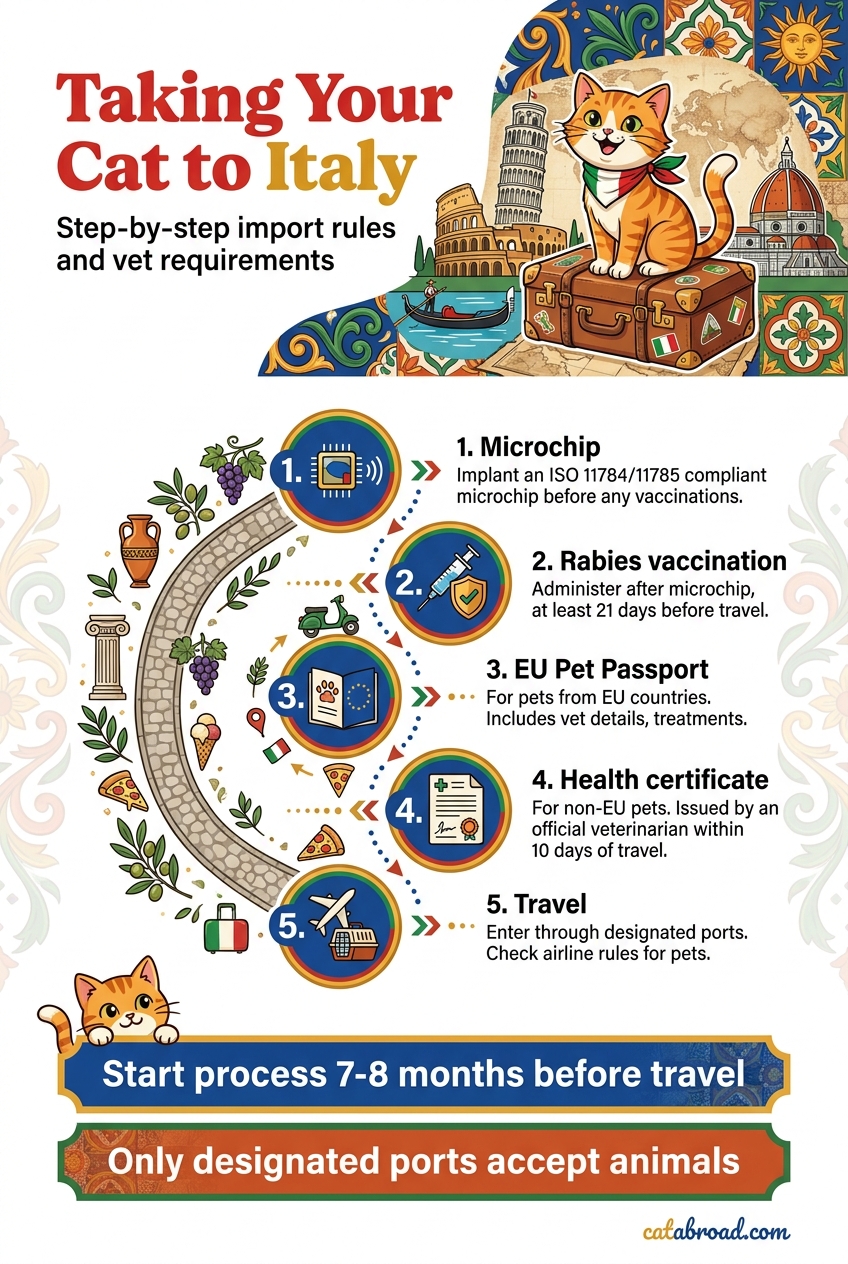
Step 1: Implant an ISO-compliant microchip
Your vet implants a 15-digit ISO 11784/11785-compliant microchip. This must happen before, or on the same day as, the rabies vaccination — a chip implanted after vaccination invalidates the rabies jab for EU travel purposes and forces a full 21-day revaccination wait.
Step 2: Administer the rabies vaccination
The rabies vaccine must be given at least 21 days before entry into Italy, counted from the day of vaccination (day 0) to the day of travel. If your cat has an up-to-date, unbroken booster history, the 21-day wait does not need to be repeated.
Step 3: Obtain an EU Pet Passport (EU-resident cats) or Health Certificate (non-EU cats)
Cats already living in an EU country travel on an EU Pet Passport issued by any authorised EU vet. Cats coming from outside the EU — the US, UK, Canada, Australia and similar — need an EU Animal Health Certificate (Annex IV, Regulation (EU) 577/2013) instead.
Step 4: Get the certificate endorsed by the government
US pet owners must have the certificate endorsed by USDA APHIS Veterinary Services (via VS Form 7001) within 10 days of departure. UK owners need an Official Veterinarian to issue the Animal Health Certificate, also within 10 days of travel, no separate DEFRA endorsement required since the UK is a Part 2 listed country.
Step 5: Book pet-friendly travel and check airline policy
Confirm your airline's in-cabin weight limits (usually 8kg including carrier), carrier dimensions, and whether you need to pre-book a pet slot — most European carriers cap pets per flight at 2–4.
Step 6: Enter Italy through a recognised port and declare your cat
Present your documents to customs/border police on arrival. For non-commercial travel with up to five cats, spot checks are common but a full veterinary inspection at a Border Inspection Post is not usually required.
Pro Tip
Photograph and keep a digital copy of every document. Italian border staff at busy airports like Rome Fiumicino occasionally request to see paperwork again at passport control, well after the initial customs check.
Microchip & Vaccination Requirements for Moving to Italy with a Cat
Italy applies the standard EU pet microchip and rabies rules, but the order of operations trips up more owners than any other part of the process.
The microchip must be ISO 11784 or 11785 compliant (the 15-digit international standard). If your cat already has a non-ISO 9-digit or 10-digit chip from an older implant, you'll need to bring your own compatible scanner or have a second ISO chip implanted — Italian officials are not required to carry universal scanners.
Warning
If the rabies vaccine is given before, or on the same day as, the microchip, it is not considered valid under EU rules. You'll have to revaccinate after chipping and restart the 21-day countdown — a mistake that has stranded travellers at check-in desks.
Cats must be at least 12 weeks old before their first rabies vaccination, and the 21-day waiting period is counted from the vaccination date to the date of travel — not the date of the certificate. Booster vaccinations given within the vaccine's validity period (usually 1–3 years depending on the product) do not require a new 21-day wait, as continuity of protection is maintained.
Good News
Unlike Finland, Ireland, Malta, Norway and the UK, Italy does not require an Echinococcus multilocularis tapeworm treatment for cats. This EU-wide anti-parasite step applies to dogs only, so cat owners skip an entire step other pet owners must complete.
A rabies antibody titre test (FAVN, minimum 0.5 IU/ml) is only required if your cat travelled through, or resided in, a country not on the EU's list of rabies-free or low-risk countries in the 6 months before entering Italy. Cats coming directly from the US, UK, Canada, Australia, Japan and most of the EU/EEA do not need a titre test — they only need the standard 21-day post-vaccination wait.
Import Permit & Health Certificate for Italy Cat Import

A common misconception is that Italy requires a separate import permit for cats. It does not — for non-commercial relocation of five cats or fewer, no import licence or Ministero della Salute permit is needed. What you do need is the correct certificate for your cat's country of origin.
Good to Know
EU Pet Passport vs. Health Certificate: pets already registered within the EU travel on the small blue EU Pet Passport, valid for life. Pets arriving from outside the EU (US, UK, Canada, etc.) instead need a fresh EU Animal Health Certificate for every single trip, valid for 4 months from issue or until the rabies vaccine expires, whichever comes first.
For non-EU arrivals, the certificate must be completed by an accredited vet using the official Annex IV model form under Regulation (EU) 577/2013, and it must be issued no more than 10 days before travel. In the US, this means a USDA-accredited vet completes the exam and paperwork, then the certificate is sent to your regional USDA APHIS Veterinary Services office for endorsement — allow 1–3 business days for processing plus courier time. In the UK, an Official Veterinarian (OV) issues the Animal Health Certificate directly; no separate government stamp is required since the UK holds Part 2 listed status under EU pet travel rules.
Bringing more than five cats, or travelling for the purpose of sale, rehoming, or exhibition, reclassifies your move as commercial. In that case you'll need to register the shipment on the EU's TRACES (Trade Control and Expert System) platform and involve a Border Control Post, which is a significantly longer and more expensive process best handled by a licensed pet shipper.
Cat Quarantine Italy: What You Need to Know
Good News
Italy has no mandatory cat quarantine for pets arriving with a compliant microchip, rabies vaccination and valid EU Pet Passport or Animal Health Certificate. This puts Italy in the same easy-entry category as most Western European countries, unlike quarantine-heavy destinations such as Australia or Japan.
The absence of routine quarantine is precisely why the paperwork sequence matters so much — Italian and EU authorities use documentation compliance instead of physical isolation to manage rabies risk. Get the sequence wrong and the consequences fall on you at the border, not later at a quarantine facility.
Warning
If your cat arrives without valid rabies vaccination proof or a compliant certificate, Italian authorities can refuse entry, require the animal to be returned to its country of origin at the owner's expense, or in rare cases place it in isolation at an approved facility pending remediation. This is costly and stressful — always double-check paperwork before booking flights.
Cats arriving from a country the EU classifies as high-risk for rabies (parts of Africa, some Asian and South American countries not on the standard listed-country list) must also pass a FAVN rabies antibody titre test at an EU-approved laboratory, then wait a further 3 months from the date of the blood sample before travelling. This is the only scenario resembling a waiting period comparable to quarantine, and it applies to the origin country's status, not the destination.
Approved Entry Points to Bring Cat to Italy

Non-commercial pet travel into Italy is legally permitted through any port, airport or land border with a functioning customs point, but in practice a handful of major hubs handle the vast majority of pet arrivals and have staff experienced with pet paperwork.
Good to Know
The busiest pet-friendly entry points are Rome Fiumicino (FCO), Milan Malpensa (MXP), Milan Linate (LIN), Venice Marco Polo (VCE), Bologna Guglielmo Marconi (BLQ), Naples Capodichino (NAP), Turin (TRN), plus the sea ports of Genoa and Civitavecchia for those arriving by ferry from Spain or Tunisia.
If you are driving into Italy from France, Switzerland, Austria or Slovenia, EU internal borders are largely open under the Schengen agreement, but you should still carry all documentation in case of a spot check, particularly at the Brenner Pass or Ventimiglia crossings where police checks have increased in recent years.
Always confirm your specific airline's pet policy separately from Italy's national rules — carriers like ITA Airways, Lufthansa and British Airways each set their own carrier size limits, in-cabin weight caps (typically 8kg including the carrier) and advance booking requirements, and these can be stricter than what Italian law technically permits.
Cost Breakdown: Italy Pet Import Requirements 2026
Budgeting for an Italy cat import in 2026 typically ranges from €250 to €700 ($270–$770) for DIY paperwork, excluding flights, or $1,500–$4,500 if you hire a full-service pet relocation company.
Cost Breakdown
| Item | Cost (local) | Cost (USD) |
|---|---|---|
| ISO microchip implantation | €40–€60 | $45–$65 |
| Rabies vaccination | €25–€60 | $28–$65 |
| EU Pet Passport (EU-resident cats) | €50–€100 | $55–$110 |
| Non-EU Health Certificate (vet exam + form) | £70–£180 / €80–€200 | $90–$220 |
| USDA APHIS endorsement (US-origin pets) | $38 fee + courier | $38–$80 |
| FAVN rabies titre test (if required) | $150–$250 | $150–$250 |
| IATA-approved travel carrier | €45–€130 | $50–$150 |
| Airline pet fee (in-cabin, one-way) | €110–€230 | $125–$250 |
| Full-service pet relocation company | €1,400–€4,200 | $1,500–$4,500 |
Costs vary by region and vet clinic, so always get a written quote before your appointment. Owners in major cities like Milan and Rome tend to pay at the higher end of these ranges, while rural vets are often cheaper.
Document Checklist for Moving to Italy with a Cat

Print this checklist and tick each item off before you head to the airport — missing even one document is the single most common reason pets get delayed at Italian check-in desks.
📋 Document Checklist
- ☐ISO 11784/11785 microchip certificate showing the 15-digit number
- ☐Rabies vaccination certificate showing date, product name and batch number, given after microchipping
- ☐EU Pet Passport (EU-resident cats) OR EU Animal Health Certificate, Annex IV model (non-EU cats)
- ☐USDA APHIS endorsement stamp (US-origin pets) or OV signature (UK-origin pets)
- ☐FAVN rabies titre test results, only if travelling from a high-risk country
- ☐Airline pet reservation confirmation and IATA-compliant carrier
- ☐Photo ID of your cat plus recent vet health check summary
- ☐Printed and digital copies of every document above
Choosing a Pet Relocation Company for Your Italy Cat Import
If juggling vet appointments, APHIS endorsements and airline pet bookings across time zones sounds overwhelming, a licensed pet relocation company can manage the entire Italy cat import on your behalf, including document review, flight booking and pickup at a Rome or Milan airport.
When comparing companies, ask specifically whether they are IPATA (International Pet and Animal Transportation Association) members, whether they handle the USDA APHIS or DEFRA endorsement step directly, and whether their quote includes door-to-door delivery or only airport-to-airport service. For our broader comparison of DIY versus professional shipping, see our full Italy guide.
Common Mistakes to Avoid When You Bring Cat to Italy

Even experienced pet owners get tripped up by Italy's specific sequencing and timing rules. Here are the three mistakes CatAbroad sees most often.
Warning: Wrong Vaccination Order
Vaccinating for rabies before microchipping invalidates the vaccine under EU rules, forcing a full revaccination and a fresh 21-day wait. Always confirm your vet implants the chip first, or on the same visit before the injection.
Warning: Health Certificate Issued Too Early
Non-EU Health Certificates are only valid if issued within 10 days of travel. Booking the vet appointment too far ahead of your flight — a common error when flights get delayed or rebooked — means starting the certificate process over from scratch.
Warning: Assuming No Documentation Is Needed Within the EU
Travellers moving between EU countries sometimes assume Schengen's open borders mean no pet paperwork is required. An EU Pet Passport with an up-to-date rabies entry is still mandatory for cats moving within the EU, and spot checks do happen at busy road and rail crossings.
Beyond these three, double-check your airline's specific carrier dimensions well before travel day, as many owners discover their carrier is 2–3cm too large only at the check-in counter, resulting in a forced cargo rebooking or a missed flight entirely.
At a Glance: Italy Cat Import Requirements
Frequently Asked Questions
Does Italy require cat quarantine?
No, Italy does not require quarantine for cats arriving with a compliant microchip, rabies vaccination given at least 21 days before travel, and a valid EU Pet Passport or Animal Health Certificate. Cats coming from EU-listed high-risk rabies countries may need a FAVN titre test and a 3-month wait instead of physical quarantine.
How much does it cost to bring a cat to Italy?
DIY costs typically range from €250 to €700 ($270–$770), covering the microchip, rabies vaccine, health certificate or passport, and government endorsement fees, not including flights. Hiring a full-service pet relocation company usually costs $1,500–$4,500 depending on origin country and service level.
Can I bring my cat to Italy without a rabies vaccine?
No, a rabies vaccination is mandatory for every cat entering Italy from outside the EU rabies-free zone, and it must be administered at least 21 days before travel. Kittens under 12 weeks old cannot be vaccinated yet and generally cannot travel to Italy until they meet the minimum age and waiting period.
What is the EU Pet Passport and do I need one for Italy?
The EU Pet Passport is a small blue booklet issued by an authorised vet in an EU country, recording microchip, vaccination and treatment history for lifetime validity. You only need one if your cat is already resident in the EU; cats travelling from outside the EU use an EU Animal Health Certificate instead.
Which airports accept pets entering Italy?
The main pet-friendly entry points are Rome Fiumicino (FCO), Milan Malpensa (MXP), Milan Linate (LIN), Venice Marco Polo (VCE), Bologna (BLQ), Naples (NAP) and Turin (TRN), alongside sea ports like Genoa and Civitavecchia. Any port with a functioning customs office can technically process a non-commercial pet arrival of up to five animals.
How long before moving to Italy should I start the cat import process?
Start the process 7–8 months before your planned travel date if your cat has never been microchipped or vaccinated, to allow time for the microchip, vaccination, the 21-day wait, and any required titre test. If your cat is already microchipped and up to date on rabies vaccination, the minimum legal lead time is 21 days plus time to arrange the health certificate.
Does my cat need a tapeworm treatment to enter Italy?
No, Italy does not require Echinococcus multilocularis tapeworm treatment for cats; this rule applies only to dogs and only for entry into Finland, Ireland, Malta, Norway and the UK. Cat owners moving to Italy can skip this step entirely, unlike dog owners on the same route.
 France
 Spain
Spain Greece
 Portugal