
Moving to Ireland with a cat is entirely achievable, but Ireland is one of Europe's strictest countries for pet imports — a legacy of its historically rabies-free status that it guards with mandatory microchipping, rabies vaccination, EU Pet Passports, official health certificates, and entry only through designated ports. The good news is that there is no mandatory quarantine if you follow the rules to the letter; the bad news is that the full compliance window takes 7–8 months from start to finish, so planning ahead is non-negotiable. This guide walks you through every step of the Ireland cat import process for 2026, with exact timelines, official form names, real costs in euros and US dollars, and the precise government contacts you need. For a complete overview, see our full Ie cat import guide.
In This Guide
Ireland — At a Glance
Ireland — At a Glance
| Difficulty | Moderate — strict compliance required, but no quarantine if rules are met |
| Quarantine | No quarantine if all documentation is correct; non-compliant cats face isolation or return |
| Microchip | ISO 11784/11785 compliant 15-digit microchip — must be implanted BEFORE rabies vaccination |
| Rabies Vaccine | Required — minimum 21-day wait after primary vaccination before travel |
| Import Permit | No formal import permit for cats entering from EU/listed countries with EU Pet Passport; advance notification required from some non-EU origins |
| Typical Cost | €300–€900 / $325–$975 for DIY compliance; €1,200–€3,500 / $1,300–$3,800 with a professional relocation service |
| Processing Time | 7–8 months minimum from microchip to travel-ready |
| Governing Body | Department of Agriculture, Food and the Marine (DAFM) — gov.ie/dafm |
| Key Legislation | EU Regulation 576/2013 (non-commercial pet movement); Rabies Order 1971 (as amended) |
Good to Know
Ireland is not part of the Schengen Area and, as an island nation, it operates its own biosecurity border entirely independently of the UK post-Brexit. Even if you are travelling from Great Britain, you must comply fully with Ireland's EU-aligned pet import rules. Ireland has been rabies-free since the early 20th century, which is why the DAFM enforces these requirements so rigorously.
Step-by-Step Import Requirements for Moving to Ireland with a Cat
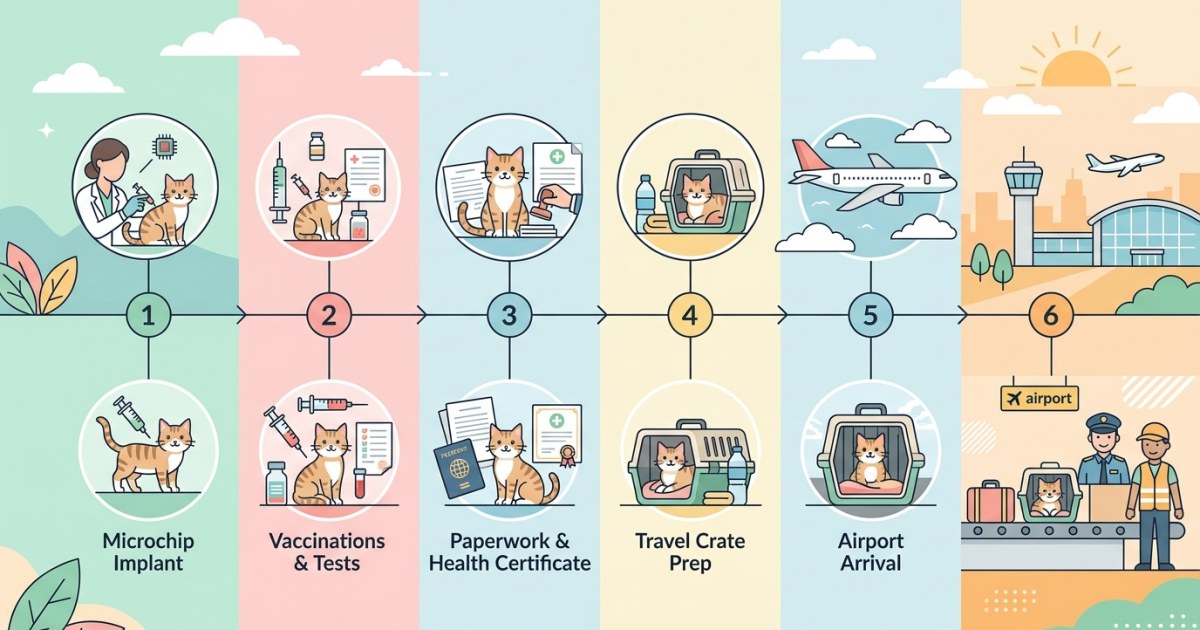
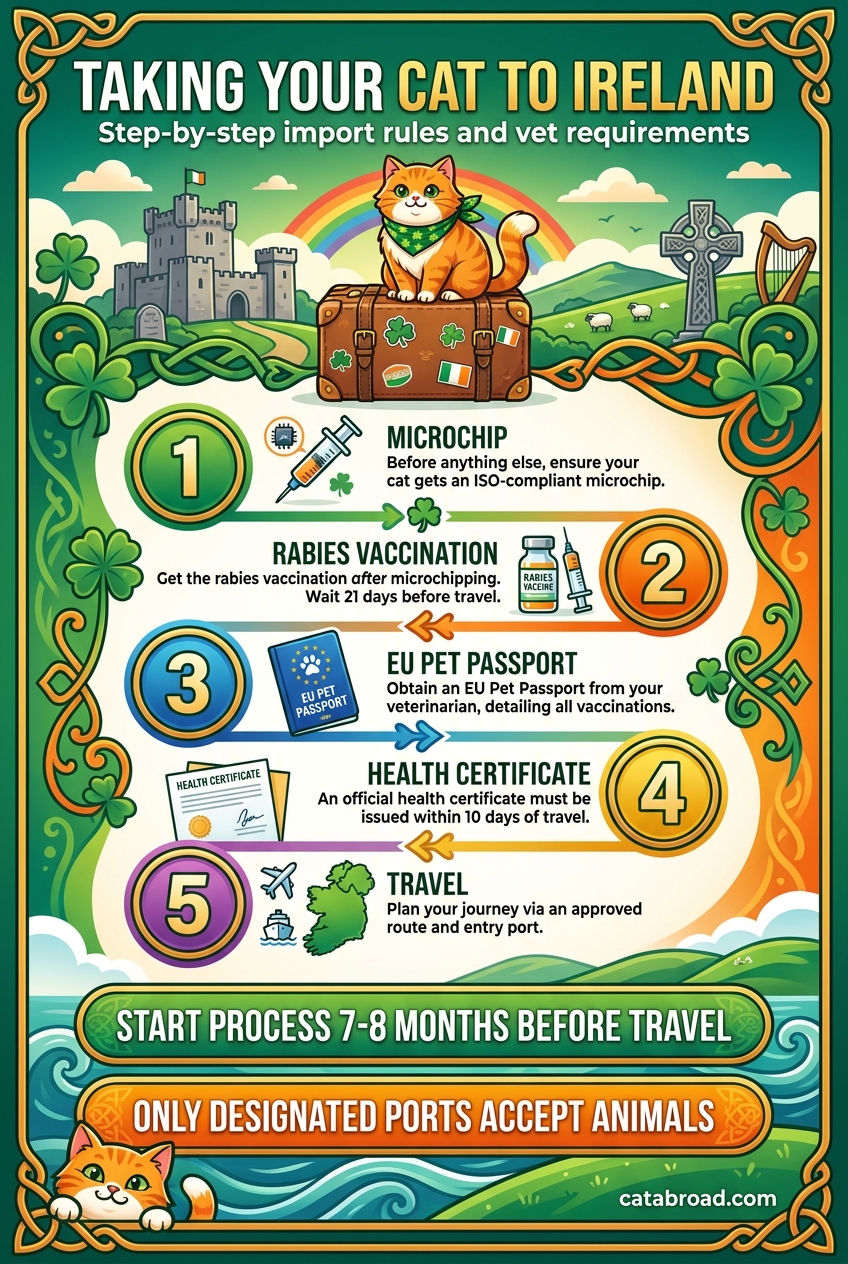
The process of moving to Ireland with a cat follows a strict chronological order. You cannot skip steps or do them simultaneously — each step unlocks the next. Begin this process at least 7–8 months before your intended travel date. Below is the complete sequence, using the same five-step framework illustrated in our Ireland cat import overview.
Step 1: Implant an ISO-Compliant Microchip
Your cat must be implanted with an ISO 11784/11785-compliant 15-digit FDXA/FDXB microchip by a registered vet. This microchip is the foundation of every other document — it links your cat's identity to their vaccinations, passport, and health certificate. The microchip must be implanted BEFORE the rabies vaccination is administered; if the chip is inserted afterwards, the entire vaccination sequence is legally invalid for Irish entry purposes and you must restart. Microchipping typically costs €20–€50 (approximately $22–$54) at a vet clinic in Ireland, or a similar amount in your country of origin. The chip number must be recorded on every subsequent document.
Pro Tip
Ask your vet to scan the microchip immediately after implantation and record the number on your own phone too. Chip migration is rare but real — having the number independently recorded means a scanner miss at the border will not hold your cat.
Step 2: Administer the Rabies Vaccination
After microchipping, your vet must administer an approved rabies vaccination. Ireland accepts any inactivated (killed-virus) rabies vaccine licensed in the country of administration, provided it meets EU standards — common brands include Nobivac Rabies, Rabisin, and Purevax Rabies. Your cat must be at least 12 weeks old on the date of vaccination. After a primary (first-ever) rabies vaccination, you must wait a minimum of 21 days before the cat can enter Ireland. This 21-day clock starts the day after the injection, not the day of. If your cat has a documented, in-date booster vaccination with no gap in coverage, the 21-day wait does not apply again.
Step 3: Obtain an EU Pet Passport
An EU Pet Passport is the primary travel document for cats moving within or into the EU. It is issued by an Official Vet (OV) or authorised vet in EU member states, or by an authorised vet in countries on the EU's approved third-country list. The passport is a standardised booklet (dark blue with the EU crest) that records your cat's microchip number, owner details, rabies vaccination dates and batch numbers, and any other relevant treatments. If you are travelling from a non-EU, non-listed country (such as the United States, Canada, or Australia), your cat cannot hold an EU Pet Passport — instead, they will require a Third Country Health Certificate (see Step 4). The EU Pet Passport costs €20–€40 ($22–$43) from an authorised vet.
Good News
If you are relocating from another EU country — including France, Germany, Spain, or any of the 27 member states — your cat's existing EU Pet Passport is fully valid for entry into Ireland. You do not need any additional import permits, and there is no quarantine. This makes Ireland one of the easiest intra-EU moves for cat owners.
Step 4: Obtain an Official Health Certificate
Cats entering Ireland from non-EU listed countries (including the UK, USA, Canada, and Australia) require an official health certificate issued by a government-authorised vet (in the USA: a USDA-accredited vet with USDA APHIS endorsement; in the UK: an Official Veterinarian issuing an AHC — Animal Health Certificate). This certificate must be issued within 10 days of travel. It certifies that the cat is healthy, correctly microchipped, and up to date on rabies vaccination. For US-origin cats, the relevant form is the USDA APHIS Form 7001 or the EU-format Annex IV health certificate for cats, which must be endorsed by USDA APHIS at a cost of $38 per endorsement. UK-origin cats require the DOCOM (Defra Official Vet) Animal Health Certificate, which replaced the EU Pet Passport post-Brexit.
Step 5: Book Travel via an Approved Route and Entry Port
Ireland only accepts cats at designated Border Inspection Posts (BIPs) or Points of Entry. You must pre-notify the relevant BIP of your arrival at least 24 hours in advance (non-commercial pet movements) or 1 working day ahead for commercial imports. Pre-notification is submitted via the TRACES NT (Trade Control and Expert System New Technology) platform at traces.ec.europa.eu. At the port of entry, an authorised officer from the DAFM will inspect your cat's documents and microchip. If everything is in order, your cat will be cleared within minutes. See the Approved Entry Points section below for the full list of designated ports.
Step 6: Pre-Notify the DAFM Before Arrival
For cats arriving from non-EU listed countries, you must submit a pre-notification via TRACES NT at least 1 working day before arrival. For cats travelling from EU member states or UK (which is a listed country for pet travel), notification is required at least 24 hours in advance. Failure to pre-notify is one of the most common reasons cats are held at the border. The DAFM's Animal Health and Welfare Division can be reached at 01 607 2379 or via the online notification portal at gov.ie/en/service/pet-travel. There is no fee for pre-notification itself.
Pro Tip
Start the TRACES NT registration process at least 2 weeks before you need to submit your first notification. The system requires identity verification and can take 3–5 business days to activate a new account. Your vet or pet relocation agent can submit the TRACES notification on your behalf if you authorise them.
Microchip & Vaccination Requirements for Ireland Cat Import
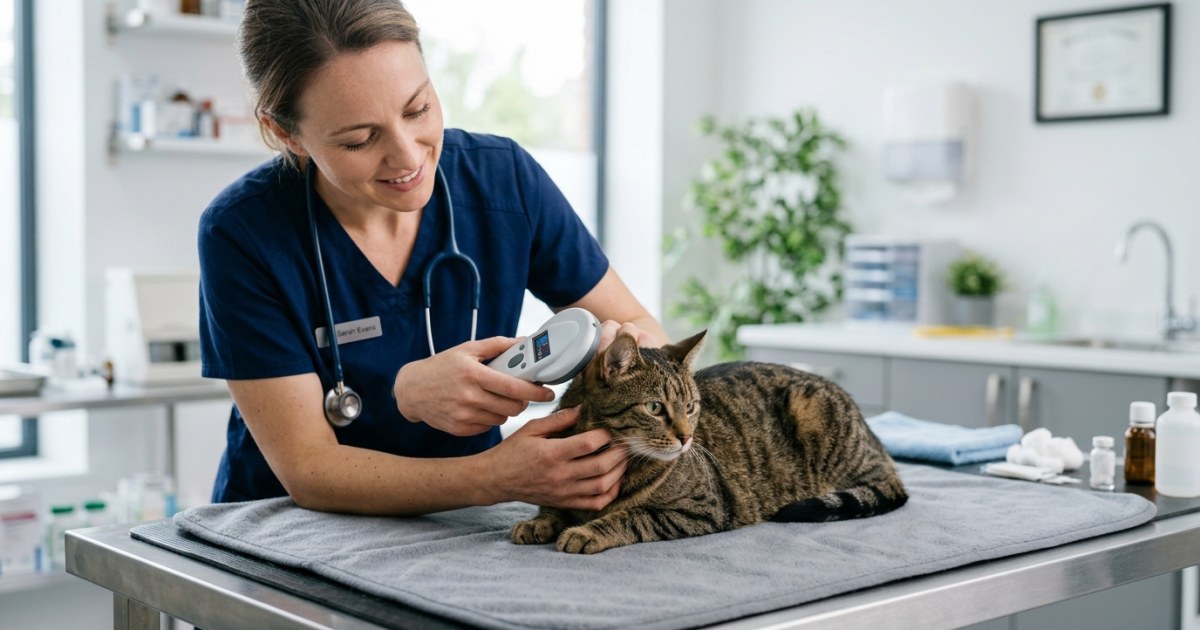
The microchip and rabies vaccination requirements are the backbone of the entire Ireland cat import process. Getting either of these wrong invalidates all downstream documents and forces you to restart the clock — potentially adding months to your timeline.
Microchip Standards
Ireland requires an ISO 11784/11785-compliant 15-digit microchip (also called FDX-B). The chip must operate at 134.2 kHz. Older 9- or 10-digit chips (commonly used in North America before 2005) are not accepted. If your cat has a non-compliant chip, you can have a second ISO-compliant chip implanted alongside the old one — this is legally acceptable, provided the EU Pet Passport or health certificate records both chip numbers and specifies which one is the ISO-compliant chip. The microchip must be implanted by a vet and recorded in all travel documentation; this is verified by scanning at the port of entry.
Rabies Vaccination Rules
The rabies vaccination must be an inactivated (killed) or recombinant vaccine authorised in the country of administration. The vaccine must be given after the microchip is implanted (if the chip number cannot be verified at the time of vaccination, the vaccine is not legally valid for Irish entry). For a primary course, your cat must be at least 12 weeks old, and you must wait 21 days after vaccination before travelling. For booster vaccinations, travel can occur immediately after the booster — provided there is no lapse in protection (i.e., the booster was given before the previous vaccine's expiry date). Ireland follows EU Regulation 576/2013, which governs non-commercial movement of pet animals.
Good to Know
Ireland does NOT require a rabies titre test (blood test measuring antibody levels) for cats arriving from EU member states or UK. However, cats travelling from countries not on the EU's approved third-country list — such as some parts of Asia, Africa, or the Middle East — may require a rabies antibody titre test (RNATT) showing a result of at least 0.5 IU/ml, carried out at an EU-approved laboratory, at least 30 days after vaccination and 3 months before travel. Always verify your country's status on the EU TRACES system before making travel arrangements.
Tapeworm Treatment — Not Required for Cats
Unlike dogs entering Ireland, cats are not required to have tapeworm (Echinococcus) treatment before arrival. This is a common point of confusion for owners with multiple pets — the tapeworm rule applies only to dogs and is not applicable to feline imports. No other routine parasite treatments are legally mandated for cat entry, though your vet may recommend flea and tick prevention as good practice before travel.
Good News
Cats travelling from the UK after Brexit are not required to have a rabies titre test, provided they have a valid UK-issued Animal Health Certificate (AHC) with up-to-date rabies vaccination records. The UK remains on Ireland's approved list of countries for pet travel, so the process is streamlined compared to truly third-country origins.
Import Permit & Health Certificate for Bringing a Cat to Ireland
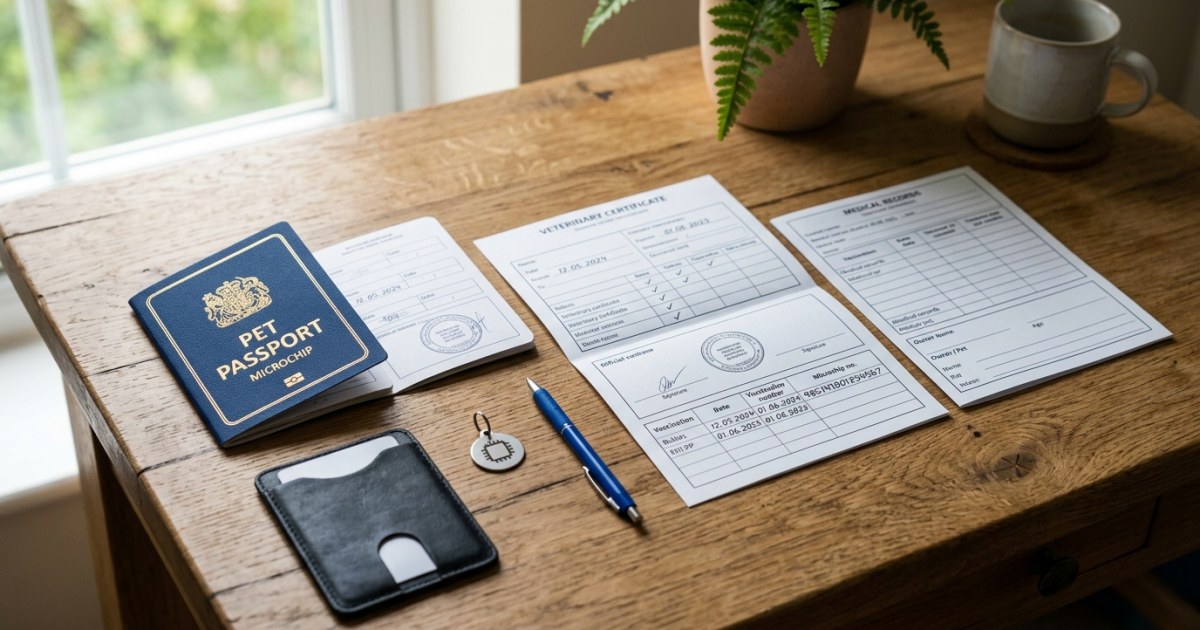
Understanding the difference between an EU Pet Passport and an official health certificate — and knowing which one applies to your cat — is essential for a successful bring-cat-to-Ireland journey. The requirements differ significantly depending on where you are travelling from.
EU Pet Passport (EU/EEA Origin)
If your cat is already resident in an EU member state or EEA country (Norway, Iceland, Liechtenstein), they should hold an EU Pet Passport issued by an authorised vet in that country. This blue booklet serves as both your import document and vaccination record. No separate import permit is required. The passport is valid for the lifetime of the animal, though individual vaccinations within it have their own expiry dates. The cost of issuance is €20–€40 ($22–$43) and is typically done at your regular vet clinic.
Animal Health Certificate — UK Origin
Since Brexit took effect on 1 January 2021, EU Pet Passports can no longer be issued in Great Britain (England, Scotland, Wales). Cats travelling from Great Britain to Ireland require an Animal Health Certificate (AHC), officially known as the GB-to-EU-NI Health Certificate. This must be issued by an Official Veterinarian (OV) in Great Britain no more than 10 days before travel. The AHC is a single-use document valid for one journey only. The OV must be registered with the Animal and Plant Health Agency (APHA). The certificate costs between £100–£220 ($125–$275) including the vet's time. Note: cats already holding an EU Pet Passport issued before Brexit (in any EU country, not GB) may still use that passport.
Pro Tip
Book your OV appointment in the UK at least 3–4 weeks before travel. Official Veterinarians are in high demand since Brexit, and a 10-day window for AHC issuance leaves little room for rescheduling. The APHA maintains a searchable list of OVs at apha.gov.uk.
USDA-Endorsed Health Certificate — USA Origin
For cats travelling from the United States, you need a health certificate in the EU's Annex IV format, completed by a USDA-accredited vet and endorsed by a USDA APHIS Veterinary Services (VS) office. The endorsement costs $38 per certificate and processing takes 1–5 business days (expedited service available at some offices for $95). The certificate must be issued within 10 days of travel. USDA APHIS maintains a list of accredited vets and endorsement offices at aphis.usda.gov. Once endorsed, the certificate is the equivalent of an EU health certificate for Irish entry purposes.
Is a Formal Import Permit Required?
Ireland does not issue a separate named 'import permit' for non-commercial cat imports (i.e., a pet cat travelling with its owner). The combination of a valid EU Pet Passport or endorsed health certificate, correct microchip, up-to-date rabies vaccination, and pre-notification via TRACES NT constitutes the complete entry requirement. Commercial imports (more than 5 animals, or cats being sold or transferred) have additional requirements under EU Regulation 576/2013 Article 13 and must be pre-authorised by the DAFM. For queries about commercial imports, contact the DAFM's Import Controls Division at importcontrols@agriculture.gov.ie.
Warning
The 10-day rule for health certificates is absolute. A certificate dated 11 days before your arrival date will be rejected at the border. If your travel plans change and you miss the window, you will need a new certificate — which means another vet appointment, possible re-examination, and additional cost. Never book a health certificate appointment more than 8 days before travel to give yourself a 2-day buffer.
Cat Quarantine Ireland: What the Rules Actually Say
The question of cat quarantine Ireland comes up constantly in expat forums, and the answer is nuanced: there is no mandatory quarantine for cats that arrive with complete, compliant documentation. However, non-compliance leads to outcomes that are effectively quarantine or worse.
No Quarantine for Compliant Cats
Under EU Regulation 576/2013, which Ireland implements as an EU member state, cats arriving from EU countries or approved listed third countries with a valid EU Pet Passport or endorsed health certificate, correct ISO microchip, and up-to-date rabies vaccination are admitted without any quarantine period. The border inspection takes minutes — an authorised officer scans the microchip, checks the documentation, and if everything matches, the cat is cleared to enter Ireland immediately. This applies at all designated Border Inspection Posts and approved entry points.
What Happens if Documentation is Incomplete
If your cat arrives with incomplete or non-compliant documentation, the DAFM has four options under the Rabies Order 1971 and EU law: (1) hold the cat at the port of entry in a licensed holding facility while documentation is verified or corrected — costs are borne entirely by the owner and run approximately €50–€120 ($54–$130) per day; (2) re-export the cat back to the country of origin at the owner's expense; (3) place the cat in isolation quarantine for a period determined by the DAFM inspector, typically 30–180 days depending on the nature of the non-compliance; or (4) in extreme cases (e.g., a cat from a high-risk rabies country with no vaccination records), euthanasia is legally permitted under the Diseases of Animals Act 1966, though this outcome is extremely rare in practice.
Warning
Quarantine holding facilities in Ireland are licensed by the DAFM but run commercially. As of 2026, daily holding fees at Dublin Airport's Animal Reception Centre range from €65–€120 ($70–$130) per day. A 30-day isolation for a documentation failure can cost you €1,950–€3,600 ($2,100–$3,900) in boarding alone, before vet checks and re-documentation are added. This is always avoidable with correct preparation — see our full Ireland cat import overview for a pre-travel checklist.
Cats from Unlisted Third Countries
Cats originating from countries not on the EU's approved third-country list face the most stringent requirements. In addition to the standard microchip, rabies vaccination, and health certificate, these cats must have a rabies neutralising antibody titre test (RNATT) result of at least 0.5 IU/ml, conducted by an EU-approved laboratory at least 30 days after vaccination and no more than 12 months before travel, followed by a 3-month wait period after the successful titre test result before the cat can enter Ireland. This means the minimum timeline from a first vaccine for a cat from an unlisted country is approximately 4 months (30 days post-vaccine + titre test wait + 3-month wait), and typically 6–8 months when combined with microchipping lead time and health certificate logistics.
Good to Know
The EU's list of approved third countries for pet travel (Part 1 and Part 2 of the list under Decision 2004/595/EC as updated) includes the USA, Canada, Australia, New Zealand, UK, Switzerland, Japan, and approximately 50 others. Cats from Part 1 listed countries do not need the titre test. Cats from Part 2 countries and unlisted countries do. Check the current list at ec.europa.eu/food/animals/pet-movement before making any plans.
Approved Entry Points for Ireland Pet Import
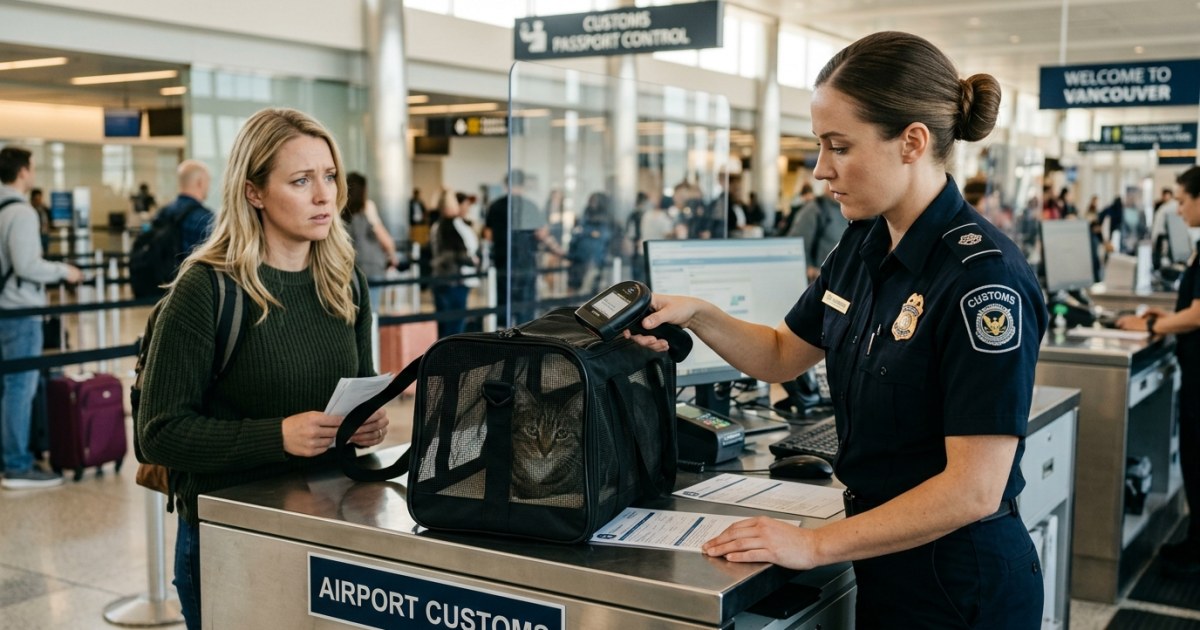
This is one of the most critical — and most overlooked — aspects of the Ireland pet import process. You cannot arrive at just any port or airport. Ireland designates specific Border Inspection Posts (BIPs) and approved Points of Entry for animal imports, and arriving at a non-designated location will result in your cat being refused entry, regardless of how perfect your documentation is.
Designated Entry Points as of 2026
The following are Ireland's approved entry points for cats travelling as non-commercial pets:
- Dublin Airport — Animal Reception Centre, Terminal 2 area. Contact: +353 1 814 5555. Advance notification required via TRACES NT at least 24 hours before arrival. Open 24 hours for pre-notified arrivals.
- Dublin Port — For ferry arrivals. Contact: DAFM Dublin Port Office +353 1 607 2379. Used primarily for ferry crossings from Holyhead (Wales) and Liverpool.
- Rosslare Europort — For ferry arrivals from Fishguard (Wales), Pembroke (Wales), and Cherbourg/Roscoff (France). Contact: +353 53 915 7920.
- Shannon Airport — Limited capacity; must confirm availability with DAFM at least 48 hours in advance. Contact: DAFM Midwest Regional Office +353 61 336 111.
- Cork Airport — Accepted but must pre-arrange with DAFM at least 48 hours ahead. Contact: DAFM Southern Regional Office +353 21 480 0250.
Warning
Ireland City Airport (Belfast), which is in Northern Ireland (part of the UK), is not an approved entry point for cats being imported into the Republic of Ireland. Arriving at Belfast and then driving south across the border does not constitute a valid entry route — your cat must physically pass through an approved Irish BIP. Similarly, Knock (Ireland West Airport) is not currently a designated pet BIP as of 2026.
Ferry vs. Air — Which is Better?
Many cat owners travelling from the UK prefer the ferry option (Irish Ferries or Stena Line from Holyhead or Pembroke to Dublin Port or Rosslare) because it allows cats to travel in a carrier in the car rather than in the aircraft hold. This is less stressful for most cats and avoids airline cargo fees, which can run €150–€400 ($160–$435) each way. The Holyhead–Dublin crossing takes 3 hours 15 minutes (fast ferry) or 3 hours 30 minutes (standard), while Pembroke–Rosslare takes 4 hours. Stena Line and Irish Ferries both accept pets on board, though cats must remain in the vehicle or in designated pet kennels on the car deck — they are not permitted in passenger cabins on most crossings.
Pro Tip
If flying long-haul (from USA, Canada, or Australia), Dublin Airport is by far the best-resourced entry point. The Animal Reception Centre at Dublin is staffed by experienced DAFM officers who handle international pet arrivals daily. Book your flight to arrive during business hours (08:00–17:00 local time) if possible — while inspections can technically happen 24/7 for pre-notified arrivals, morning arrivals tend to have faster clearance times.
Cost Breakdown: What It Costs to Move a Cat to Ireland
Budgeting correctly for your Ireland cat import avoids nasty surprises. Below is a comprehensive breakdown of all costs you should plan for, ranging from the minimum DIY cost if you are already in an EU country, to the full-service professional relocation cost for a cat travelling from the USA or Australia.
Cost Breakdown
| Item | Cost (EUR / local) | Cost (USD) |
|---|---|---|
| ISO microchip implantation | €20–€50 | $22–$54 |
| Rabies vaccination (primary) | €30–€70 | $33–$76 |
| EU Pet Passport issuance | €20–€40 | $22–$43 |
| Health certificate (UK OV — AHC) | £100–£220 | $125–$275 |
| USDA APHIS endorsement (USA origin) | $38 standard / $95 expedited | $38–$95 |
| Rabies titre test (unlisted countries only) | €150–€300 | $163–$325 |
| IATA-approved travel carrier (one-off) | €40–€150 | $43–$163 |
| Airline cargo / excess baggage fee (in-cabin) | €50–€200 (EU); €200–€600 (long-haul) | $54–$650 |
| Ferry surcharge (UK–Ireland, Stena/Irish Ferries) | £20–£40 per crossing | $25–$50 |
| DAFM border inspection fee | €0 (no fee for non-commercial pets) | $0 |
| Professional pet relocation service (full service) | €1,100–€3,200 | $1,190–$3,465 |
| TOTAL (DIY, EU origin) | €110–€310 | $120–$336 |
| TOTAL (DIY, UK origin) | €250–€600 | $271–$650 |
| TOTAL (DIY, USA origin) | €400–€900 | $433–$975 |
Good to Know
The DAFM does not charge an inspection fee for non-commercial pet movements (i.e., one person travelling with their own cat as a pet companion). Commercial importers pay a sliding scale of BIP inspection fees starting at €55 per consignment. All costs above are based on 2026 pricing and are subject to change — always confirm with your vet and service provider before budgeting.
Document Checklist for Ireland Cat Import Requirements 2026

Print this checklist and go through it the day before travel — every single item must be present and correct before you leave for the port or airport. One missing or expired document is enough to prevent entry.
📋 Document Checklist — Ireland Cat Import 2026
- ☐ISO 15-digit microchip — Confirm chip number is readable by scanning 24 hours before travel. Record number on your phone separately.
- ☐Rabies vaccination certificate / EU Pet Passport entry — Confirm vaccination date, batch number, and expiry date. Primary vaccine: at least 21 days ago. Booster: within valid period, no lapse.
- ☐EU Pet Passport (if travelling from EU/EEA) — Ensure vet's authorisation stamp, owner details, and all vaccination records are complete and legible.
- ☐Animal Health Certificate / AHC (if travelling from UK) — Must be dated within 10 days of travel. Signed by an Official Veterinarian registered with APHA.
- ☐USDA APHIS-endorsed health certificate (if travelling from USA) — Endorsed within 10 days of travel. Endorsement stamp clearly visible on original document.
- ☐Rabies titre test result (if required — unlisted countries only) — Lab report from EU-approved laboratory showing ≥0.5 IU/ml. Test conducted at least 30 days after vaccination, at least 3 months before entry.
- ☐TRACES NT pre-notification confirmation — Screenshot or printout of submitted notification, confirmation number, and expected arrival port/time.
- ☐Owner ID / passport — Your own travel document matching the owner name on the pet passport or health certificate.
- ☐IATA-compliant travel carrier — Large enough for cat to stand, turn, and lie down. Securely latched. Water and absorbent bedding provided.
- ☐Copies of all documents — Keep one set of photocopies/digital photos separate from the originals (in different bag or cloud storage). Originals must be presented at inspection.
- ☐DAFM contact number saved — Dublin Airport Animal Reception Centre: +353 1 814 5555. Dublin Port DAFM: +353 1 607 2379.
Pro Tip
Create a dedicated folder (physical and digital) for all your cat's travel documents from day one of the process. Label each document clearly with the date and issuing vet or authority. At the border, being able to lay all documents out clearly and quickly signals to the inspector that you are a prepared, compliant traveller — and anecdotally, this results in faster clearance.
Choosing a Pet Relocation Company for Moving to Ireland with a Cat
Whether you are moving to Ireland from the EU, the UK, or further afield, the complexity of the documentation process leads many cat owners to consider using a professional pet relocation company. A good relocation agent can coordinate every step of the process — from booking your vet appointments and completing TRACES NT notifications to managing cargo bookings and meeting you at the airport. Here is how to choose wisely.
What to Look for in a Pet Relocation Company
The most important accreditation to look for is membership of the International Pet and Animal Transportation Association (IPATA) — a global network of licensed, vetted pet transport companies that adhere to IATA Live Animals Regulations. IPATA members operating in Ireland include companies with local expertise in DAFM requirements, TRACES NT filings, and BIP coordination. You should also confirm that any company you use is licensed by the DAFM as an animal movement agent, and that they provide you with a written breakdown of all services, timelines, and costs upfront.
DIY vs. Professional — When Does It Make Sense?
If you are moving from another EU country with a cat that already has a current EU Pet Passport, the process is straightforward enough to manage yourself — the cost savings of €800–€2,500 ($865–$2,700) over using a full-service company are significant. However, if you are relocating from the USA, Canada, Australia, or a country requiring a titre test, the documentation chains are complex enough that a single mistake can cost you weeks and hundreds of euros. In that scenario, the professional fee is typically worth it for the peace of mind alone. Our Ireland cat import overview includes a decision tree to help you assess which route is right for your situation.
Questions to Ask Any Pet Relocation Company
Common Mistakes to Avoid When Moving to Ireland with a Cat
The DAFM turns away or holds dozens of pets at Irish borders every year due to entirely avoidable documentation errors. These are the mistakes we see most frequently — and the ones that cause the most distress, delay, and expense.
Warning: Microchip Before Vaccine — Always
The single most common documentation failure for cats moving to Ireland from outside the EU is the vaccine being administered before the microchip, or on the same day without the chip number being verified first. If a vet records a rabies vaccination and the microchip number is written in afterwards, Irish border officials may deem the vaccination legally invalid — because there is no proof the vaccinated cat is the chipped cat. This error requires a full restart: a new primary vaccination, a new 21-day wait, and a new health certificate. Always confirm your vet will follow the strict chip-first sequence and will scan the chip in front of you before giving the injection.
Warning: Arriving at the Wrong Port
Booking a cheap flight into Cork or Knock without confirming pet inspection arrangements with the DAFM at least 48 hours before arrival is a serious risk. While Cork Airport is technically an approved entry point, it has limited capacity for animal inspections and is not staffed 24/7 for pet arrivals. Owners who have arrived without pre-arrangement have had their cats held overnight — at their own cost — while an authorised inspector was sourced. Always call the relevant DAFM regional office directly (not just submit via TRACES) to confirm your arrival is expected and that inspection capacity exists.
Warning: Letting the Rabies Vaccine Lapse
Rabies vaccines have specific validity periods — typically 1 year for the initial course and 1–3 years for boosters depending on the brand used. If your cat's rabies vaccine lapses even by a single day before your travel date, the vaccine record is treated as invalid and the 21-day waiting period after a new primary vaccination applies all over again. Set a calendar reminder 6 weeks before your cat's rabies booster is due — this gives you time to book a vet appointment and still travel on schedule. Do not assume your vet will automatically remind you.
Warning: Missing the 10-Day Health Certificate Window
Cats travelling from the UK or USA require a health certificate issued within 10 days of arrival in Ireland. Owners who book their vet appointment too early — or whose flights are delayed or rescheduled — can find their certificate has expired before they arrive. If your travel plans change and your certificate will be more than 10 days old on arrival, you must obtain a new one. This costs another £100–£220 ($125–$275) in the UK or $200–$350 for a USDA-accredited exam and endorsement in the USA. Build a 2-day buffer by booking the vet appointment no more than 8 days before your planned arrival date.
Warning: Forgetting to Pre-Notify via TRACES NT
TRACES NT pre-notification is not optional and is not the same as your airline or ferry booking. It is a separate, mandatory submission to the Irish competent authority that must be made at least 24 hours before arrival (for EU/UK origin cats) or 1 working day before arrival (for non-EU origin cats). Owners who skip this step are routinely held at the border while inspectors manually process the notification — a delay that can take 2–6 hours. Submit via traces.ec.europa.eu and save your confirmation number. If you use a relocation agent, confirm in writing that they have submitted the TRACES notification and provide you with the reference number.
Good News
Every single one of the above mistakes is completely avoidable with a clear timeline and the right professional support. Thousands of cats move to Ireland successfully every year. Use the step-by-step process in this guide, start 7–8 months ahead of your travel date, and consult our full Ireland cat import overview for country-specific worked examples and a month-by-month planning calendar.
At a Glance: Ireland Cat Import Requirements
Frequently Asked Questions
Do cats need to quarantine when moving to Ireland?
No, cats do not need to quarantine when moving to Ireland, provided all documentation is correct — a valid EU Pet Passport or official health certificate, ISO-compliant microchip implanted before rabies vaccination, and up-to-date rabies vaccination with the 21-day post-primary wait observed. If documentation is incomplete or incorrect at the border, the DAFM can impose isolation in a licensed holding facility at the owner's expense (€65–€120 / $70–$130 per day) or refuse entry entirely. Correct preparation eliminates this risk entirely.
How long does it take to bring a cat to Ireland from the USA?
The minimum timeline for bringing a cat to Ireland from the USA is 7–8 months from the date of microchipping and first rabies vaccination. This includes the 21-day post-vaccination wait, time to arrange USDA APHIS health certificate endorsement ($38–$95), and the health certificate must be issued within 10 days of arrival. If your cat requires a rabies titre test (for cats from unlisted third countries), the timeline extends to a minimum of 4 months for titre compliance alone, making the full process 8–10 months.
Can I bring my cat to Ireland from the UK after Brexit?
Yes, you can bring a cat to Ireland from the UK after Brexit, but EU Pet Passports can no longer be issued in Great Britain (England, Scotland, Wales) — you need an Animal Health Certificate (AHC) issued by an Official Veterinarian (OV) registered with APHA. The AHC costs £100–£220 ($125–$275) and must be issued within 10 days of travel. The UK remains on Ireland's approved third-country list, so no rabies titre test is required, and there is no quarantine for compliant arrivals.
What is an EU Pet Passport and does my cat need one for Ireland?
An EU Pet Passport is a standardised blue booklet issued by an authorised vet in an EU/EEA member state that records your cat's microchip number, owner details, and vaccination history. Cats travelling from EU or EEA countries need one for entry into Ireland — no other import permit is required. Cats from non-EU countries (USA, UK, Australia, Canada) cannot hold an EU Pet Passport and instead require an official government-endorsed health certificate issued within 10 days of travel.
Which airports and ports can I use to bring a cat into Ireland?
The designated entry points for cats entering Ireland as of 2026 are: Dublin Airport (Animal Reception Centre, +353 1 814 5555), Dublin Port, Rosslare Europort, Shannon Airport, and Cork Airport. Shannon and Cork require 48-hour advance confirmation with the DAFM. All entries must be pre-notified via TRACES NT at least 24 hours (EU/UK) or 1 working day (non-EU) before arrival. Arriving at a non-designated port — including Belfast City Airport or Knock — is not a valid entry route into the Republic of Ireland.
How much does it cost to bring a cat to Ireland?
The total cost of bringing a cat to Ireland ranges from €110–€310 ($120–$336) for a DIY move from another EU country, to €400–€900 ($433–$975) for a DIY move from the USA including USDA endorsement and airline cargo fees. Using a professional pet relocation service such as a specialist pet transport company costs €1,100–€3,200 ($1,190–$3,465) for a full-service package. The DAFM charges no inspection fee for non-commercial pet arrivals. Hidden costs to budget for include an IATA-approved carrier (€40–€150 / $43–$163) and the health certificate vet appointment.
Does my cat need a rabies titre test to enter Ireland?
A rabies titre test (RNATT — Rabies Neutralising Antibody Titre Test) is not required for cats entering Ireland from EU member states, EEA countries, the UK, USA, Canada, Australia, New Zealand, or any other country on the EU's approved Part 1 third-country list. The titre test is required only for cats originating from countries not on this approved list. The test must show a result of at least 0.5 IU/ml, be conducted at an EU-approved laboratory at least 30 days after rabies vaccination, and at least 3 months must elapse after a successful titre result before the cat can enter Ireland.
Can I bring more than one cat to Ireland at the same time?
Yes, you can bring up to 5 cats per person into Ireland as non-commercial pets under EU Regulation 576/2013, provided each cat has its own compliant documentation — individual microchip, individual vaccination records, and individual EU Pet Passport or health certificate. Each cat must be listed on a separate TRACES NT pre-notification. If you are travelling with more than 5 cats, or if any of the cats are being sold or transferred, the movement is classified as commercial and requires additional authorisation from the DAFM's Import Controls Division at importcontrols@agriculture.gov.ie.
Related Country Guides
 United Kingdom
 France
 Germany
 Australia
 United States
📋 Official Requirements: View the full import rules and vet requirements for taking your cat to Ireland on CatAbroad.com.