
Moving to France with a cat is one of the more straightforward international pet relocations you can undertake, but only if you follow the EU's strict five-step import process in exactly the right order and start planning at least 7–8 months before your travel date. France welcomed more than 300,000 pets through official EU entry channels in 2024, and a single missed step — such as vaccinating before microchipping — can invalidate your cat's entire paperwork chain and result in a return flight at your expense. This guide walks you through every France cat import requirement for 2026: microchip standards, rabies vaccination windows, the EU Pet Passport, the official health certificate, approved ports of entry, a full cost breakdown, and the most common mistakes that trip up even experienced travellers. For a complete overview, see our full Fr cat import guide.
France — At a Glance
France — At a Glance
| Difficulty | Moderate (strict sequencing required; no quarantine if compliant) |
| Quarantine | None for compliant pets; non-compliant cats may face mandatory return or destruction |
| Microchip | ISO 11784/11785 compliant 15-digit FDXB chip — mandatory before rabies vaccination |
| Rabies Vaccine | Required; must be administered after microchip implantation |
| Rabies Titre Test | Required only for cats entering from non-listed (third) countries; 3-month wait after titre |
| Import Permit | No formal import permit; EU Pet Passport or official health certificate required |
| Health Certificate | EU-format health certificate (Annex IV / TRACES NT) issued within 10 days of travel |
| Typical Cost | €350–€900 / $375–$970 (excluding professional relocation fees) |
| Processing Time | 7–8 months minimum from first vet appointment to travel day |
| Governing Authority | Direction Générale de l'Alimentation (DGAL) / EU Regulation 576/2013 |
France is a full EU member state and applies EU Regulation 576/2013 on the non-commercial movement of pet animals. This means the rules are harmonised across the bloc, but France's own border agency — the Direction Générale de l'Alimentation (DGAL) — enforces compliance at designated ports of entry. For cats arriving from other EU member states or EU-listed countries (such as the UK post-Brexit, Australia, the USA, and Canada), the process is clean and predictable. For cats arriving from non-listed third countries, a rabies antibody titre test and a 3-month waiting period add considerable time. Check the current European Commission's listed countries page before you begin. For a broader overview of what to expect, visit our France cat import overview.
Good to Know
Since Brexit, the United Kingdom is classified as a "Part 1 listed" country by the EU, meaning UK cats travelling to France benefit from the same simplified process as EU cats — provided they hold a valid GB Pet Passport or an Animal Health Certificate (AHC) issued by an Official Veterinarian (OV) within 10 days of travel.
Step-by-Step: Moving to France with a Cat — The Full Process
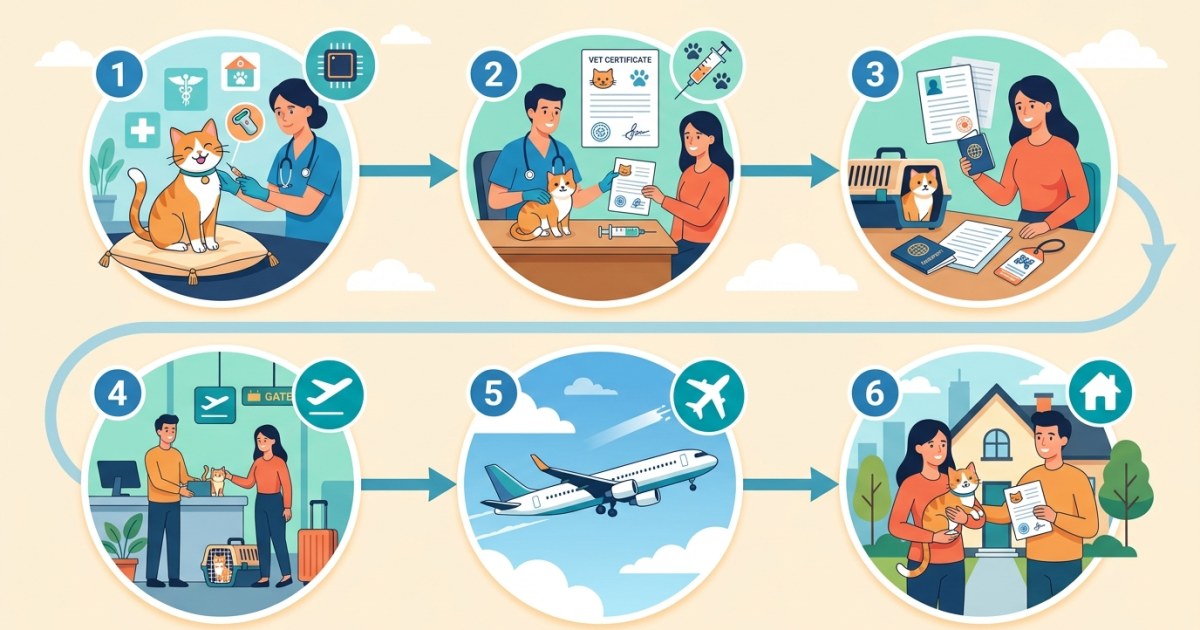
France cat import rules follow a strict chronological sequence. Performing any step out of order — especially vaccinating before microchipping — nullifies the entire process and forces you to restart. Below are the six mandatory steps with exact timings.
Step 1: Implant an ISO-Compliant Microchip
Your cat must be identified with an ISO 11784/11785 compliant 15-digit FDXB transponder before any other step takes place. This is non-negotiable under EU Regulation 576/2013 Article 17. Most UK, EU, and Australian vets implant ISO chips as standard; if you are travelling from the USA, verify with your vet — many American chips are 9- or 10-digit FDXA chips and will not be read by EU scanners. The chip must be implanted before the rabies vaccination is administered on the same day or earlier. Cost: €25–€60 / $27–$65.
Step 2: Administer a Rabies Vaccination
After (never before) the microchip has been successfully read by a scanner, an authorised vet must administer a WHO-approved rabies vaccination. Accepted vaccines in 2026 include Nobivac Rabies, Rabisin, Versiguard, and Purevax Rabies. The vaccination is only valid once 21 days have elapsed — meaning your cat cannot legally enter France until day 22 after the jab. Boosters must remain in date: if a booster is even one day overdue, the entire vaccination history is void and the 21-day waiting period restarts. Cost: €30–€75 / $32–$81.
Step 3: Obtain a Rabies Antibody Titre Test (Non-Listed Countries Only)
If your cat is travelling from a non-listed (unlisted third) country — such as Egypt, Morocco, Thailand, or Brazil — you must have a Fluorescent Antibody Virus Neutralisation (FAVN) titre test performed at an EU-approved laboratory at least 30 days after the primary rabies vaccination. The titre result must show ≥0.5 IU/mL. Once a satisfactory result is obtained, you must then wait a further 3 calendar months before your cat can legally enter France. The 3-month clock starts from the date the blood sample was taken, not the result date. EU-approved UK lab: APHA Weybridge. Cost: €150–€250 / $160–$270 (test only, excluding blood draw).
Pro Tip
If you are relocating from a non-listed country, always request your titre test results in writing with the EU-approved laboratory reference number. French border vets will scrutinise this document closely, and missing lab accreditation details are the single most common reason for rejection at the border.
Step 4: Obtain an EU Pet Passport or Official Health Certificate
Cats travelling within the EU use an EU Pet Passport, issued by an authorised vet in the country of origin. This blue booklet (model established by Commission Implementing Regulation (EU) 2019/159) contains your cat's microchip number, vaccination records, and vet details. Cats travelling from non-EU countries (including the UK, USA, Australia, and Canada) require an official health certificate — specifically the EU Annex IV health certificate (for cats from listed countries) — generated through the TRACES NT system and signed by an Official Veterinarian (OV) or USDA-accredited vet. This certificate is valid for 10 days from the date of the vet examination to the date of entry into France. For UK cats, the AHC is issued under the UK PETS Travel scheme by an OV listed on the RCVS register. Cost: €40–€80 / $43–$86.
Step 5: Book an Approved Carrier and Designated Entry Point
France only accepts cats at designated Border Inspection Posts (BIPs) or approved entry points for non-commercial pet movements. Not every airport or port handles animals. Confirm with your airline that it accepts cats in-cabin or as checked baggage on your specific route — many European carriers, including Air France, allow cats in-cabin up to 8 kg (cat + carrier combined) for €35–€65 each way. Book your carrier (IATA-compliant, minimum dimensions 46 × 28 × 24 cm for cabin travel) well in advance, as airline pet spaces are limited. Always notify the airline of your pet at the time of booking, not at check-in.
Step 6: Border Inspection on Arrival in France
On arrival, a DGAL-authorised border vet or customs officer will scan your cat's microchip, verify that its number matches the health certificate or EU Pet Passport, confirm the rabies vaccination is current and the 21-day window has elapsed, and — for non-listed country arrivals — check the titre test result and 3-month waiting period. Inspections are typically completed within 20–40 minutes. There is no inspection fee for non-commercial pet movements (i.e., personal relocation). If documentation is incomplete, the cat may be placed in temporary authorised kennels at the owner's expense (€40–€80 / $43–$86 per day) while paperwork is rectified, or returned to the country of departure.
Good News
France imposes no quarantine on cats that arrive fully compliant with EU Regulation 576/2013. A cat with a valid microchip, up-to-date rabies vaccination (and titre test if required), and a correct health certificate walks straight through the border inspection and goes home with you the same day.
Moving to France with a Cat: Microchip & Vaccination Requirements in Full
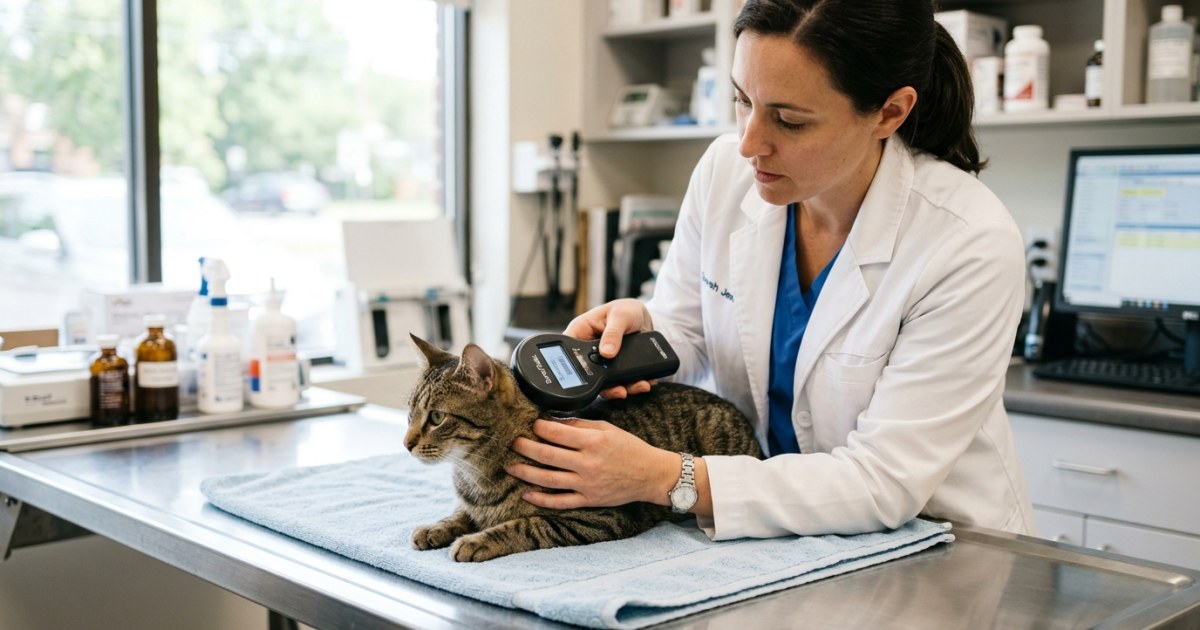
Microchip Standards
The EU mandates an ISO 11784/11785 FDXB (Full Duplex B) 15-digit transponder, operating at 134.2 kHz. This chip must be readable by a standard EU ISO scanner. Chips that do not meet this standard — including the older FDXA (125 kHz) chips common in the USA before 2010 — will not be recognised at the French border, and your cat will be treated as unidentified. If your cat already has a non-ISO chip, you have two options: implant a second ISO-compliant chip (perfectly safe and widely done) or carry a compatible reader with you and declare the situation to the border vet in advance. The microchip number must match exactly across every document — one digit discrepancy is grounds for rejection.
Rabies Vaccination Rules
Under EU Regulation 576/2013 Annex III, the rabies vaccine must be:
- An inactivated or recombinant vaccine — live attenuated rabies vaccines are not accepted
- Administered by a licensed vet after the microchip has been scanned and confirmed
- Entered in the EU Pet Passport or health certificate with the batch number, manufacturer, and expiry date
- Current at the time of entry — if a booster was due on 1 June 2026 and you travel on 2 June 2026, your cat is non-compliant
Primary vaccination: valid 21 days after administration, then continuous until the manufacturer's stated expiry (typically 1–3 years). Booster given on or before expiry: continuous validity from booster date, no waiting period required.
Pro Tip
Book a vet appointment 8 months before your planned travel date — not 6. The extra 8 weeks gives you buffer time if your cat's microchip needs replacing, if a titre test is borderline, or if your vet is unavailable to issue the health certificate in the 10-day window before departure.
Tapeworm Treatment (Echinococcus)
Unlike dogs entering the UK or Finland, cats are not required to receive tapeworm treatment before entering France. This requirement applies exclusively to dogs. No deworming certificate is needed for cats, which simplifies the process considerably. For a complete breakdown of what France requires versus neighbouring EU countries, see our full France guide.
Good to Know
France permits a maximum of 5 pets per person on a non-commercial basis under EU Regulation 576/2013. If you are moving with more than 5 cats, or if any of your pets are intended for sale, rehoming, or transfer of ownership, the movement is classified as commercial and requires compliance with Council Directive 92/65/EEC, which involves additional TRACES documentation and potentially a pre-export health inspection.
Import Permit & Health Certificate for Moving to France with a Cat
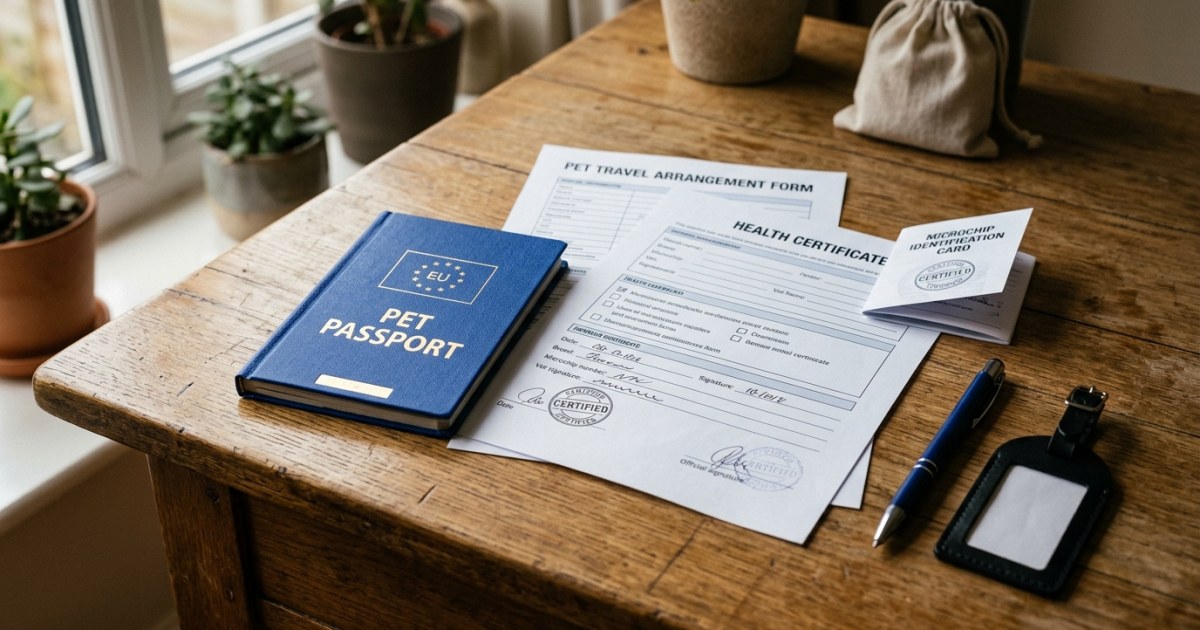
Do You Need an Import Permit?
France does not require a separate import permit for non-commercial movement of cats (i.e., personal relocation with up to 5 pets). The health certificate or EU Pet Passport serves as the controlling document. There is no application fee, no government import licence, and no pre-notification required to the Direction Générale de l'Alimentation (DGAL) for standard pet movements. However, if you are arriving at a Border Inspection Post that handles commercial imports, it is advisable to call ahead and confirm your arrival time so a border vet is available.
The EU Annex IV Health Certificate (Non-EU Travellers)
Cats arriving from outside the EU — including the UK, USA, Canada, Australia, and New Zealand — must travel with an official health certificate. The correct document depends on your origin country:
- UK cats: Animal Health Certificate (AHC), Form PETS BF01, issued by an RCVS-listed Official Veterinarian. Valid for 10 days from the date of clinical examination to entry into France, then 4 months for onward travel within the EU.
- US cats: EU Annex IV health certificate (model set out in Commission Implementing Regulation (EU) 2021/1938), issued by a USDA-accredited veterinarian and endorsed by the relevant USDA-APHIS State Veterinarian office. Valid for 10 days from issue to entry.
- Australian cats: Same Annex IV model, issued by an Australian Government-authorised vet and countersigned by the Australian Department of Agriculture, Fisheries and Forestry (DAFF). Valid for 10 days from issue.
All certificates must be generated or submitted via the TRACES NT (Trade Control and Expert System – New Technology) platform operated by the European Commission. Your Official Veterinarian will handle TRACES NT submission; you do not need a TRACES account yourself. The certificate must accompany the cat in physical printed form; digital copies are not accepted at the French border as of 2026.
Warning
The 10-day validity window on the health certificate is counted from the date of the clinical examination by the vet, not from when the certificate was printed or signed. If your flight is delayed and you miss the 10-day window, you will need a new examination and a new certificate. Build at least 3 days of buffer between your examination date and your planned travel date.
EU Pet Passport (EU Residents)
If you are already living within the EU and moving to France from another EU member state, your cat should already hold an EU Pet Passport. This booklet — available from any authorised vet in the EU for approximately €20–€50 / $22–$54 — replaces the health certificate for intra-EU travel. It has no expiry date itself, but the rabies vaccination records within it must remain current. If you have lost the passport, your vet can issue a replacement, but vaccination history cannot be transferred — your cat will require a new primary vaccination and the 21-day waiting period restarts.
Pro Tip
Once your cat is resident in France and registered with a French vet, ask them to issue a French EU Pet Passport. This makes future travel anywhere within the EU — including back to the UK on holiday — much simpler and avoids the need to obtain a new AHC each time.
Quarantine Rules for Moving to France with a Cat
France imposes no mandatory quarantine on cats arriving with fully compliant documentation under EU Regulation 576/2013. This is one of the major advantages of the EU's harmonised pet travel framework: a correctly prepared cat walks through the border inspection and goes straight home with its owner on arrival day.
What Happens if Your Cat Fails Inspection?
Non-compliant cats are not simply turned away at the door. Under EU Regulation 576/2013 Article 32, the competent authority (DGAL in France) has three options:
- Return the animal to its country of origin within a reasonable period at the owner's expense
- Isolate the animal in authorised kennels under official supervision at the owner's expense (€40–€80 / $43–$86 per day) while a remedy is sought
- Euthanise the animal as a last resort if neither return nor isolation is feasible
In practice, the third option is exceedingly rare and is reserved for animals with no return route and impossible-to-remedy paperwork failures. Most non-compliant arrivals result in temporary kennelling (typically 1–5 days) while documents are corrected or a return flight is arranged. The cost of emergency kennelling near Paris Charles de Gaulle (CDG) typically runs €50–€90 / $54–$97 per day.
Warning
Travel insurance policies for pets rarely cover the cost of mandatory border kennelling or return flights resulting from documentation failures. These costs — which can reach €500–€2,000 / $540–$2,150 depending on the situation — fall entirely on the owner. Double-check every document with your vet at least two weeks before departure.
Cats from Non-Listed Countries: The 3-Month Rule
For cats arriving from non-listed countries, the 3-month waiting period after a satisfactory rabies titre test result effectively acts as a de facto home quarantine in the country of origin. Your cat must remain in the country of origin for the full 3 calendar months before travelling to France. There is no shortened option, no appeal process, and no exemption — not even for cats that previously held a satisfactory titre result but allowed it to lapse. The DGAL is strict on this point.
Good News
Cats arriving from EU-listed countries — including the UK, USA, Canada, Mexico, Australia, and New Zealand — do not need a titre test and face no waiting period beyond the initial 21 days post-primary vaccination. The full list of listed countries is maintained by the European Commission at food.ec.europa.eu.
Approved Entry Points for France Cat Import
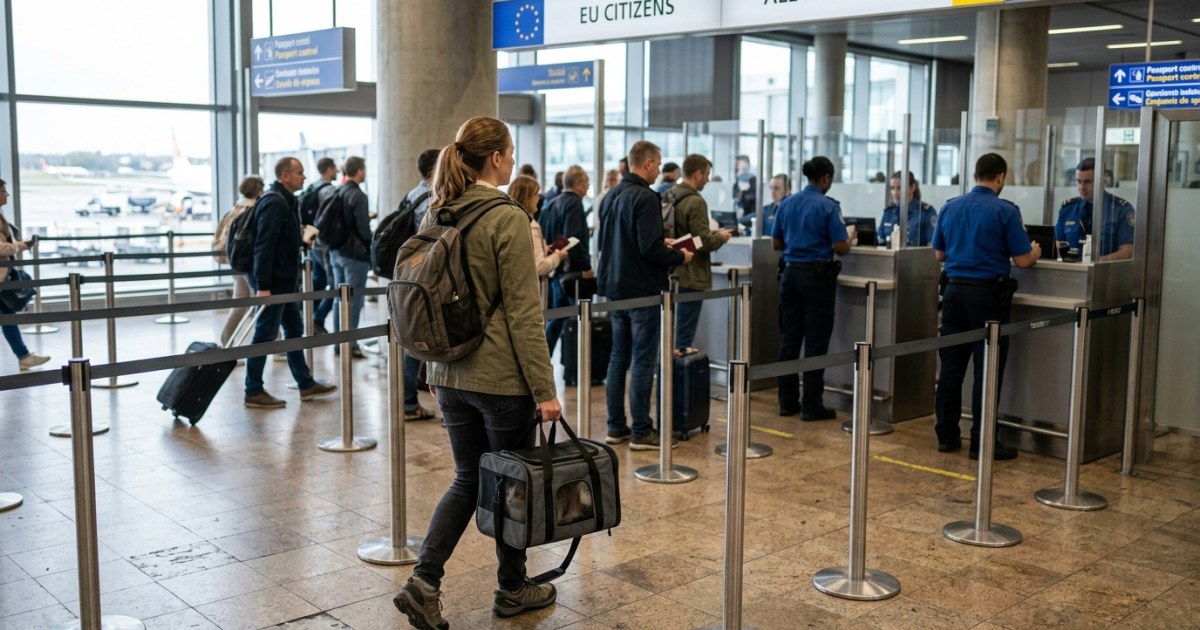
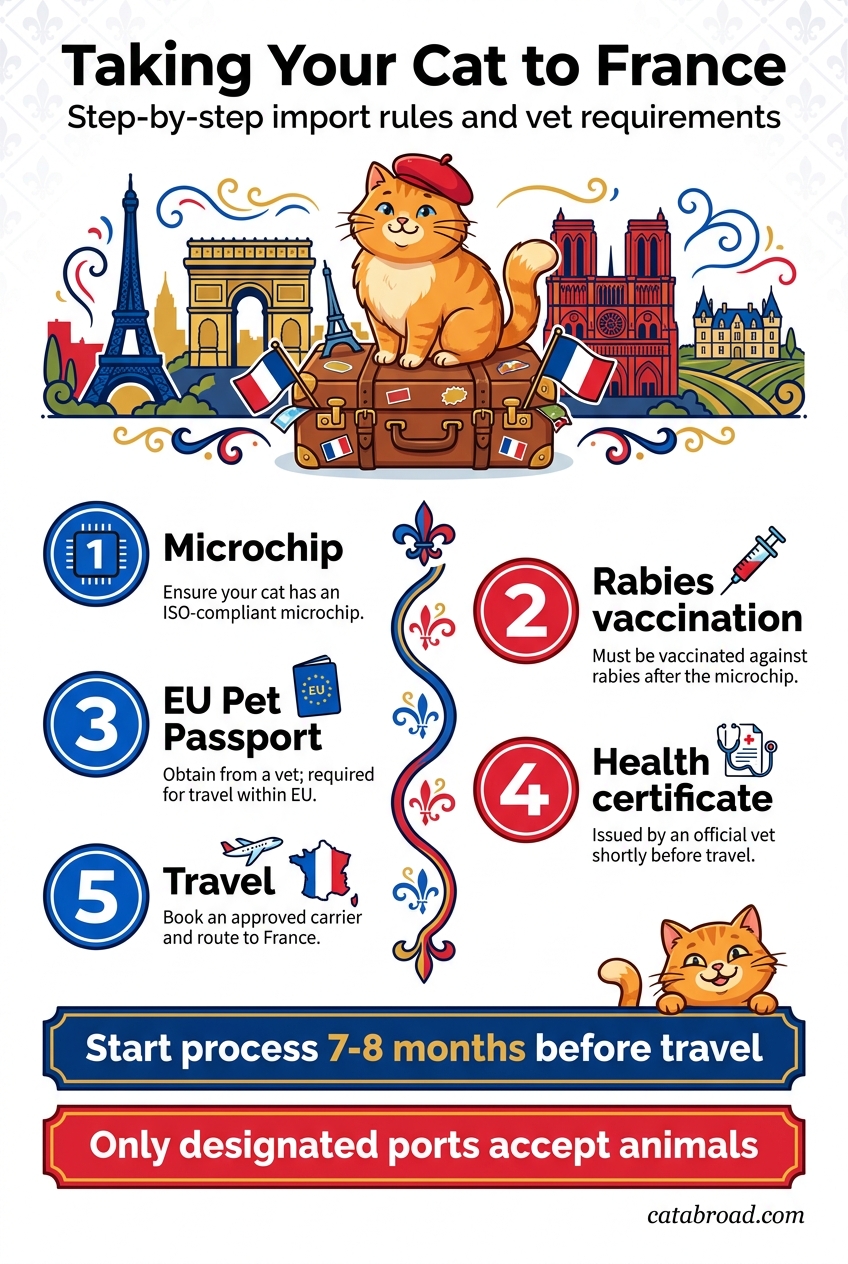
This is one of the most overlooked requirements when bringing a cat to France. As the infographic makes clear: only designated ports accept animals. Under EU law, pet animals entering from third countries (non-EU nations) must pass through an approved entry point where a competent official can carry out the document and identity check. Travelling through a non-designated port with a cat from outside the EU is illegal and will result in your cat being seized.
Major Approved Entry Points for Cats Entering France
The following are the primary approved non-commercial pet entry points into France as of 2026. Always verify the current list with the DGAL at agriculture.gouv.fr before travelling, as approved routes can change:
- Paris Charles de Gaulle Airport (CDG) — the most commonly used entry point for long-haul arrivals; border vet available during operating hours
- Paris Orly Airport (ORY) — handles select international routes
- Lyon Saint-Exupéry Airport (LYS)
- Marseille Provence Airport (MRS)
- Nice Côte d'Azur Airport (NCE)
- Bordeaux–Mérignac Airport (BOD)
- Calais (Port of Calais) — for arrivals via Eurotunnel Le Shuttle or ferry from Dover
- Dunkirk (Port of Dunkerque) — for ferry arrivals
- Caen-Ouistreham (Port de Caen) — for Brittany Ferries arrivals from Portsmouth
- Cherbourg (Port de Cherbourg) — for ferry arrivals from Poole/Rosslare
- Roscoff (Port de Roscoff) — for ferry arrivals from Plymouth/Cork
- Saint-Malo (Port de Saint-Malo) — for Condor Ferries/Brittany Ferries arrivals
Pro Tip
If you are taking the Eurotunnel Le Shuttle from Folkestone to Coquelles (near Calais), your pet check takes place at the Folkestone Pet Reception on the UK side before boarding — not in France. Arrive at Folkestone at least 90 minutes before your train departure to allow time for the document check. Pre-register your pet at least 48 hours in advance via the Eurotunnel website.
Cats travelling between EU member states (e.g., from Germany or Spain to France) do not need to pass through a designated Border Inspection Post — free movement of compliant pets within the Schengen/EU zone is permitted. The BIP requirement applies specifically to arrivals from non-EU countries.
Cost Breakdown for Bringing a Cat to France in 2026
The total cost of bringing a cat to France varies depending on your country of origin, your cat's existing vaccination status, and whether you use a professional pet relocation service. Below is a comprehensive breakdown of individual costs for a cat travelling from a listed country (e.g., UK or USA) without a titre test requirement. All EUR/USD figures use an exchange rate of approximately 1 EUR = 1.08 USD as of early 2026.
Cost Breakdown — France Cat Import 2026
| Item | Cost (EUR) | Cost (USD) |
|---|---|---|
| ISO microchip implantation | €25–€60 | $27–$65 |
| Rabies vaccination (primary) | €30–€75 | $32–$81 |
| EU Pet Passport (EU residents) | €20–€50 | $22–$54 |
| Official health certificate / AHC (non-EU) | €80–€180 | $86–$194 |
| USDA/DAFF endorsement of health certificate | €30–€90 | $32–$97 |
| Rabies titre test — FAVN (non-listed countries only) | €150–€250 | $162–$270 |
| IATA-approved travel carrier (cabin size) | €40–€120 | $43–$130 |
| Airline pet fee (cabin, one way) | €35–€65 | $38–$70 |
| Eurotunnel Le Shuttle pet fee (one way) | €20–€30 | $22–$32 |
| Pre-travel health check consultation | €40–€80 | $43–$86 |
| Professional pet relocation service (optional) | €600–€2,500 | $648–$2,700 |
| TOTAL (listed country, no titre test, DIY) | €270–€620 | $292–$669 |
| TOTAL (non-listed country, with titre test, DIY) | €420–€870 | $454–$940 |
Good to Know
USDA endorsement of health certificates is processed at USDA-APHIS Veterinary Export offices. Standard processing takes 3–5 business days; expedited processing (next-day turnaround) is available at select offices for an additional fee of approximately $38. Always allow at least 5 business days for US endorsements given the 10-day window on the health certificate itself.
Document Checklist for Moving to France with a Cat
Use this checklist to ensure you have every document ready before leaving for the airport or port. Carry originals of everything — do not rely on digital copies or photographs. For a printable version, see our France cat import overview.
📋 Document Checklist — France Cat Import 2026
IDENTITY & VACCINATION (All cats)
- ☐ISO 11784/11785 microchip implanted and scanned — 15-digit number matches all documents exactly
- ☐Rabies vaccination certificate: batch number, vaccine brand, expiry date, administering vet's details
- ☐Proof that vaccination was given after microchip implantation (same date or later — never before)
- ☐Confirmation that at least 21 days have elapsed since primary rabies vaccination
TRAVEL DOCUMENTATION
- ☐EU Pet Passport (EU residents travelling within the EU) — check vaccination boosters are in date
- ☐Official health certificate / Animal Health Certificate (AHC) — for non-EU residents; dated within 10 days of entry into France
- ☐USDA-APHIS or DAFF endorsement stamp on health certificate (US / Australian cats)
- ☐TRACES NT reference number (if applicable — your OV will provide this)
NON-LISTED COUNTRY EXTRAS
- ☐FAVN titre test result: ≥0.5 IU/mL, performed by EU-approved laboratory, blood drawn at least 30 days post-vaccination
- ☐Proof that 3 calendar months have elapsed since the blood sample date
- ☐EU-approved laboratory accreditation reference on the titre test result
TRAVEL LOGISTICS
- ☐IATA-approved carrier (minimum cabin dimensions: 46 × 28 × 24 cm; minimum hold dimensions: consult airline)
- ☐Airline pet booking confirmation (pet added to booking, not just verbal agreement)
- ☐Entry via a DGAL-approved designated port or BIP (confirmed in writing where possible)
- ☐Your own identification document (passport) to match the owner details on the health certificate
- ☐Emergency vet contact number in France (useful for first 48 hours post-arrival)
Choosing a Pet Relocation Company for Your France Cat Import

Given the tight timelines, precise sequencing, and document-specific requirements involved in moving to France with a cat, many owners — especially those relocating from outside the EU — opt to use a professional pet relocation company. A good relocation specialist will coordinate your entire process: scheduling vet appointments in the correct order, completing TRACES NT submissions, arranging IATA-compliant transport, booking approved entry routes, and meeting you at the port to ensure a smooth border inspection.
What to Look for in a Pet Relocation Specialist
- Membership of the International Pet and Animal Transportation Association (IPATA) — the global industry standard body
- Proven experience with France-specific documentation, including TRACES NT and DGAL requirements
- A named point of contact who you can reach by phone, not just email, in the days before travel
- Clear itemised pricing with no hidden government fees or airline surcharges
- References or reviews from clients who have successfully moved cats to France
Good to Know
IPATA member companies are contractually bound by a code of conduct that includes mandatory liability cover and adherence to IATA Live Animals Regulations. Always verify IPATA membership at ipata.org before engaging any pet transport service — non-member operators have caused significant distress to pet owners through negligence on documentation-heavy routes like France.
Common Mistakes to Avoid When Moving to France with a Cat
The France pet import requirements are not complicated in isolation, but they are unforgiving when steps are missed or performed out of order. Here are the most frequent — and most costly — errors that owners make when attempting to bring a cat to France.
Warning: Vaccinating Before Microchipping
This is the single most common and most catastrophic error. If a vet administers the rabies vaccine before implanting and scanning the microchip, the entire vaccination history is legally void under EU Regulation 576/2013. The 21-day waiting period resets from the date of a new valid vaccination (i.e., one given after a confirmed microchip). There is no waiver, no appeal, and no exception. Always confirm with your vet verbally — and in writing — that they will chip before they vaccinate.
Warning: Allowing the Rabies Vaccination to Lapse
A booster given even one day after its due date is treated as a new primary vaccination — meaning the 21-day wait restarts and the cat's entire continuous vaccination history is broken. Set a calendar reminder 60 days before each booster is due. If you are travelling with a cat whose booster is within 3 months of expiry, check with your vet whether administering an early booster before the trip is advisable. Most vaccines allow boosters up to 1 month early without voiding continuous validity.
Warning: Arriving at a Non-Designated Port
Not every airport and ferry port in France is an approved entry point for cats from non-EU countries. Arriving at an unapproved port — for example, flying into Toulouse-Blagnac (TLS) from the USA — means no DGAL-authorised border vet is present to complete the inspection, and your cat legally cannot be cleared for entry. Always confirm your exact departure airport, arrival airport, and route with your relocation specialist or directly with the DGAL before booking flights.
Warning: Health Certificate Outside the 10-Day Window
The official health certificate for cats arriving from non-EU countries is valid for exactly 10 days from the date of the clinical examination — not from when it was signed, printed, or submitted to TRACES NT. A flight delay, a rebooking, or even a slow endorsement process can push you outside this window. If your travel date shifts, you will need a brand-new examination and a new certificate. Build your travel timeline with a minimum of 3 days' buffer between the examination date and your planned entry into France.
Warning: Mismatched Microchip Numbers on Documents
A single digit error between the microchip number on the health certificate and the number read by the border scanner results in immediate identification failure. The cat is treated as unidentified. Border vets will attempt a re-scan, but if the chip is faulty, migrated, or simply transcribed incorrectly, the cat cannot be cleared. Check the 15-digit chip number on every document at every stage of preparation — EU Pet Passport, health certificate, vaccination record, and titre test result (if applicable).
Pro Tip
Do a full document review with your vet exactly 14 days before your travel date — not the day before. This gives you time to fix errors, request re-issued documents, and handle USDA endorsement delays without missing your flight. Our France cat import overview has a printable timeline you can use to track each milestone.
At a Glance: France Cat Import Requirements
Frequently Asked Questions
Do I need a pet passport to take my cat to France?
If you are travelling from within the EU, your cat needs an EU Pet Passport issued by an authorised vet in your country of origin. If you are travelling from a non-EU country such as the UK, USA, or Australia, you need an official EU Annex IV health certificate — not a pet passport — issued by an Official Veterinarian within 10 days of entering France. UK cats travelling on a post-Brexit GB Pet Passport still need a new Animal Health Certificate (AHC) for each trip to France, as GB passports are no longer valid for EU entry.
Is there cat quarantine in France?
No — France does not impose mandatory quarantine on cats that arrive fully compliant with EU Regulation 576/2013. A correctly microchipped, vaccinated, and documented cat passes through the border inspection and goes home with its owner the same day. The only de facto waiting period is the 3-month wait after a satisfactory rabies titre test result, which must be completed in the country of origin before travel, and applies only to cats from non-listed third countries.
How long does it take to prepare a cat for travel to France?
The minimum preparation time for cats from listed countries (UK, USA, Canada, Australia) is approximately 7–8 weeks if your cat has no existing microchip or rabies vaccination — 21 days for the post-vaccination wait plus time for the health certificate and travel booking. However, as the infographic advises, starting the process 7–8 months ahead gives essential buffer time for vet appointment availability, USDA endorsement delays, and airline pet space booking. Cats from non-listed countries require a minimum of 4–5 months due to the titre test and 3-month waiting period.
Can I bring my cat to France on the Eurostar or Eurotunnel?
Cats are not permitted on Eurostar passenger trains as of 2026. However, you can bring your cat on the Eurotunnel Le Shuttle (Folkestone to Coquelles/Calais), where pets travel with you in your vehicle. Pet inspection takes place at the Folkestone Pet Reception on the UK side before boarding — arrive 90 minutes early and pre-register your pet at least 48 hours in advance via the Eurotunnel website. The pet surcharge for the Le Shuttle is approximately €20–€30 / $22–$32 per crossing.
What microchip does my cat need for France?
France requires an ISO 11784/11785 compliant 15-digit FDXB (Full Duplex B) transponder operating at 134.2 kHz. This is the global standard chip used in the UK, EU, and Australia. US cats chipped before 2010 may have a 9- or 10-digit FDXA chip that will not be read by EU scanners — in this case, a second ISO-compliant chip can be implanted alongside the existing one. The microchip must be implanted and confirmed by scanner before the rabies vaccination is administered; vaccinating before microchipping voids the entire vaccination history under EU law.
How much does it cost to bring a cat to France from the UK?
Moving a cat from the UK to France typically costs £230–£520 / $290–$660 on a DIY basis, covering the Animal Health Certificate (£80–£160), rabies booster if due (£30–£75), IATA-compliant carrier (£40–£120), and ferry or Eurotunnel pet fee (£20–£30) or airline cabin pet fee (£35–£65). If you use a professional pet relocation service , expect an additional £550–£2,000 / $700–$2,540 for end-to-end management of paperwork, transport, and border logistics.
What happens if my cat's paperwork is wrong at the French border?
Under EU Regulation 576/2013 Article 32, French border authorities (DGAL) can return your cat to its country of origin at your expense, place it in authorised kennels at your expense (€40–€80 / $43–$86 per day) while the situation is resolved, or as a last resort, order euthanasia. In practice, most paperwork errors result in temporary kennelling lasting 1–5 days while documents are corrected or a return flight is arranged. Emergency kennelling near Paris Charles de Gaulle Airport typically costs €50–€90 / $54–$97 per day, and return airfare for the cat can add several hundred euros.
Related Country Guides
 Germany
 Spain
Spain Italy
Italy Netherlands
 Portugal
📋 Official Requirements: View the full import rules and vet requirements for taking your cat to France on CatAbroad.com.