Moving to Canada with a cat is one of the more straightforward international pet relocations available, but 'straightforward' does not mean paperless — Canada's Food Inspection Agency (CFIA) enforces a clear five-step compliance chain that, if broken at any point, can see your cat turned back at the border or held at your expense. Canada accepts cats from all countries without mandatory quarantine, provided your documentation is complete and correctly endorsed — a significant advantage over destinations such as Australia or New Zealand. This guide walks you through every CFIA requirement in force for 2026, from ISO-compliant microchipping through to government endorsement, with exact costs, real timelines, and the form numbers you'll hand to the border officer on arrival.
Canada — At a Glance
Canada — At a Glance
| Difficulty | Moderate (paperwork-intensive but no quarantine) |
| Quarantine | None — provided all documents are compliant |
| Microchip | ISO 11784/11785 compliant, 15-digit, implanted before rabies vaccination |
| Rabies Vaccine | Required — administered 30–365 days before entry |
| Import Permit | No formal import permit required for domestic cats |
| Health Certificate | Required — issued within 10 days of travel, government-endorsed |
| Governing Body | Canadian Food Inspection Agency (CFIA) |
| Typical Cost | CAD $450–$1,200 / USD $330–$880 (owner-managed); CAD $2,500–$5,000 / USD $1,840–$3,670 (full relocation service) |
| Processing Time | Start 7–8 months before travel date |
| Official Resource | inspection.canada.ca/pets |
Canada sits in a comfortable middle ground for international cat travel. The country imposes no mandatory quarantine on cats from any origin country, and unlike the European Union, it does not require a titre test or tapeworm treatment. The core compliance chain — microchip, rabies vaccination, health certificate, government endorsement — is well-documented by the CFIA and achievable by any prepared owner. That said, the government endorsement step catches many travellers off guard: it adds both time and cost to the process and cannot be skipped. See our Canada cat import overview for a high-level summary before diving into the step-by-step requirements below.
Pro Tip
The CFIA recommends starting the process 7–8 months before your travel date. This timeline accounts for the 30-day wait after rabies vaccination, the 10-day health certificate window, government endorsement processing (up to 10 business days), and airline/route confirmation. Starting late is the single most common reason cats miss their travel date.
Step-by-Step Import Requirements for Moving to Canada with a Cat
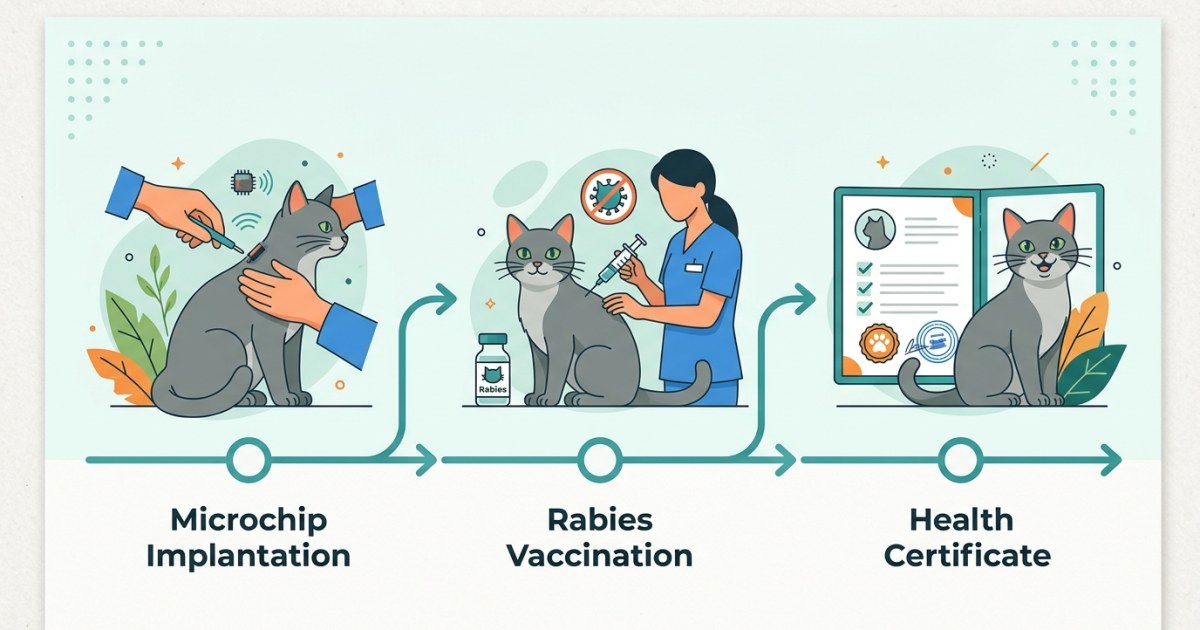
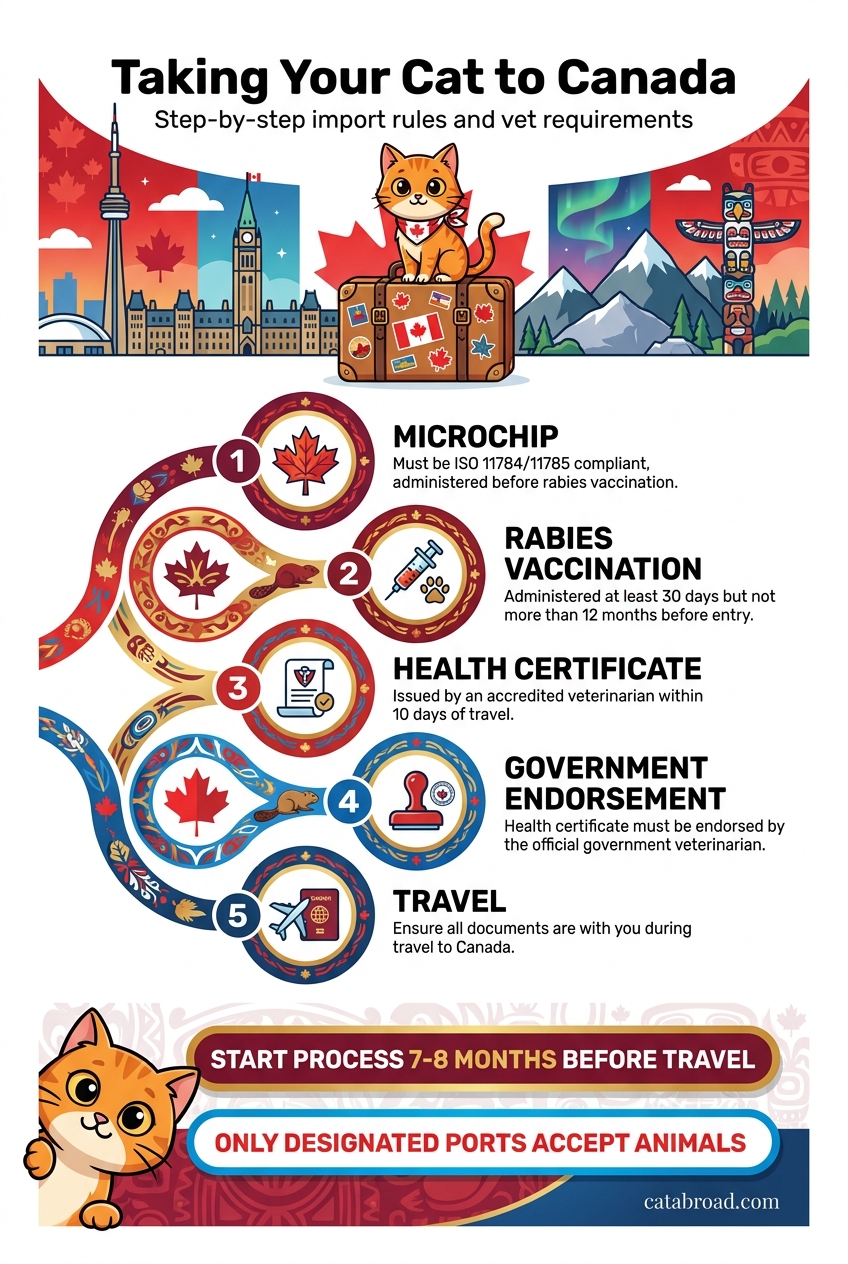
Moving to Canada with a cat follows a strict sequential process. Each step must be completed in the correct order — the microchip must precede the vaccination, and the vaccination must precede the health certificate. Jumping ahead, even by a single day, can invalidate your paperwork entirely. The five core steps below are derived directly from the CFIA's official import requirements published at inspection.canada.ca.
Step 1: Implant an ISO-Compliant Microchip
Your cat must be implanted with an ISO 11784/11785 compliant 15-digit microchip before any vaccinations are administered. This is non-negotiable: if the microchip is implanted after the rabies vaccination, the vaccination record cannot be linked to the chip and the entire vaccination must be repeated after re-chipping. The ISO standard covers all modern 15-digit chips sold in the UK, EU, Australia, and most of Asia. North American 9-digit (125 kHz) chips are not ISO 11784/11785 compliant — if your cat was previously chipped in the USA or Canada with a 9-digit chip, implant a compliant 15-digit chip alongside it and ensure the health certificate references the 15-digit number. Ask your vet to record the chip number in writing at the time of implantation. Cost: CAD $50–$80 (USD $37–$59).
Step 2: Administer the Rabies Vaccination
Once the microchip is confirmed functional (your vet should scan it immediately after implantation), your cat may receive a rabies vaccination. The vaccine must be administered at least 30 days before the date of entry into Canada, and it must remain valid on the day of entry — meaning it must not have expired. Most modern rabies vaccines are licensed for either 1 year or 3 years; confirm the expiry on the certificate. The vaccination cannot be more than 12 months old at the time of entry unless a 3-year vaccine was used and the certificate clearly states this. If your cat has a valid, in-date rabies vaccination already on record from a previous vet visit, confirm it was given after the ISO microchip implantation before assuming it is acceptable. Cost: CAD $40–$100 (USD $29–$73).
Step 3: Obtain a Health Certificate from an Accredited Vet
Within 10 days of your travel date, a licensed and accredited veterinarian must examine your cat and issue a health certificate confirming the animal is fit to travel, correctly microchipped, and fully vaccinated. In the United Kingdom, the issuing vet must be an Official Veterinarian (OV) — a vet who has completed the RCVS official veterinarian qualification and is registered with the Animal and Plant Health Agency (APHA). In the USA, the vet must be USDA-accredited. In other countries, the equivalent government-accredited vet category applies. The health certificate must include: the cat's full description (species, breed, age, sex, coat colour), the 15-digit microchip number, rabies vaccination details (vaccine name, batch number, date administered, expiry date), a declaration that the animal appears clinically healthy, and the vet's official stamp and signature. Cost: CAD $120–$300 (USD $88–$220), depending on the vet practice and country of origin.
Step 4: Obtain Government Endorsement of the Health Certificate
After the health certificate is issued by your accredited vet, it must be endorsed by the official government veterinary authority in your country of origin. In the UK, this is the Animal and Plant Health Agency (APHA) — you submit via the APHA's official portal or by post to the APHA centre in Carlisle. In the USA, this is the USDA-APHIS (Animal and Plant Health Inspection Service); endorsement is requested through your state veterinarian's office or directly via the USDA-APHIS endorsement offices. In Australia, the endorsing body is the Department of Agriculture, Fisheries and Forestry (DAFF). Processing times range from 1–10 business days depending on the country and submission method (in-person is fastest). Given the 10-day health certificate validity window, you must book your endorsement appointment before the vet appointment, not after. In the UK, APHA endorsement costs £31 (approximately USD $39) per certificate. In the USA, USDA-APHIS endorsement costs USD $38 per certificate. Allow 3–5 business days by post; same-day or next-day if attending an APHA office in person.
Step 5: Book a CFIA-Designated Entry Port
Not every Canadian airport or border crossing can accept live animal imports. Your cat must arrive at a port of entry that has a CFIA inspector on duty and is designated for animal imports. All major international airports — Toronto Pearson (YYZ), Vancouver International (YVR), Montréal-Trudeau (YUL), Calgary International (YYC), and Ottawa Macdonald–Cartier (YOW) — are designated ports. If you are driving from the USA, the Peace Arch crossing (Douglas, BC), the Ambassador Bridge (Windsor, ON), and the Niagara Falls Rainbow Bridge crossing (ON) all have CFIA capacity, but you must call ahead to confirm inspector availability. Arriving at a non-designated port — including many smaller regional airports — will result in your cat being held or returned. The CFIA maintains an up-to-date list of designated ports of entry at inspection.canada.ca.
Step 6: Present Documents at the Canadian Border
On arrival in Canada, declare your cat to the Canada Border Services Agency (CBSA) officer. You will be directed to a CFIA inspector who will verify: the microchip number (they will scan it), the rabies vaccination record, the endorsed health certificate, and your cat's physical description against the documentation. The inspection takes 15–30 minutes if documentation is complete. There is no inspection fee for cats entering Canada from most countries. If the CFIA inspector identifies a discrepancy — such as a microchip number that does not match the certificate — your cat may be held at a bonded facility at your expense (typically CAD $80–$150 per day, USD $59–$110) while the issue is investigated. Bring both originals and photocopies of every document.
Good News
Canada does not require a titre test (blood test measuring rabies antibody levels), a tapeworm treatment, or a mandatory quarantine period for cats from any country — including those considered high-risk for rabies. As long as your vaccination record is current and correctly endorsed, your cat walks off the plane with you on the same day.
Microchip & Vaccination Requirements for Canada Cat Import
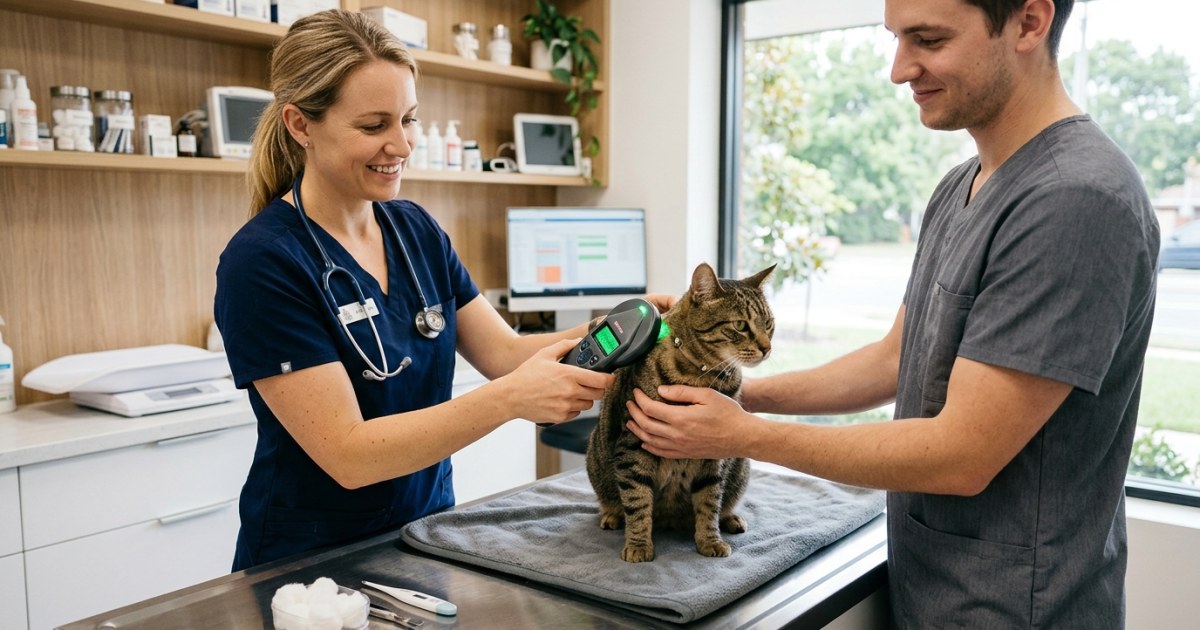
The microchip and rabies vaccination requirements sit at the heart of every successful Canada cat import. Get these two elements right and the rest of the process becomes significantly simpler. Get them wrong — particularly the sequencing — and you face repeating both procedures from scratch, adding 30 days to your timeline at a minimum.
Microchip Specifications
The CFIA requires microchips to comply with ISO standards 11784 and 11785. These standards define a 15-digit (64-bit FDX-B) chip that operates at 134.2 kHz. This is the same standard used by the European Union's pet passport system and by the UK's pet travel scheme. Chips sold under brand names including AVID Euro, Trovan, Datamars, and HomeAgain's ISO-compliant range all meet this standard. The older 125 kHz chips — still common in the USA and parts of Canada — do not comply, and CFIA border scanners may not read them. If you are relocating from the USA and your cat has a 9-digit chip, have a 15-digit chip implanted by a vet in the USA or shortly before your health certificate appointment; the health certificate must reference the 15-digit number exclusively.
Good to Know
ISO 11784/11785 chips have a 15-digit number that always begins with a 3-digit country code (e.g., 826 for the UK, 840 for the USA). If your cat's chip number is only 9 or 10 digits long, it is not ISO compliant and must be supplemented with a 15-digit chip before the health certificate is issued.
Rabies Vaccination Rules in Detail
Canada's rabies vaccination requirement for cats specifies a minimum waiting period of 30 days between vaccination and entry, and a maximum validity of 12 months (or 36 months if a licensed 3-year vaccine such as PUREVAX Feline Rabies 3 YR or Nobivac Rabies was used). The 30-day waiting period is firm: a cat vaccinated on 1 January cannot enter Canada before 31 January. There is no grace period for ferry or delayed flight arrivals. For cats receiving their first-ever rabies vaccination, the 30-day wait is mandatory regardless of any other circumstances. For boosters, provided the booster was administered before the previous vaccine's expiry date, Canada accepts continuous coverage with no waiting period — the cat must simply not have had a gap in coverage. Your vet must record the vaccine brand name, batch number, date of administration, and licence expiry date on all documentation.
Pro Tip
Book your cat's microchipping and rabies vaccination appointment at least 32–35 days before your intended health certificate appointment, not 30. This gives a buffer for appointment availability and ensures you are comfortably within the CFIA's 30-day minimum window when the vet examines your cat.
Kittens Under 3 Months
Kittens under 3 months of age cannot receive a rabies vaccination — most licensed rabies vaccines are not approved for use in animals under 12 weeks. Canada does not have a special exemption for very young kittens: if your kitten is too young to be vaccinated, it is too young to enter Canada as a compliant import from most countries. Plan your travel date around the kitten being at least 3–4 months old, allowing time for vaccination plus the 30-day wait. A kitten microchipped at 8 weeks, vaccinated at 12 weeks, and travelling at 17 weeks (30 days post-vaccination) is the earliest realistic timeline.
Import Permit & Health Certificate When You Bring a Cat to Canada
One of the most frequently asked questions about bringing a cat to Canada is whether an import permit is required. For domestic cats (Felis catus) entering Canada as personal pets, no formal import permit from the CFIA is required — this sets Canada apart from countries such as Singapore or Taiwan where a permit application must be submitted weeks in advance. However, the health certificate and government endorsement function as your cat's de facto entry document and must be treated with the same seriousness as a permit.
The Health Certificate: What It Must Include
The CFIA does not mandate a specific government-issued health certificate form for cats from most countries (unlike dogs from some high-risk rabies regions, which require a specific CFIA form). Instead, the certificate issued by your country's accredited vet must contain all of the following data fields to be accepted at the Canadian border:
- Owner's full name, address, and contact details
- Cat's species (Felis catus), breed, age, sex, and coat description
- 15-digit ISO microchip number and location of implantation (e.g., left side of neck)
- Rabies vaccination: vaccine brand, manufacturer, batch number, date administered, expiry date
- Statement that the cat appears clinically healthy and free of signs of infectious disease
- Country of origin and intended destination in Canada
- Date of examination (must be within 10 calendar days of the date of departure)
- Accredited vet's name, licence number, official stamp, and wet signature
Some countries — notably the USA — have their own USDA-endorsed Veterinary Health Certificate forms that are accepted as-is by Canada. UK vets issuing health certificates for Canada travel typically use the APHA export health certificate template for companion animals to non-EU countries (EHC template number AHC/EHC 1). Confirm the correct template with your OV and with APHA before your appointment.
Good to Know
The 10-day health certificate window counts from the date of the vet examination, not from the date of government endorsement or the date you receive the paperwork back. If your vet examines your cat on a Monday, your departure must occur no later than the following Wednesday (10 calendar days later, inclusive of the examination day).
Government Endorsement: The Step Most People Underestimate
After your accredited vet issues the health certificate, it must be endorsed (officially stamped and counter-signed) by the government veterinary authority of your country. This is not optional — a health certificate that carries only the vet's signature and stamp, without government endorsement, will be rejected at the Canadian border. In the UK, endorsement is provided by the Animal and Plant Health Agency (APHA). The APHA's endorsement service for export health certificates currently costs £31 per certificate (approximately USD $39). You can submit in person at APHA's Carlisle office for same-day or next-day processing, or post documents for processing within 5–10 working days. Given that your health certificate is only valid for 10 days, you must book your APHA appointment for the same day as or the day immediately after the vet examination — there is no margin for delays. In the USA, USDA-APHIS endorses health certificates; fees are USD $38 per certificate and turnaround is typically 1–5 business days (same-day at some APHIS offices if you attend in person). For further country-specific endorsement processes, consult our .
Warning
The government endorsement step can take up to 10 business days by post. If you book your vet appointment first and then try to arrange endorsement, you will almost certainly exceed the 10-day validity window of the health certificate. Always secure your government endorsement appointment before finalising your vet appointment date.
Cat Quarantine Canada: What the Rules Actually Say

The good news about cat quarantine in Canada is simple: there is none. Canada does not impose a mandatory quarantine period on cats from any country, provided the required documentation is complete and correctly endorsed. This applies equally to cats arriving from rabies-endemic countries in Asia, Africa, and South America — the CFIA's position is that a valid, in-date rabies vaccination, correctly administered after microchipping, is sufficient evidence of protection. This is in stark contrast to countries such as Australia, New Zealand, Japan, and Taiwan, which impose quarantine periods of 10–180 days regardless of vaccination status.
Good News
Canada imposes zero mandatory quarantine for cats from any country in 2026. A compliant cat with a valid endorsed health certificate and current rabies vaccination will be released to its owner at the port of entry on the same day, typically within 15–30 minutes of the CFIA inspection.
Conditional Detention: When Things Go Wrong
While there is no scheduled quarantine, the CFIA does retain the authority to detain a cat if documentation is incomplete, if the microchip does not match the health certificate, or if the cat appears clinically unwell at inspection. In such cases, the cat is held at a CFIA-approved animal holding facility near the port of entry at the owner's expense. Holding fees at Toronto Pearson (YYZ) and Vancouver (YVR) facilities typically run CAD $80–$150 per day (USD $59–$110). If the issue cannot be resolved — for example, if the health certificate has expired because the flight was significantly delayed — the cat may be returned to the country of origin at the owner's expense. This scenario is avoidable with correct preparation, but it does occur.
Cats Arriving from High-Risk Rabies Countries
Canada does maintain a list of countries considered high-risk for canine (dog) rabies, and for dogs arriving from these countries, additional requirements apply — including a CFIA-issued import permit and a 180-day waiting period post-vaccination. Crucially, these enhanced restrictions apply to dogs only, not to cats. As of 2026, no additional requirements beyond the standard five-step process apply to cats arriving from any country, regardless of its rabies risk classification. However, the CFIA does review this policy periodically; check inspection.canada.ca for the most current rules before your travel date.
Pro Tip
If your flight is cancelled or significantly delayed and your health certificate is at risk of expiring, contact the CFIA at 1-800-442-2342 (their general enquiry line) as early as possible. While the CFIA has no formal grace period for expired certificates, early contact gives you the best chance of arranging a rapid re-examination at the destination rather than an automatic return.
Approved Entry Points for Canada Pet Import
Only designated ports of entry have CFIA inspectors with the authority to clear live animal imports. Arriving at a non-designated port — even if it is staffed by CBSA officers — will result in your cat being unable to clear customs and potentially being held or returned. Planning your route around a designated port is not optional; it is a core part of Canada pet import 2026 planning.
Major Designated Airports
The following airports are fully designated for live cat imports and have CFIA inspectors available during normal business hours (and often outside them, by pre-arrangement):
- Toronto Pearson International Airport (YYZ) — the busiest entry point; CFIA office located in the cargo area and in the international arrivals hall
- Vancouver International Airport (YVR) — designated for both in-cabin and cargo animal arrivals
- Montréal-Trudeau International Airport (YUL) — CFIA present in international arrivals; French-language documentation accepted
- Calgary International Airport (YYC) — designated for live animal imports; contact CFIA Calgary at (403) 292-4300 to confirm inspector availability
- Ottawa Macdonald–Cartier International Airport (YOW) — smaller volume; CFIA inspector availability should be confirmed 48 hours in advance
- Edmonton International Airport (YEG) — designated; confirm CFIA availability in advance for early morning or late evening arrivals
- Winnipeg Richardson International Airport (YWG) — designated; advance notification recommended
Land Border Crossings
If you are driving from the USA, the following land crossings have CFIA capacity for live animal imports: Peace Arch / Douglas (BC), Pacific Highway / Truck Crossing (BC), Ambassador Bridge (Windsor, ON), Blue Water Bridge (Sarnia, ON), and Niagara Falls Rainbow Bridge (ON). CFIA inspector availability at land crossings is not guaranteed 24/7 — call the specific crossing's CFIA office at least 24–48 hours before arrival. The CFIA's national contact number is 1-800-442-2342.
Warning
Regional airports such as Victoria (YYJ), Kelowna (YLW), Halifax (YHZ), and Quebec City (YQB) are not always designated for live animal imports or may have limited CFIA inspector hours. If you are connecting through a major hub and continuing to a smaller regional airport, your cat's CFIA clearance must occur at the first Canadian port of entry — not your final destination. Plan your routing accordingly and confirm with the airline that live animal transport is available on the connecting leg.
Good to Know
CFIA clearance for a cat arriving as accompanied baggage (in the aircraft cabin or as checked excess baggage) occurs in the international arrivals hall alongside your customs declaration. For cats arriving as unaccompanied cargo (travelling separately from the owner, booked through the airline's cargo division), CFIA clearance occurs at the airport cargo facility, not the passenger terminal — factor in an additional 1–3 hours for cargo release paperwork.
Cost Breakdown for Moving to Canada with a Cat
The total cost of moving to Canada with a cat varies significantly depending on your country of origin, whether your cat travels in-cabin or as cargo, and whether you use a professional pet relocation service. The figures below reflect a UK-to-Canada move; costs from other countries are broadly similar but government endorsement fees will differ. All CAD figures use an exchange rate of 1 CAD = 0.73 USD (mid-2025 rate; verify current rates before budgeting).
Cost Breakdown — UK to Canada, Owner-Managed
| Item | Cost (GBP / CAD) | Cost (USD) |
|---|---|---|
| ISO microchip implantation | £25–£50 / CAD $44–$88 | $32–$65 |
| Rabies vaccination | £35–£80 / CAD $62–$140 | $46–$105 |
| Accredited vet health certificate (OV exam) | £80–£200 / CAD $140–$350 | $104–$260 |
| APHA government endorsement (UK) | £31 / CAD $55 | $39 |
| IATA-approved travel carrier (cabin) | £40–£120 / CAD $70–$210 | $52–$155 |
| Airline in-cabin pet fee (typical) | £50–£100 / CAD $88–$175 | $65–$128 |
| Airline cargo fee (if applicable, per kg) | £200–£600 / CAD $350–$1,050 | $256–$780 |
| CFIA inspection fee at border | £0 / CAD $0 | $0 (no fee for cats) |
| Total (in-cabin, owner-managed) | £261–£581 / CAD $459–$1,018 | $338–$752 |
| Total (full professional relocation service) | £1,400–£2,850 / CAD $2,450–$5,000 | $1,790–$3,660 |
The largest variable in the cost of moving to Canada with a cat is the mode of travel. Most airlines permit cats under 8 kg (cat plus carrier combined) to travel in the cabin on transatlantic routes, with fees ranging from CAD $75 (WestJet domestic) to CAD $175 (Air Canada international). Cats over the weight limit or larger must travel as accompanied excess baggage or as unaccompanied cargo, where costs scale with the total weight and dimensions of the crate. A standard cargo crate for a medium domestic cat on a London–Toronto route typically costs GBP £280–£550 in cargo fees alone (CAD $490–$965, USD $359–$707).
Pro Tip
Air Canada's official pet-in-cabin policy allows cats on most North Atlantic routes (except codeshare flights operated by other carriers). The in-cabin fee is CAD $50 domestically and CAD $100–$175 for international flights. Check Air Canada's current pet policy at aircanada.com/pets and book the pet reservation at the same time as your own ticket — spaces for in-cabin pets are limited to 2–4 per flight.
Document Checklist for Canada Cat Import 2026

Use this checklist to ensure nothing is missing before you leave for the airport. Every item should be present in both original and photocopy form. Store originals in an easily accessible folder — do not pack them in checked luggage — so you can hand them to the CFIA inspector at the port of entry without delay.
📋 Document Checklist — Moving to Canada with a Cat
- ☐ISO 11784/11785 microchip certificate — showing 15-digit chip number, date of implantation, and implanting vet's details
- ☐Rabies vaccination certificate — showing vaccine brand, batch number, date administered, and expiry date (must be 30–365 days before entry, or within 3-year vaccine licence period)
- ☐Accredited vet health certificate — issued by an Official Veterinarian (OV) or equivalent, dated within 10 days of departure, bearing the vet's stamp and signature
- ☐Government endorsement of health certificate — APHA stamp (UK), USDA-APHIS endorsement (USA), or equivalent authority from your country of origin
- ☐Vaccination history booklet / pet passport — useful supplementary evidence showing full vaccination history; not mandatory but helpful if the CFIA inspector has questions
- ☐Airline booking confirmation for pet — showing your cat is registered on the flight as an in-cabin pet or cargo booking
- ☐IATA-approved travel carrier — meeting the airline's size requirements; must be clearly labelled with your name, address, and destination contact details
- ☐Recent photograph of your cat — optional but recommended; useful if there is any dispute about the animal's identity at the border
- ☐Photocopies of all above documents — keep a full set of copies separate from the originals, e.g., in your checked luggage or emailed to yourself
- ☐Vet contact details — name and phone number of the issuing OV or accredited vet, in case the CFIA inspector needs to verify anything by phone
- ☐CFIA contact number saved — 1-800-442-2342 (for emergencies or delays at the border)
Good to Know
Canada does not currently require a titre test (FAVN blood test for rabies antibody levels) for cats from any country. This means you do not need to factor in the 3–4 week titre test processing time or the CAD $350–$500 (USD $256–$366) cost associated with EU or Australian pet travel. This makes moving to Canada with a cat considerably cheaper and faster than many comparable destinations.
Choosing a Pet Relocation Company for Moving to Canada with a Cat
For many owners, the paperwork sequence, government endorsement timing, and airline coordination involved in moving to Canada with a cat is best handled by a professional pet relocation company. These specialists manage the entire process from vet appointment scheduling through to CFIA clearance on arrival, removing the risk of sequencing errors that could invalidate documents or delay travel. A reputable company will typically charge CAD $2,500–$5,000 (USD $1,840–$3,670) for a full door-to-door relocation service from the UK or USA — which includes vet coordination, health certificate preparation, government endorsement, IATA-compliant crating, airline cargo booking, and airport meet-and-greet on arrival in Canada.
What to Look For in a Pet Relocation Company
Choose a company that is a member of the International Pet and Animal Transportation Association (IPATA). IPATA members are bound by a code of conduct covering animal welfare, documentation accuracy, and carrier standards. Verify that the company has demonstrable experience with Canadian CFIA requirements specifically — not just general international pet transport experience. Ask for references from clients who have relocated cats to Canada within the past 12 months, and confirm that the company uses IATA-compliant crating and has direct relationships with cargo departments at Air Canada, Lufthansa Cargo, or other carriers serving your route.
FIA staff at major ports of entry — which matters enormously if a documentation query arises on arrival. Their service includes a dedicated case manager, vet coordination, USDA or APHA endorsement management, airline booking, and a live flight tracking service. For owners relocating from the USA, Canada cat import ove"text-2xl font-black text-slate-900 mt-12 mb-4 uppercase tracking-wide">Common Mistakes to Avoid When Moving to Canada with a Cat
Warning: Vaccinating Before Microchipping The single most common and most costly mistake is administering the rabies vaccination before implanting the ISO microchip. If the vaccination was given first, the CFIA cannot confirm the vaccinated animal is the same animal being presented at the border. The entire vaccination history is considered unverifiable, and your cat must be re-chipped and re-vaccinated, adding a minimum of 30 days to your timeline and CAD $90–$180 (USD $66–$132) in repeat costs. Always microchip first, confirm the chip is functioning, and only then vaccinate. Warning: Missing the Government Endorsement Step Many owners present beautifully completed health certificates at the Canadian border — signed by an accredited OV or USDA-accredited vet — only to have them rejected because the government endorsement stamp is absent. A health certificate signed only by a private vet, without the APHA (UK), USDA-APHIS (USA), or equivalent government authority counter-stamp, is not valid for Canadian entry. The government endorsement is not a formality — it is a mandatory legal requirement under Canada's Health of Animals Act. Budget at least 5–10 business days for endorsement and factor this into your health certificate timing. Warning: Arriving at a Non-Designated Port Booking a connecting flight that touches down first at a regional Canadian airport without CFIA capacity — such as Victoria (YYJ) or Quebec City (YQB) — means your cat cannot be legally cleared on arrival. CBSA officers at non-designated ports do not have the authority to release live animal imports, and there may be no CFIA-approved holding facility nearby. If your itinerary routes through a non-designated airport, restructure it to ensure your first Canadian landing is at a fully designated port such as YYZ, YVR, or YUL. Warning: Health Certificate Issued Too Early or Too Late The vet examination for the health certificate must occur within 10 calendar days of your departure date. If the examination takes place on Day 1 and you depart on Day 11, the certificate is invalid. Conversely, if your vet is unavailable until 12 days before your flight, you must either reschedule the flight or find another OV. Note that the 10-day window is counted from the examination date, not from the endorsement date — APHA endorsement processing time does not extend the certificate's validity. Warning: Using a Non-Accredited Vet for the Health Certificate In the UK, only Official Veterinarians (OVs) registered with APHA can issue export health certificates. A health certificate issued by a standard private vet who is not OV-registered — even if they are a highly experienced feline specialist — is not legally valid for international travel to Canada. Use the RCVS's OV register or the APHA's OV finder tool to locate an OV in your area before booking your appointment. In the USA, use the USDA-APHIS Veterinarian Locator at aphis.usda.gov to confirm your vet is USDA-accredited for international health certificates. Good News Every single mistake listed above is entirely preventable with a structured timeline that starts 7–8 months before your travel date. The CFIA's requirements are clearly published, consistent, and have not changed materially since 2022. Owners who follow the five-step process in order, use accredited vets, and book government endorsement appointments in advance have a near-100% success rate at the Canadian border. Do I need a pet import permit to bring my cat to Canada? No formal import permit is required by the Canadian Food Inspection Agency (CFIA) for domestic cats (Felis catus) entering Canada as personal pets. The government-endorsed health certificate and valid rabies vaccination certificate function as the entry documentation. This applies to cats from all countries, including those considered high-risk for rabies — unlike dogs, which face additional permit requirements from certain regions. Is there a quarantine period for cats entering Canada? Canada does not impose any mandatory quarantine period on cats from any country in 2026, provided the documentation chain is complete and correctly endorsed. Your cat will be inspected and released to you at the port of entry on the same day, typically within 15–30 minutes of arrival. Only if documentation is incomplete or the cat appears clinically unwell can the CFIA detain the animal at a holding facility at the owner's expense, typically CAD $80–$150 per day (USD $59–$110). How long before travel does my cat need a rabies vaccination for Canada? The CFIA requires the rabies vaccination to be administered at least 30 days before the date of entry into Canada, and the vaccine must remain valid (not expired) on arrival. For first-time vaccinations, the 30-day wait is mandatory with no exceptions. For booster vaccinations given before the previous vaccine's expiry date, continuous coverage is accepted and no additional waiting period applies, but the vaccine must still be in date on the day of entry. Which airports in Canada accept live cat imports? The following airports are designated by the CFIA to receive live cat imports: Toronto Pearson (YYZ), Vancouver International (YVR), Montréal-Trudeau (YUL), Calgary International (YYC), Ottawa Macdonald–Cartier (YOW), Edmonton International (YEG), and Winnipeg Richardson (YWG). Your cat must be cleared by a CFIA inspector at the first Canadian port of entry. Smaller regional airports are generally not designated; confirm with the CFIA at 1-800-442-2342 before booking. What microchip does my cat need to enter Canada? Canada requires an ISO 11784/11785 compliant 15-digit microchip, operating at 134.2 kHz (FDX-B standard). All modern European chips, Australian chips, and chips sold under brands including Travan, Datamars, and AVID Euro comply with this standard. Older North American 9-digit (125 kHz) chips do not comply. If your cat has a non-compliant chip, a 15-digit chip must be implanted — and all subsequent vaccinations must be administered after the new chip is confirmed functional. How much does it cost to bring a cat to Canada from the UK? Owner-managed costs for a UK-to-Canada cat relocation total approximately GBP £261–£581 (CAD $459–$1,018 / USD $338–$752), covering microchipping, rabies vaccination, accredited vet health certificate, APHA government endorsement, IATA-approved carrier, and airline in-cabin fee. If you use a professional pet relocation service such as ng. Can I bring my cat to Canada in the cabin of the plane? Yes, most airlines operating transatlantic and transpacific routes to Canada permit cats in the cabin, provided the combined weight of cat plus carrier does not exceed the airline's limit — typically 8 kg for Air Canada. The in-cabin fee on Air Canada is CAD $50 for domestic Canadian routes and CAD $100–$175 for international routes. Cabin spaces are limited to 2–4 pets per flight, so book your cat's place at the same time as your own ticket. Cats that exceed the weight limit must travel as excess baggage or as unaccompanied air cargo. Does Canada require a rabies titre test (blood test) for cats? No. Canada does not require a rabies titre test (FAVN antibody test) for cats from any country as of 2026. This is a significant difference from destinations the UK, Australia, Japan, and New Zealand, which require titre tests months in advance. For Canada, a valid in-date rabies vaccination certificate, administered after ISO microchipping and endorsed by the relevant government authority, is all that is required. 📋 Official Requirements: View the full import rules and vet requirements for taking your cat to Canada on CatAbroad.com.At a Glance: Canada Cat Import Requirements
Frequently Asked Questions
Related Country Guides
 United States
 Australia
 United Kingdom
 New Zealand