It is 3:47am. Your cat is sprinting full speed down the hallway, ricochets off the bedroom door, lands on your face, and then sits on your chest purring like absolutely nothing happened. You lie there, heart pounding, wondering what on earth is wrong with this animal. The answer? Nothing. That walnut-sized brain is working exactly as designed. Here is the neuroscience behind every baffling, maddening, and inexplicably charming thing your cat does.
The 3am Zoomies: Your Cat Is Not Broken
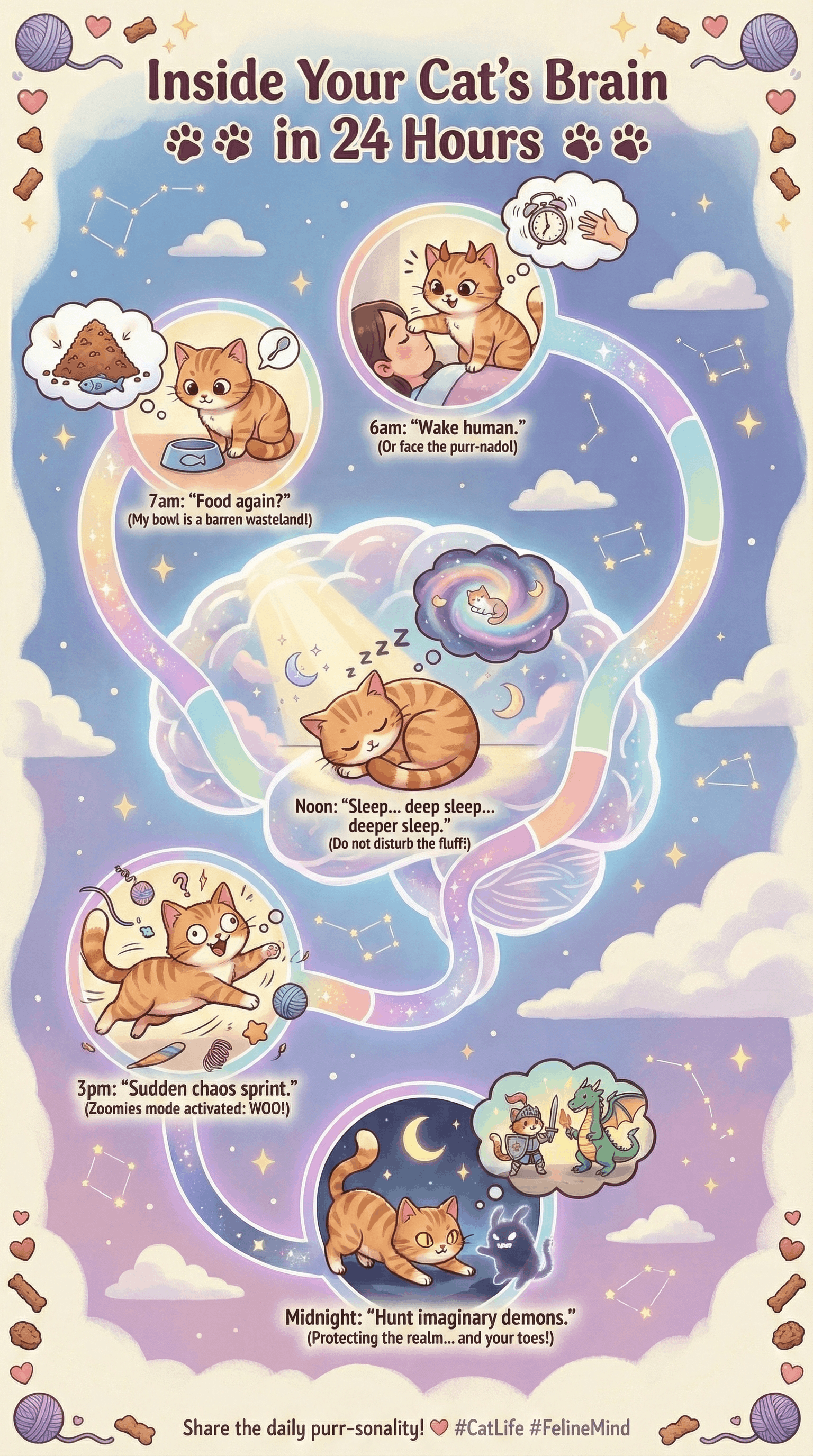
Your cat is a crepuscular predator — hardwired over millions of years to be most active at dawn and dusk. That 3am sprint is not random chaos; it is a compressed hunting sequence. In the wild, this would be the stalk-chase-pounce-kill cycle. In your flat, it is the hallway-sofa-your-face cycle. Same neural pathway, different prey.
The cat brain has approximately 250–300 million cortical neurons dedicated to processing sensory information and coordinating movement. Their cerebellum — the brain region controlling motor skills and balance — is proportionally larger than in most mammals. This is why your cat can launch from a standing start, clear a 1.5-metre bookshelf, land silently on a narrow ledge, and look at you like you are the weird one.
The zoomies are also how indoor cats burn off predatory energy. A cat in the wild would spend 6–8 hours per day hunting, mostly failing. Your cat gets a bowl of food placed in front of them twice a day. All that hunt-wired neural energy has to go somewhere. At 3am, it goes into your hallway at full speed.
Why Your Cat Knocks Things Off Tables
This one has a genuine neurological explanation: object investigation through paw manipulation. Cats have dense clusters of nerve endings in their paw pads, connected to a dedicated region of the somatosensory cortex. When your cat bats your water glass toward the edge of the table, they are processing information about the object — weight, texture, how it moves, whether it might be alive.
Then it goes over the edge and smashes. Your cat watches it fall with what appears to be deep satisfaction. This is because the cat brain is wired to track moving objects with intense focus — their visual cortex contains approximately 51,400 neurons per cubic millimetre, more than humans have in the equivalent region. Watching your glass fall is, neurologically speaking, extremely stimulating. The fact that you are now on your knees with kitchen roll is not their problem.
There is also a learned behaviour component. Cats have excellent long-term procedural memory — lasting 10 years or more. If knocking something off a table once produced an interesting reaction from you (shouting, rushing over, paying attention), that cause-and-effect is stored permanently. Congratulations: you trained your cat to do this.
The Slow Blink: Your Cat Is Saying ‘I Trust You’
When your cat looks at you and slowly closes and opens their eyes, this is not drowsiness. It is a deliberate social signal processed through the limbic system — the brain region governing emotions and social bonding. In cat body language, prolonged direct eye contact is a threat. A slow blink breaks that threat signal and communicates: I feel safe enough around you to close my eyes.
Studies at the University of Sussex confirmed that cats are significantly more likely to approach a human who slow-blinks at them versus one who maintains a neutral expression. The slow blink activates the same trust and bonding neural circuits that physical grooming does between cats in a social colony. When you slow-blink back, you are speaking fluent cat.
Why Your Cat Brings You Dead Things
Your cat deposits a half-dead mouse on your pillow at 6am and looks at you expectantly. You scream. They are confused. In their brain, this interaction made perfect sense.
The leading theory among feline behaviourists is that this is provisioning behaviour — the same instinct that drives mother cats to bring prey to kittens who are too young to hunt. Your cat, observing that you never hunt, never catch anything, and seem to get all your food from a loud humming box in the kitchen, may have concluded that you are a very large, very incompetent kitten who needs help.
The neural basis is the predatory sequence encoded in the basal ganglia: detect → stalk → chase → grab → kill → deliver. Indoor cats often get stuck in the earlier stages of this loop (hence the zoomies), but cats with outdoor access can complete the full sequence. The delivery phase is socially directed — they are bringing it to you specifically, not just leaving it randomly. This is, in the most horrifying way possible, a compliment.
The Box Obsession: It’s a Security Thing
A cat will ignore a £50 bed and climb into a shoebox. This is not spite (though it looks like it). It is the brain’s threat-assessment system at work.
Cats are both predators and prey. Their amygdala — the brain region processing fear and threat detection — is constantly monitoring for danger from above, behind, and the sides. An enclosed space like a box eliminates threats from all directions except one. The cat’s stress hormones measurably drop inside a box. A study at Utrecht University found that shelter cats given hiding boxes adapted to their new environment significantly faster and showed lower stress levels than cats without them.
This has direct implications for travel. When you put your cat in a carrier, you are essentially giving them a mobile box — which is why covering the carrier with a blanket often calms a stressed cat. You are reducing visual stimuli and creating an enclosed safe space that their brain instinctively recognises as secure.
Travel Tip: Use Box Brain to Your Advantage
Why Your Cat Stares at Nothing
Your cat is sitting in the middle of the room, staring intently at a blank wall. You see nothing. You check again. Definitely nothing. Your cat continues to stare, ears rotating like satellite dishes.
This is not paranormal activity (probably). Cats can hear frequencies up to 64 kHz — more than three times the human upper limit of 20 kHz. They can also detect vibrations and air pressure changes through their whiskers. What looks like staring at nothing is actually your cat processing sounds and stimuli that are completely invisible to your comparatively blunt human senses. There might be a mouse in the wall cavity, pipes settling, or an insect behind the skirting board.
Their visual system also detects movement at much lower light levels than yours, thanks to the tapetum lucidum — a reflective layer behind the retina that gives them roughly 6–8 times better night vision. In dim conditions, your cat can see subtle movements that your eyes cannot register at all.
So when your cat stares at a dark corner at 2am and you feel a chill run down your spine — it is almost certainly a spider. Almost certainly.
The Head Bump: Marking You as Property
When your cat bonks their head against your face, they are not being affectionate. Well, they are — but they are also marking you with pheromones from glands located around their cheeks, chin, and forehead. These scent markers are processed by the vomeronasal organ (Jacobsen’s organ), a specialised chemosensory system in the roof of the mouth that detects pheromones invisible to human noses.
Head bunting deposits your cat’s unique chemical signature on you, effectively labelling you as part of their social group and territory. Every cat in the neighbourhood who sniffs you will know you belong to someone. You have been claimed. You did not get a say in this.
Why Your Cat Ignores You (Selectively)
Research at the University of Tokyo confirmed what every cat owner already knew: cats recognise their owner’s voice and deliberately choose not to respond. The study played recordings of owners calling their cat’s name, and measured physiological responses — ear movement, pupil dilation, head turning. The cats clearly recognised and processed the sound. They simply did not get up.
This is not defiance. It is evolutionary programming. Dogs were selectively bred for thousands of years to respond to human commands. Cats domesticated themselves by hanging around grain stores where mice were plentiful — a relationship that required no obedience whatsoever. The cat brain never developed the “respond to authority” circuitry that dogs have, because there was never any survival advantage to doing so.
Your cat hears you. Your cat knows their name. Your cat has made a cost-benefit analysis and decided that getting up is not worth it. This is not stupidity. If anything, it might be the smartest thing in the room.
The Numbers Behind the Madness
Cortical neurons: ~250–300 million
Brain structure similarity to humans: ~90%
Hearing range: Up to 64 kHz (humans: 20 kHz)
Night vision: 6–8x better than humans
Long-term memory: 10+ years
Working memory: ~16–24 hours (dogs: ~5 minutes)
Cognitive equivalent: 2–3 year old human child
Interest in your opinion: Statistically negligible
What This Means When You Travel With Your Cat
Every one of these behaviours has implications for cat travel. Their acute hearing means airport terminals and cargo holds are overwhelming. Their scent-marking instinct means arriving somewhere that smells completely wrong triggers genuine anxiety. Their powerful long-term memory means one bad transport experience can create fear associations that last years. And their need for enclosed safe spaces means a properly introduced carrier is your single most important travel tool.
The good news? That same remarkable brain adapts quickly. Familiar scents (your worn t-shirt in the carrier), consistent routines, and a quiet room to decompress in on arrival can reset your cat’s threat-assessment system within days. They have been adapting to new environments for 10,000 years. They are very, very good at it — once you give them the right conditions.
They will, however, still wake you up at 3am. Some things are non-negotiable.
 United Kingdom
 Spain
Spain Thailand
 Japan
Japan