
Your cat can stalk a mouse through a pitch-black garden with pinpoint precision, yet somehow manage to walk directly into a chair leg in broad daylight. They will ignore a toy sitting completely still, then launch into a full predatory sprint the instant it twitches. And if you put a treat down right in front of their nose, they will sniff the floor in increasingly confused circles while standing directly on top of it. This is not stupidity — it is the logical outcome of one of nature's most brilliantly specialised visual systems, optimised ruthlessly for one purpose at the expense of almost everything else. Here is how cat vision actually works, why it is both more impressive and more limited than most people realise, and what it means for life with your cat.
THE EYES OF A PREDATOR: WHY CAT VISION EVOLVED THE WAY IT DID
To understand cat vision, you have to start with the evolutionary brief. Cats are crepuscular and nocturnal hunters — most of their ancestral activity happens at dawn, dusk, and through the night, precisely the periods when their prey is also most active. The cat's visual system was not designed to admire sunsets or read small print. It was designed, with extraordinary precision, to detect a small warm-bodied animal moving through low light at distances of up to about six metres, and to do so faster and more reliably than almost any other predator of comparable size.
That single design goal shapes everything about how a cat sees. The eye itself is proportionally enormous relative to skull size — if human eyes were scaled to the same ratio, they would be roughly the size of grapefruits. Large eyes capture more light, full stop. But the engineering goes much deeper than simple size.
Good to Know
The domestic cat's eye can open its pupil to roughly three times the maximum dilation of a human eye, allowing vastly more light to reach the retina in dim conditions. In bright daylight, that same pupil closes to a narrow vertical slit — a shape that allows much finer control over light intake than a circular pupil does.
The vertical slit pupil is itself a fascinating piece of design. Research published in Science Advances in 2015 found that slit pupils are far more common in animals that ambush prey close to the ground. The vertical orientation works with the horizontal structure of natural environments — grass, horizons, the line of the ground — to help the cat judge depth and distance during that critical final lunge. It is a targeting system built directly into the shape of the eye.
THE TAPETUM LUCIDUM: THE MIRROR BEHIND THE EYE THAT MAKES NIGHT VISION POSSIBLE
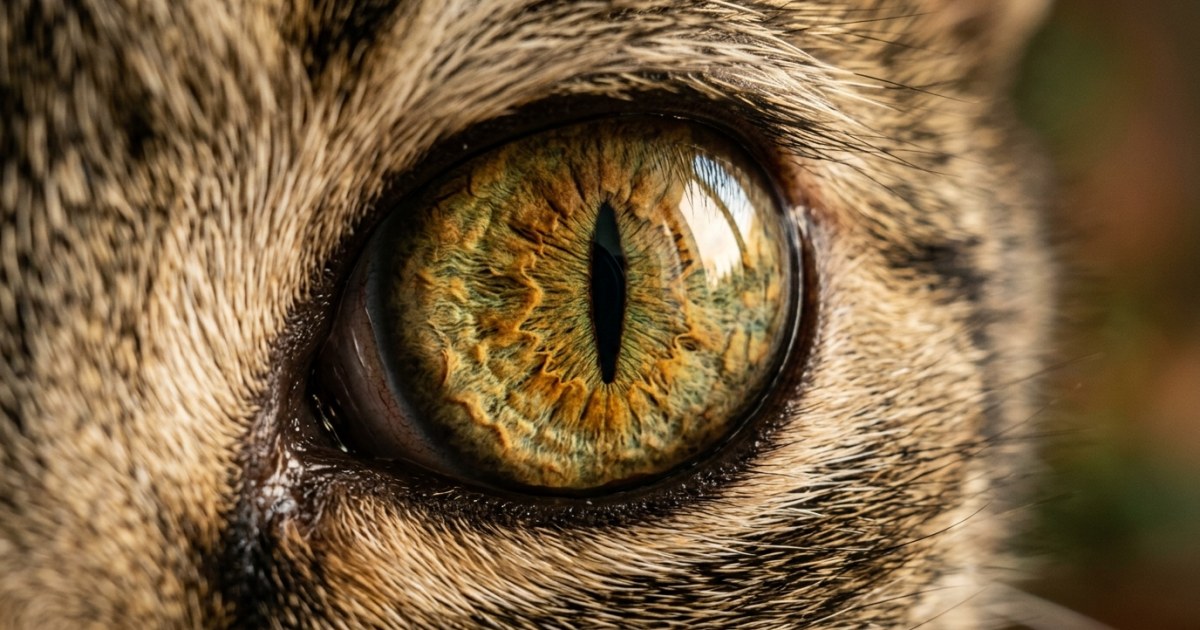
The single most important structure in the cat's low-light arsenal is one you have almost certainly seen its effects of, even if you did not know what you were looking at. Those eerie, glowing eyes in a photograph flash? That is the tapetum lucidum at work.
The tapetum lucidum — Latin for "bright tapestry" — is a layer of highly reflective cells situated behind the retina. In humans and most primates, this layer simply does not exist. In cats, it acts like a mirror: any light that passes through the retina without being absorbed by a photoreceptor is bounced straight back through the retina for a second pass. Effectively, every photon of light gets two chances to trigger a visual signal instead of one.
Good to Know
Cats need approximately six times less light than humans to form a usable visual image. At the lower threshold, a cat can see in light conditions that are effectively invisible to the unaided human eye — the equivalent of a single candle viewed from about 500 metres away.
The trade-off — and there is always a trade-off — is a slight reduction in fine detail. When reflected light bounces back through the retina, it does not land in precisely the same spots as the original incoming light. This introduces a tiny degree of blur or "scatter" into the image. For a cat hunting in the dark, this is an entirely acceptable compromise. Detecting that a mouse exists and is moving is far more important than resolving the exact texture of its fur.
The tapetum also explains why different cats' eyes glow different colours in photographs. The colour of the eyeshine — which ranges from gold and green to blue and even red in some cats — depends on the precise composition of the reflective layer and the amount of melanin in the eye, not the iris colour itself.
RODS, CONES, AND THE RETINAL TRADE-OFF THAT EXPLAINS ALMOST EVERYTHING
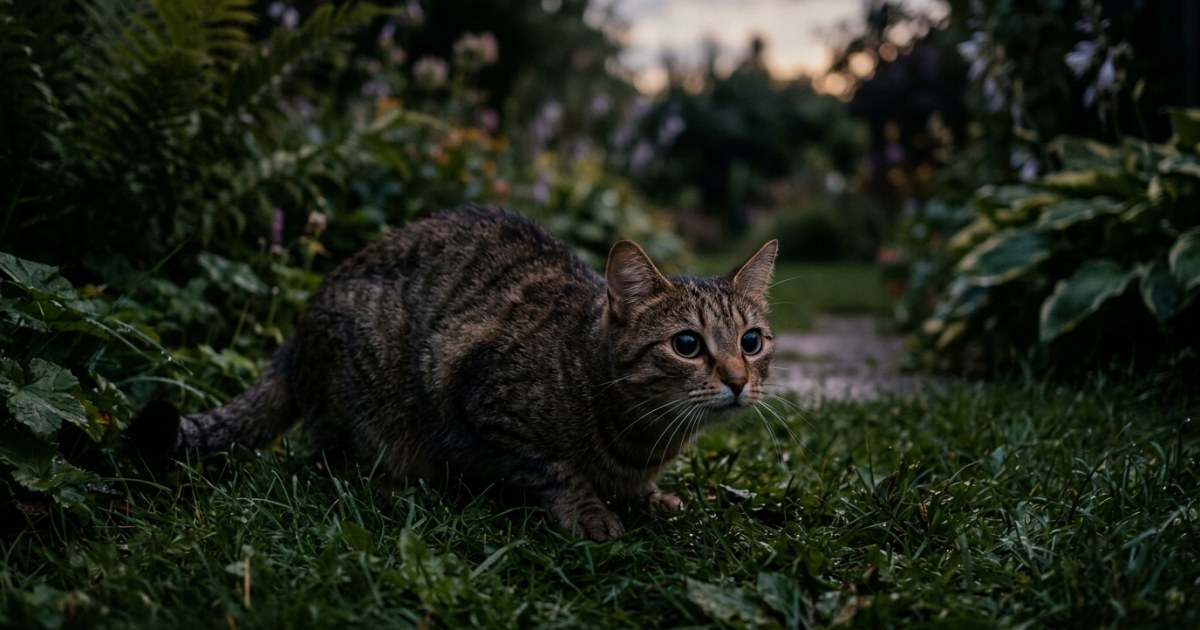
The retina is lined with two types of photoreceptor cells: rods and cones. Understanding the balance between them in cats versus humans explains not just why cats see well in the dark, but also why their colour vision is limited and their ability to see fine detail in daylight is genuinely worse than yours.
Rods: These are the low-light specialists. They are exquisitely sensitive to even tiny amounts of light, respond quickly to changes in brightness, and are excellent at detecting motion. The downside is that rods do not process colour and they do not deliver sharp detail — they are built for sensitivity, not resolution.
Cones: These handle colour perception and fine detail, but they require relatively bright light to function. Humans have three types of cone, each sensitive to a different wavelength of light (roughly corresponding to red, green, and blue), which together give us our rich colour vision and sharp visual acuity.
Rods vs Cones: Cats vs Humans
| Rod-to-cone ratio | Cats: approximately 25:1 — Humans: approximately 20:1 |
| Cone types | Cats: 2 (blue-violet and yellow-green) — Humans: 3 (red, green, blue) |
| Colour range | Cats: similar to a red-green colour-blind human — Humans: full trichromatic colour |
| Low-light sensitivity | Cats: ~6× more sensitive than humans |
| Visual acuity (distance) | Cats: 20/100 to 20/200 — Humans: 20/20 (typical) |
Cats have a higher density of rods and significantly fewer cones than humans, particularly in the central area of the retina. The upshot is a visual system that is brilliantly sensitive in low light and superb at detecting motion, but which delivers a world that is somewhat muted in colour, lower in fine detail, and — in bright conditions — actually less sharp than the vision of the human observing them.
What colour does a cat actually see? Research suggests their world looks something like the view through red-green colour-blind human eyes: they can distinguish blue-violet tones and yellow-green tones reasonably well, but reds and oranges likely appear as muted yellowy-browns, and greens and reds are difficult to tell apart. That bright red laser dot? To your cat, it is probably closer to grey or dark beige — but it moves, which is the part that matters.
Pro Tip
Cat toys in blue, violet, and yellow-green shades are more visually salient to cats than red or orange ones. If you want your cat to actually notice a toy by sight rather than by movement, colour choice makes a genuine difference.
THE MOTION DETECTION SUPERPOWER: WHY STILLNESS IS INVISIBILITY
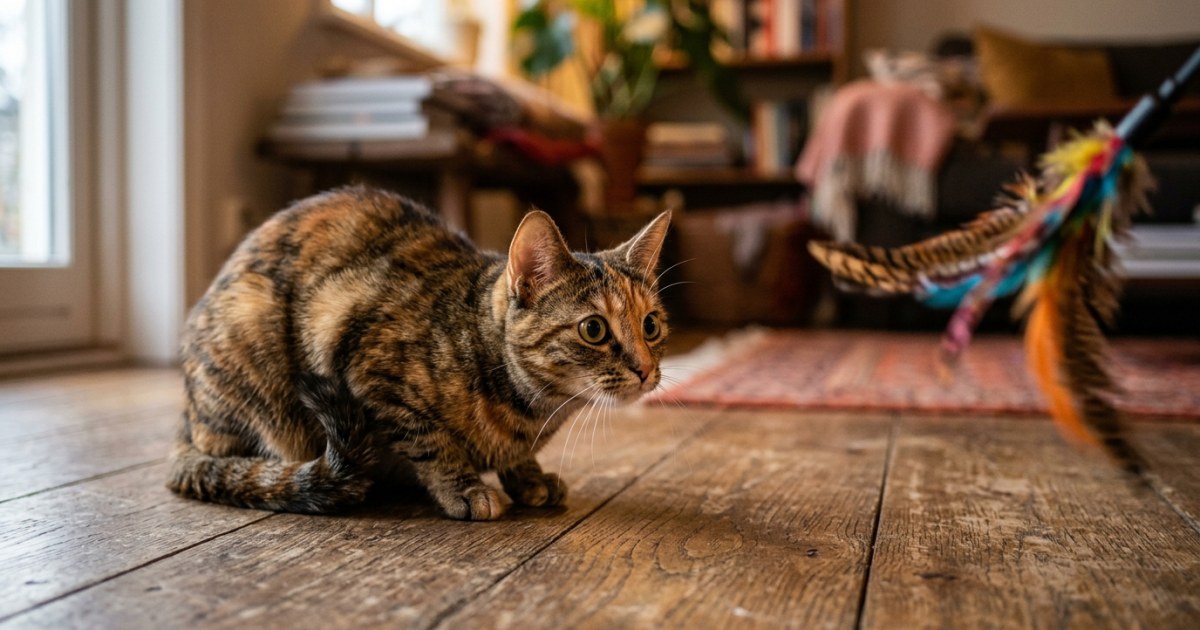
If there is one aspect of cat vision that most deserves the word "superpower", it is motion detection. Cats can detect movement at speeds and in light conditions that would be invisible to human vision, and their entire visual cortex devotes a disproportionately large amount of processing power to tracking moving objects. This is not just a passive sensitivity — it is an active, dedicated neural system.
The rod cells responsible for this are not evenly distributed across the retina. Cats have a horizontal band of high rod density running across the centre of the retina, called the visual streak, which aligns with the natural horizon line in their environment. This means the zone of highest motion sensitivity is precisely the zone that corresponds to the ground level in front of them — exactly where prey animals move.
Good to Know
Cats can detect motion at speeds as slow as 1–2 millimetres per second — roughly the speed of a second hand on an analogue clock. For context, human motion detection at low light thresholds is considerably less sensitive.
This is why the toy that sits completely still on the floor is, to your cat, essentially furniture. Their visual system is not optimised to inspect static objects with interest — it is optimised to detect the change in state from still to moving. The moment that toy twitches, it crosses a threshold in their neural processing and is instantly reclassified from "background" to "prey". The predatory response that follows is not a decision in any deliberate sense — it is a hardwired reflex.
It also explains something owners often find baffling: a cat can lock onto a tiny insect moving across a wall at the far end of a room without any apparent effort, yet fail to notice a large, brightly coloured toy placed directly in their path. Size is almost irrelevant. Movement is everything.
Pro Tip
If your cat has lost interest in a wand toy, try holding it completely still for five to ten seconds before making a tiny, slow movement rather than waving it frantically. Slow, deliberate, prey-like movements trigger the hunting sequence far more effectively than fast, chaotic ones.
THE NEAR-SIGHTEDNESS PARADOX: BLIND SPOTS, POOR FOCUS, AND THE TREAT UNDER THE NOSE
Here is where cat vision gets genuinely surprising, because it contradicts what most people assume. Despite being exceptional hunters, cats have quite poor close-up vision. They are technically hyperopic — long-sighted, in everyday terms — meaning their eyes are naturally focused for distances beyond the close range, not within it. Most cats cannot form a clear, sharp image of anything closer than approximately 25–30 centimetres. Anything within that range is blurry, indistinct, and largely meaningless to the visual cortex.
This is not a defect. At hunting distance — somewhere between half a metre and five or six metres — cat vision is well-focused and effective. It is only at very close range that the system breaks down, because evolution simply did not prioritise it. Once prey is caught, the cat does not need to see it clearly from two centimetres away. It needs to feel it, smell it, and deliver a precise bite — which is why whiskers, not eyes, take over at close range.
Good to Know
A cat's whiskers span approximately the width of their body and function as a highly sensitive spatial awareness tool. When a cat moves in close on prey, the whiskers sweep forward into a fan shape called the "whisker spread" — effectively creating a tactile targeting system that substitutes for the vision that has become useless at that range.
The blind spot directly beneath the nose: Even beyond the general close-focus issue, cats have a specific functional blind spot in the area directly below and immediately in front of their nose — roughly a cone-shaped zone extending about 10–15 centimetres from the face downward. This is a consequence of eye placement. Cats have forward-facing eyes like most predators, giving them excellent binocular overlap (more on this shortly) for judging depth at hunting distance, but the price is a zone directly under the snout where neither eye can comfortably focus.
This is the definitive scientific explanation for one of the internet's most beloved cat behaviours: the cat who sniffs frantically around the area in front of their food bowl while appearing to search desperately for a treat that is, in plain view, sitting directly beneath their chin. They are not confused, not unintelligent, and not performing for your amusement. They genuinely cannot see it. They are using scent to locate something their visual system is simply not designed to detect at that range and angle. When the treat is directly in their blind zone, smell is all they have — and smell takes time.
Warning
Deep, narrow food bowls can be genuinely uncomfortable for cats — not just because of whisker sensitivity ("whisker fatigue"), but because the depth places the food squarely in their near-vision blind zone. Wide, shallow dishes allow cats to see and smell their food much more effectively.
FIELD OF VIEW, DEPTH PERCEPTION, AND WHY CATS ARE ACTUALLY SHORT-SIGHTED AT DISTANCE
The placement of a cat's eyes gives them a total visual field of around 200 degrees — somewhat wider than the human field of approximately 180 degrees, thanks to the eyes being positioned slightly more to the sides of the skull. Within that total field, their binocular zone — the area where both eyes overlap and depth perception is possible — covers roughly 90–100 degrees directly in front of them. Humans have a binocular zone of about 120 degrees, so cats actually have slightly less stereoscopic depth perception than we do, despite common assumptions to the contrary.
What cats gain from their slightly wider overall field is more peripheral awareness — useful for detecting approaching threats or movement in their surroundings without turning their head. It is not a dramatic advantage over human vision, but it contributes to that general sense cats project of seeming simultaneously oblivious and hyper-aware depending on circumstances.
Visual acuity — the real surprise: In good lighting conditions, looking at a static scene, a cat's distance vision is actually considerably worse than human 20/20 vision. Most studies place cat visual acuity between 20/100 and 20/200 on the standard optician's chart, meaning a cat would need to be 6 metres away from something to see it with the same clarity that a human with typical vision could manage from 30–60 metres. The world through a cat's eyes at a distance is not dramatically sharper than a slightly out-of-focus photograph.
Good to Know
This is why cats rarely show recognition of their owners from across a large room using vision alone. At 10 metres, your face is not a particularly clear or detailed image to your cat. They are far more likely to identify you from your scent, the sound of your footsteps, or the specific silhouette and gait you present — not from fine facial features.
None of this prevents effective hunting, because hunting is not about fine detail at long range. It is about detecting and tracking movement at moderate distances, judging the final approach, and delivering a fast, accurate strike — all of which cat vision handles superbly. The system was never asked to read a book or appreciate a painting. It was asked to catch mice in the dark, and at that, it is genuinely extraordinary.
CAT VISION VS HUMAN VISION: A CLEAR COMPARISON
It is worth stepping back and looking at these differences side by side, because the picture that emerges is of two systems optimised for completely different priorities — not one system that is simply better or worse than the other.
Cat Vision vs Human Vision: At a Glance
| Night vision | Cats: exceptional — up to 6× more sensitive than humans. Humans: poor in true darkness. |
| Colour vision | Cats: limited — similar to a red-green colour-blind human, best in blue and yellow-green. Humans: rich full-spectrum trichromatic colour. |
| Motion detection | Cats: superb — highly sensitive at low speeds and in low light. Humans: good, but significantly less sensitive. |
| Distance acuity | Cats: 20/100 to 20/200 — blurry at distance. Humans: typically 20/20 — clear and detailed. |
| Close-up focus | Cats: poor — cannot focus on objects closer than ~25–30cm. Humans: can focus clearly down to ~10cm. |
| Field of view (total) | Cats: ~200°. Humans: ~180°. |
| Binocular overlap | Cats: ~90–100°. Humans: ~120°. |
| Flicker detection | Cats: ~70–80 Hz — can detect flicker in fluorescent lighting that appears steady to humans. Humans: ~50–60 Hz threshold. |
That last row in the table is worth dwelling on. Cats process visual frames faster than humans — their "critical flicker fusion" rate is higher, meaning they can detect rapid fluctuations in light that appear perfectly steady to us. This is one reason some cats show visible discomfort or restlessness under certain fluorescent or LED lighting systems that flicker at frequencies invisible to their owners. It is also part of why screens designed for human viewing rates can appear to cats as a series of flickering frames rather than smooth motion — though newer high-refresh-rate screens are increasingly cat-compatible.
Pro Tip
If your cat seems agitated under a specific light source, it may be reacting to flicker rather than brightness. Switching to a high-quality LED with a high CRI (colour rendering index) rating and a stable driver circuit can make a noticeable difference to a sensitive cat's comfort.
WHAT THIS MEANS FOR YOU: PRACTICAL WAYS TO WORK WITH YOUR CAT'S VISION
Understanding the science of how your cat sees the world is not just academically satisfying — it has direct, practical implications for how you set up their environment, interact with them, and choose their accessories. Here is what the research actually suggests you should do differently.
Food and water bowls: Wide, shallow dishes are genuinely better for cats than deep, narrow ones. Depth puts food in or near the close-range blind zone directly below the snout, and narrow walls create whisker contact that many cats find unpleasant. A wide ceramic or stainless steel bowl with gently sloping sides lets your cat see, smell, and access food without difficulty.
Treat placement: When you put a treat down for your cat, place it at least 30 centimetres away from their nose and on a surface with good contrast against the treat's colour. A white treat on a white floor is a double challenge — it is both in the near blind zone when too close and provides no colour or contrast signal. A light-coloured treat on a dark mat at a sensible distance is far easier for them to locate visually.
Toy selection and play technique: Prioritise movement over appearance. A dull grey feather on a wand that moves unpredictably will be far more engaging than a brightly coloured stuffed toy sitting still. Choose toys in blue, violet, or yellow-green tones if you want colour to play a role. During play, mimic prey movement — slow, intermittent, hesitant movements followed by sudden dashes are more stimulating than constant fast waving.
📋 Vision-Friendly Setup Checklist for Cat Owners
- ☐Use wide, shallow food and water bowls — avoid deep, narrow dishes
- ☐Place treats at 30cm+ from your cat's nose, on a contrasting surface
- ☐Choose toys in blue, violet, or yellow-green rather than red or orange
- ☐Use slow, prey-like movement when playing — not fast, chaotic waving
- ☐Avoid suddenly looming over your cat — approach from their peripheral field at a visible distance
- ☐Check lighting in your home for flicker — high-quality stable LEDs are preferable
- ☐If your cat ignores you from across a room, use sound or scent cues rather than visual signals
- ☐Consider a high-refresh-rate screen (90Hz+) if you play cat enrichment videos for your cat
Approaching and communicating with your cat: Because your face is not a particularly clear image to a cat beyond about three to four metres, facial expressions play almost no role in long-distance cat communication. Instead, use the slow blink — which works as a trust signal at any range — and remember that your silhouette, movement pattern, and scent are far more important identification cues than your features. If you want to approach without startling a cat, move into their peripheral vision first rather than materialising suddenly in front of them.
Understanding apparent clumsiness: When your cat misjudges a jump, walks into furniture in a lit room, or takes an unexpected tumble from a surface, this is often not a coordination failure — it is a visual one. Daylight-level sharpness for a cat is still considerably lower than it is for a human in the same room, and objects at very close range are genuinely hard for them to assess. Making sure that pathways between favourite spots are clutter-free, and that landing areas are broad and stable rather than narrow and precarious, is a practical way to compensate for these visual limitations.
Warning
A sudden change in vision — increased bumping into objects, difficulty navigating familiar spaces, apparent inability to track movement, or asymmetric pupil size — is never normal and should prompt a prompt visit to a veterinarian. Gradual vision loss, hypertension (extremely common in older cats), and retinal detachment are all conditions where early intervention makes a significant difference to outcome.
The bigger takeaway from all of this is a shift in perspective. Your cat does not experience the world as a slightly inferior version of the world you see. They experience a fundamentally different visual reality — one that is more sensitive, more attuned to movement and darkness, but also blurrier at distance, more limited in colour, and genuinely blind in the zone directly under their nose. Understanding that is not just interesting science. It is the foundation of a better relationship with an animal whose behaviour makes far more sense once you see — as best you can — through their extraordinary, imperfect, beautifully specialised eyes.
Frequently Asked Questions
Can cats see in complete darkness?
No — cats cannot see in absolute darkness, as some light is always required to activate the photoreceptor cells in the retina. However, they can see effectively in light levels so low that a human would perceive the environment as completely black, needing approximately six times less light than humans to form a usable image. The tapetum lucidum, a reflective layer behind the retina, bounces light back through the photoreceptors for a second pass, dramatically increasing sensitivity.
Why can't my cat find a treat right in front of their nose?
Cats have a functional blind spot in the zone directly below and immediately in front of their nose, caused by the forward-facing position of their eyes. Additionally, cats cannot focus clearly on anything closer than about 25–30 centimetres. When a treat lands in this near-blind zone, the cat shifts to scent rather than vision to locate it, which takes more time and results in the familiar frantic sniffing behaviour while standing directly on top of the food.
Do cats see colour or is their vision black and white?
Cat vision is not black and white — cats do see colour, but in a much more limited range than humans. They have two types of cone cell rather than three, making their colour vision broadly similar to that of a person with red-green colour blindness. They see blue-violet and yellow-green tones most clearly, while reds and oranges appear as muted, dull tones. Their colour world is less vivid but not absent.
Why does my cat ignore a toy until it moves?
Cats have an exceptionally powerful motion-detection system built on a high density of rod cells and a dedicated neural pathway that is specifically triggered by movement. A stationary object registers as background in the cat's visual processing, whereas any movement — even very slow movement — immediately triggers the predatory response. This is not boredom or pickiness; it is a hardwired feature of visual neuroscience shaped by millions of years of hunting small, moving prey.
Is a cat's vision better or worse than a human's?
The honest answer is: it depends entirely on the conditions. In low light and for detecting movement, cat vision is significantly superior to human vision. In good daylight, looking at static detail or colour, human vision is considerably sharper and richer. A cat's visual acuity in normal lighting is estimated at 20/100 to 20/200 — several times blurrier than typical human 20/20 vision. Neither system is universally better; they are optimised for different priorities.
What do cats actually see when they look at humans?
At close to moderate range, cats see a reasonably clear silhouette and can track movement well, but fine facial details — individual features, expressions, subtle changes — are blurry and visually unremarkable to them. Beyond about three to four metres, your face is quite indistinct. Cats are far more likely to identify their owners from sound, scent, and recognisable movement patterns than from visual appearance. This is why your cat may not appear to recognise you across a large room.
Why do cats' eyes glow in photos?
The glow — known as eyeshine — is caused by the tapetum lucidum, a reflective layer of cells behind the retina. When light from a camera flash (or any bright source) enters the eye, it passes through the retina once, and any light that is not absorbed is reflected back out through the pupil by the tapetum, producing the characteristic glow. The colour of the eyeshine varies between individual cats and depends on the composition of the tapetum and the level of melanin in the eye.
Are deep food bowls bad for cats?
Deep, narrow food bowls present two issues for cats: they force the cat's sensitive whiskers into contact with the bowl sides, which many cats find uncomfortable — a phenomenon sometimes called whisker fatigue — and they place the food at a depth that may fall within the cat's near-vision blind zone directly below the snout. Wide, shallow dishes with gently sloping sides allow cats to see and access their food easily and are generally recommended by behaviourists and veterinary nutritionists.