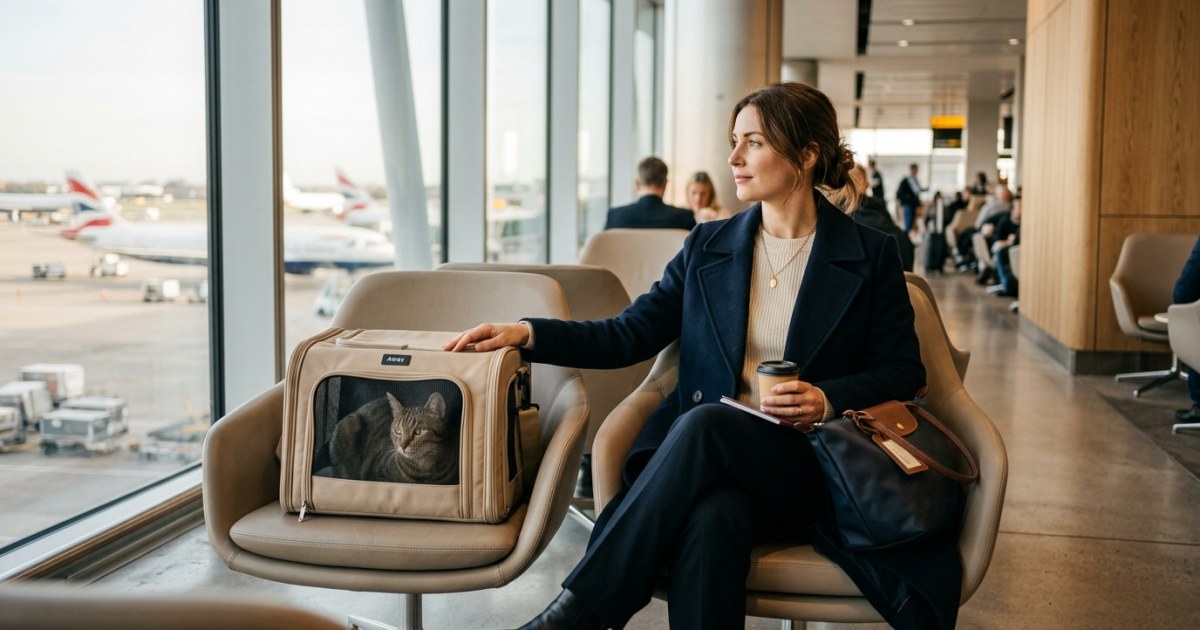
Flying with a cat is one of those experiences that sounds straightforward until the day arrives — and then suddenly you're juggling a stressed animal, a security queue, and a carry-on that won't quite fit under the seat. The good news is that with the right preparation, air travel with cats is genuinely manageable, even comfortable, for both of you. This guide covers everything: carrier training, what to pack, navigating TSA, sedation decisions, and how to help your cat decompress once you arrive.
CARRIER PREPARATION: MAKING IT A SAFE SPACE BEFORE TRAVEL DAY
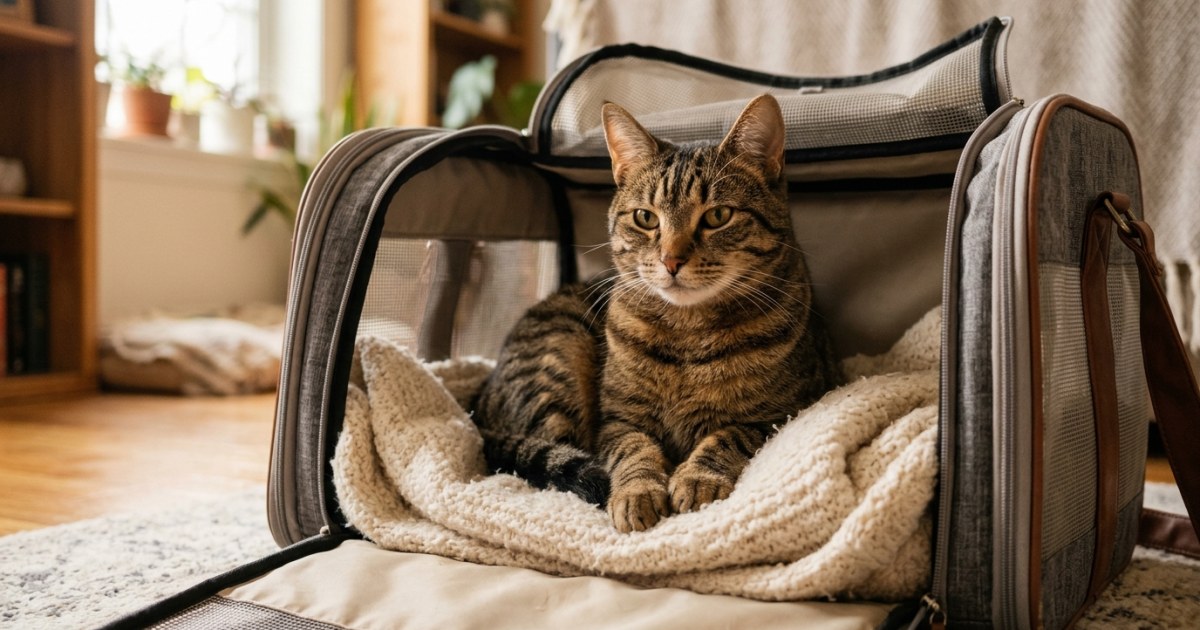
If there is one single thing that will make the biggest difference to how your cat handles air travel, it is this: the carrier should never be a stranger. Cats are creatures of association. If the only time your cat sees their carrier is when they're scooped into it and driven to the vet, their nervous system has already decided that the carrier equals threat. Your job, weeks before any flight, is to completely rewrite that association.
Start early — ideally four to six weeks out: Place the carrier in a room your cat uses regularly and simply leave it there, door open, with nothing expected of them. Let them investigate it on their own terms. Some cats will walk straight in within hours; others will take a fortnight to so much as sniff the entrance. Both are normal. The point is that curiosity, not coercion, is what you're after.
Layer in familiar scents: Place a well-worn item of your clothing inside — a t-shirt you've slept in is ideal. Your scent is one of the most powerful calming signals available to a domestic cat. Add their favourite blanket or a piece of bedding from their usual sleeping spot. The goal is to make the interior smell unmistakably of home.
Reserve special treats exclusively for inside the carrier: Don't offer these treats anywhere else. High-value rewards — a small piece of cooked chicken, a squeeze of cat-safe paste, whatever your cat goes wild for — should only ever appear inside that carrier. Over time, your cat begins to associate the carrier not with confinement, but with genuinely good things happening. Feed meals in there if your cat will tolerate it.
Pro Tip
Spray the interior of the carrier with a feline pheromone product such as Feliway at least 30 minutes before your cat goes in — never spray it directly on the cat. Reapply before a long journey. It won't sedate your cat, but it meaningfully reduces ambient anxiety.
Confirm airline approval before you commit to a carrier: This is non-negotiable. Every airline has specific dimensions for under-seat pet carriers, and these vary — sometimes dramatically — between carriers. Before you invest in a bag or become attached to the one you own, look up the exact under-seat dimensions for your specific flight, on your specific aircraft type if possible. Soft-sided carriers are almost universally required for cabin travel, as they can compress slightly to fit. Hard-sided carriers are typically only accepted in cargo, which brings us to the next point.
Carrier Preparation at a Glance
| Start time | 4–6 weeks before travel |
| Scent items | Worn clothing, familiar bedding |
| Treats | High-value, reserved exclusively for inside carrier |
| Carrier type | Soft-sided, airline-approved dimensions |
| Pheromone spray | Apply 30 mins before use, never directly on cat |
CABIN ONLY: WHY YOUR CAT MUST NEVER FLY IN THE HOLD
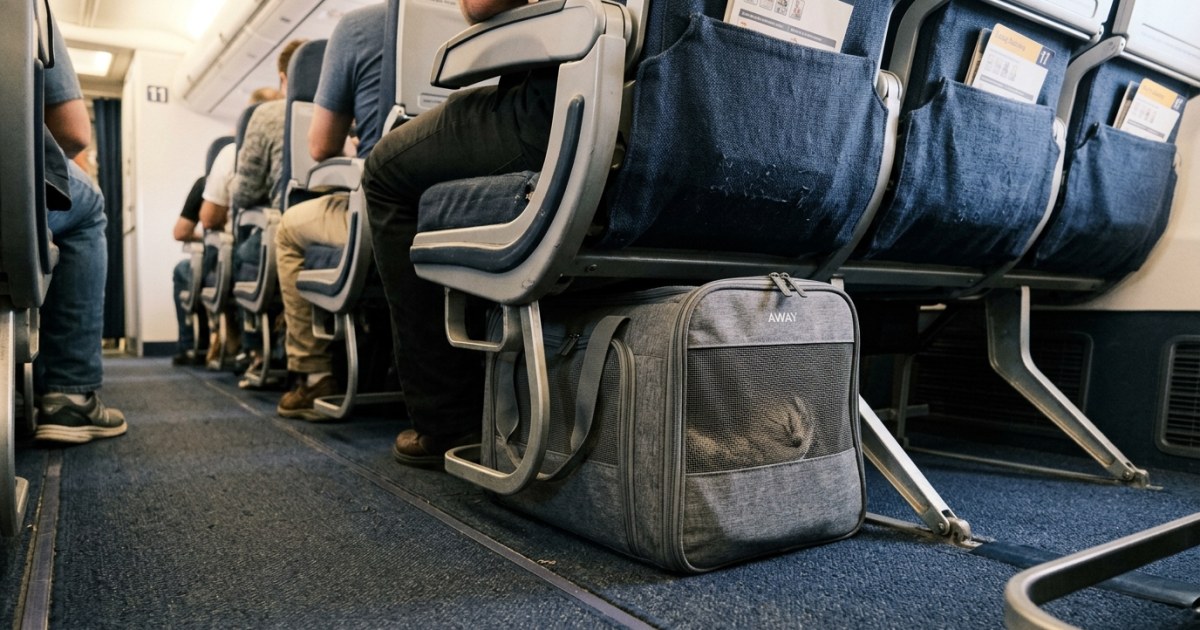
This is perhaps the most important decision you will make when flying with a cat, and it isn't really a decision at all — it's a rule. Your cat should travel in the cabin, under the seat in front of you, full stop. The cargo hold is not a viable alternative for a domestic cat, and anyone who suggests otherwise is underestimating the very real risks involved.
The cargo environment is genuinely dangerous for cats: The hold is pressurised and temperature-regulated on most modern commercial aircraft, but the keyword is "most" and "regulated" does not mean comfortable or consistent. Temperatures can fluctuate significantly during loading, taxiing, and transit. There is no human presence to notice if something goes wrong. Your cat will be surrounded by noise, vibration, and complete sensory disorientation, with no reassurance from you or anyone else. The psychological distress alone can be severe.
Mortality and injury statistics are sobering: Reported incidents involving animals in cargo — including deaths, injuries, and escapes — are logged by airlines and regulatory bodies, and the numbers are not small. Brachycephalic cats (flat-faced breeds such as Persians and Exotic Shorthairs) are at particular risk from respiratory distress in stressful, poorly-controlled environments. Many airlines have now banned certain breeds from cargo travel entirely for this reason.
Warning
If an airline does not permit your cat in the cabin — whether due to route restrictions, aircraft type, or pet policies — do not put them in cargo. Explore alternative routes, different airlines, ground transport, or pet relocation specialists instead. The hold is not a compromise; it's a risk.
Booking cabin space for your cat: Most airlines that permit in-cabin pets charge a fee, require advance booking, and cap the number of pets allowed in the cabin per flight — typically one or two per cabin section. Book your cat's space at the same time you book your own ticket, not as an afterthought. Contact the airline directly to confirm, and get written confirmation. Check-in staff have been known to be unaware of bookings made through third-party platforms.
Good to Know
Some long-haul routes — particularly transatlantic flights — do not permit pets in the cabin at all. If you are relocating internationally, research airline pet policies before you book your own ticket. Your route options may need to be built around what your cat is allowed.
In-flight cabin behaviour: Once you're airborne, your cat will likely settle. The drone of the engines is actually quite effective white noise, and if your carrier preparation has done its job, the interior of the bag smells of home. Keep the carrier under the seat — do not be tempted to place it on your lap or open it to comfort your cat mid-flight, as this can create a safety issue and may violate airline rules. You can reach a hand in to stroke your cat if they're distressed, but the goal is calm containment, not interaction.
YOUR TRAVEL EMERGENCY KIT: WHAT TO PACK FOR ACCIDENTS AND ANXIETY

Even the most relaxed, well-prepared cat can have an accident in transit. A long journey — especially one involving check-in queues, a security process, waiting at the gate, and the flight itself — can span six, eight, or ten hours from door to door. Accidents are not a sign that something has gone wrong; they're a normal physiological response to stress. The goal is not to prevent them entirely but to handle them with minimal disruption to your cat's comfort and dignity.
Puppy pee pads are essential: Line the base of your carrier with them before you leave the house. They're highly absorbent, flat, and can be swapped out quickly without removing your cat. Pack several spare pads in an easily accessible pocket of your hand luggage — you should be able to replace one without unpacking your bag entirely.
Pet-safe wet wipes: Choose unscented, non-toxic wipes — ideally formulated for pets. These are for wiping down your cat and the interior surfaces of the carrier if there's a mess. Heavily scented wipes can be irritating to cats and may increase anxiety. Keep these at the top of your bag, not buried at the bottom.
Spare towels: A couple of small, soft towels serve multiple purposes. They can replace soiled bedding, provide extra warmth if your cat is distressed, or act as a cover for the carrier to create a darker, calmer environment. Darker spaces tend to be more calming for anxious cats, as it reduces visual stimulation.
Garbage bags: Zip-lock bags or small drawstring bin liners for used pads, soiled bedding, and anything else that needs to be contained and disposed of. Airports have bins, but you don't want to be carrying anything loose.
A carrier cover: A purpose-made carrier cover or a large, lightweight scarf that can be draped over the bag. This is one of the single most effective in-transit calming tools. It reduces visual stimulation, muffles some ambient noise, and creates a den-like environment. If your cat is showing signs of distress — vocalising, pawing at the mesh, pressing against the sides — a cover will often reduce this noticeably within minutes.
📋 Cat Travel Emergency Kit Checklist
- ☐Puppy pee pads (at least 4–6 spares per travel day)
- ☐Pet-safe, unscented wet wipes
- ☐2–3 small spare towels or fleece squares
- ☐Small zip-lock or drawstring bags for waste
- ☐Carrier cover or large lightweight scarf
- ☐Weeks' worth of any regular medication (not just a few days)
- ☐Copy of vet health certificate and vaccination records
- ☐Small water dish and a bottle of water from home
- ☐High-value treats for reassurance
- ☐Feliway or equivalent pheromone spray
Medication — pack weeks' worth, not days': If your cat is on regular medication for any condition — hyperthyroidism, IBD, anxiety, or anything else — pack considerably more than you think you'll need. Delays happen. International moves can involve unexpected administrative hold-ups. Getting a specific prescription medication in a new country, particularly one with different pharmaceutical regulations, can take days or even weeks. Running out is not an inconvenience; for some conditions it's a genuine health risk. Ask your vet to prescribe a generous supply, and carry it in your hand luggage, never in checked baggage.
Pro Tip
Ask your vet for a written letter on headed paper detailing your cat's medications, dosages, and the clinical reason for each. This is invaluable if you're questioned at customs, need to refill a prescription abroad, or if your cat needs veterinary attention in a new country.
NAVIGATING AIRPORT SECURITY WITH YOUR CAT: WHAT ACTUALLY HAPPENS
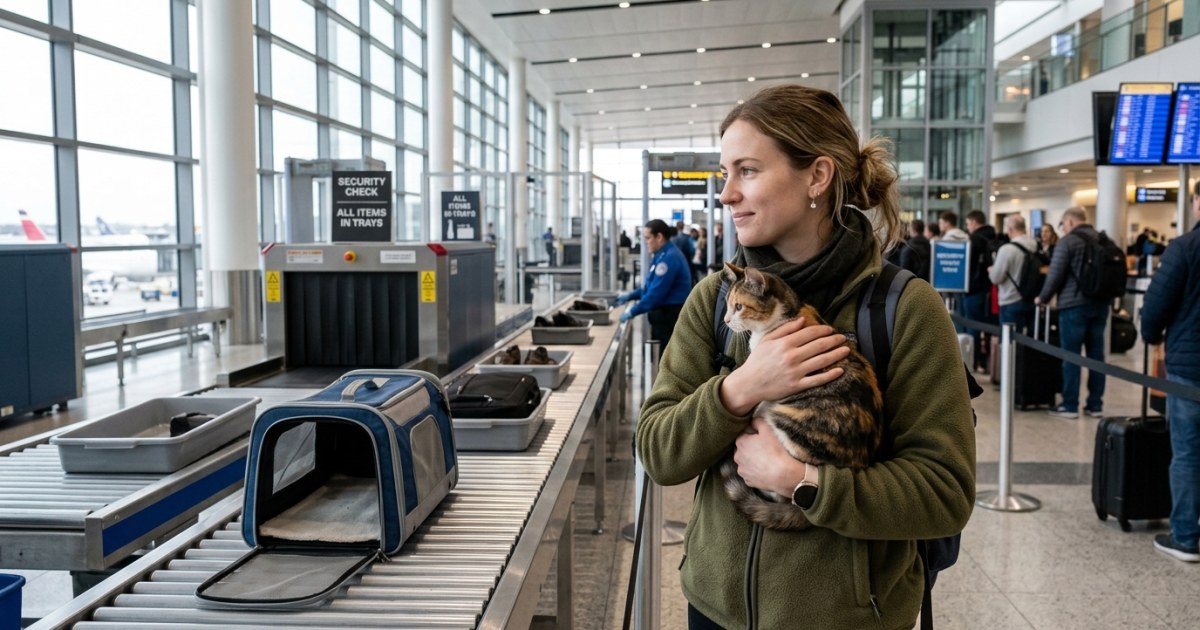
Airport security is often the most stressful part of flying with a cat — not because it's particularly long or complicated, but because it involves removing your cat from the carrier in a busy, noisy, unfamiliar environment. Knowing exactly what to expect in advance makes an enormous difference to how calmly you can handle it.
You will be required to remove your cat from the carrier at the checkpoint: This is standard procedure at TSA and most international equivalents. The carrier must go through the X-ray machine separately; your cat cannot remain inside it. You will be holding your cat — an already stressed animal — in your arms while you walk through the scanner, and then attempting to get them back into the carrier on the other side, often with people behind you.
Harness training is not optional — it's essential: A cat that bolts in an airport is a catastrophe. Airports are large, loud, complex spaces with hundreds of open doors, moving vehicles, and no easy way to corner a panicked animal. A well-fitted, escape-proof harness worn under the carrier is your primary safety net. Begin harness training at the same time as carrier training — well before travel. Let your cat wear the harness for short periods at home, gradually extending the duration. The harness should fit snugly enough that it cannot be backed out of; a cat can escape a loosely-fitted harness remarkably quickly when frightened.
Warning
Never rely on a collar alone at security. Cats can slip even well-fitted collars in seconds when panicked. Use an H-harness or a vest-style harness specifically designed to be escape-proof, and attach a lead to it so you have physical control at all times during the security process.
You can request a private screening room: This is worth knowing and worth using. At TSA checkpoints in the US, and at many international airports, you have the right to request a private room for the pet removal process. This means you're not trying to manage your cat in an open, crowded space with people pressing behind you. Simply tell the security officer when you approach that you have a live animal and would like to use the private screening area. Most officers are entirely used to this request. The environment will be quieter, less chaotic, and far more manageable.
Practical tips for getting through security smoothly: Wear shoes you can remove easily — you'll need to take them off while holding a cat. Consider wearing a fleece or soft layer your cat can press against while you're managing your belongings. Have your boarding pass and documents accessible before you reach the conveyor belt, not buried in a bag you then have to rummage through one-handed. If you're travelling with a companion, designate clear roles: one person manages the cat, one person manages the bags and tray.
Good to Know
At many international airports outside the US, pets in carriers may be swabbed for explosive residue rather than requiring full removal. Procedures vary significantly by country and airport. Research the specific security protocol at your departure airport in advance so you're not caught off-guard.
After security: Once you're through, find a quieter spot away from the main flow of foot traffic before you try to settle your cat back into the carrier. Give them a moment to re-orientate, offer a high-value treat, and speak to them calmly. Re-cover the carrier once they're inside to help them decompress before the gate experience.
SEDATION AND ANXIETY MANAGEMENT: WHAT WORKS AND WHAT TO AVOID

The question of whether to sedate a cat for travel is one of the most common — and most emotionally loaded — that cat owners face. The honest answer is that sedation is appropriate for a small minority of cats, and for the majority, non-pharmaceutical approaches will be both safer and more effective. Understanding the full spectrum of options, and how to choose between them, is essential preparation.
Start with the non-pharmaceutical options: For most cats, the anxiety they experience during travel is significantly reduced — sometimes eliminated — by good carrier preparation, familiar scents, a carrier cover, and pheromone products. These are the foundation. If you've done the work of making the carrier a genuinely safe space, and your cat is not clinically anxious in everyday life, you may find that no chemical intervention is needed at all.
Flower essences and calming supplements: Products such as Bach Rescue Remedy for Pets (note: use the pet-specific version, as the human version contains brandy), or similar non-toxic flower essence blends, are a gentle first step for cats who are mildly anxious travellers. These are not sedatives — they do not chemically alter your cat's neurological state — but many owners report a meaningful reduction in anxious behaviour, and they carry essentially no risk of adverse reaction. They can be added to water or food, or applied to the fur. Start using them several days before travel, not just on the day itself.
Pro Tip
Some vets recommend a short course of a calming supplement containing L-theanine, tryptophan, or alpha-casozepine in the week leading up to travel. These are available as veterinary products and are considerably gentler than prescription sedatives while being more reliably effective than flower essences for moderate anxiety.
Prescription medication — when it's appropriate and how to use it safely: For cats that genuinely panic — that injure themselves trying to escape the carrier, that vocalise continuously for hours, that show signs of severe physiological stress — prescription medication may be genuinely warranted and genuinely kind. Common options include gabapentin, which has good evidence for reducing travel anxiety in cats, and trazodone. Your vet is the only person qualified to make this recommendation.
The trial-at-home rule is absolute: Whatever prescription medication your vet recommends, you must trial it at home before travel day. This is not optional. Cats can have idiosyncratic reactions to medications — some become disinhibited and more distressed rather than calmer; some experience significant side effects. You need to know how your individual cat responds before you're at 35,000 feet with no way to call your vet. Give the trial dose on a normal day at home, observe your cat for the full duration of the drug's action, and discuss the results with your vet before travel.
Warning
Never give a cat any form of human sedative, antihistamine, or over-the-counter sleep aid without explicit veterinary guidance. Benadryl, for example, is sometimes suggested in online forums — it is not appropriate for cats without veterinary direction and can cause severe adverse reactions. When in doubt, call your vet, not the internet.
Sedation and cargo are never a safe combination: This is worth stating clearly because it still appears as advice online. Sedated animals in the cargo hold cannot thermoregulate effectively, cannot rebalance their inner ear to the pressure changes, and cannot respond normally if something goes wrong. This is precisely why many airlines refuse to transport sedated animals. The guidance from veterinary bodies and experienced cat behaviourists is consistent: if your cat needs sedation, they need to be in the cabin with you, never in cargo.
MANAGING MOVING STRESS: BEFORE DEPARTURE AND AFTER ARRIVAL
Flying is only one part of what is, from your cat's perspective, a deeply disorienting experience. Moving home — whether across a city or across a continent — is a major stressor for cats in a way that is genuinely different from how humans process it. We feel excited about new beginnings; cats feel the acute loss of a familiar territory. Understanding this helps you make better decisions at both ends of the journey.
Cats sense disruption long before moving day: The packing process alone — boxes appearing, furniture moving, rooms being emptied — is enough to trigger anxiety in sensitive cats. They read their environment continuously, and a home that smells and looks different is a home that no longer feels safe. In the weeks before a move, try to keep your cat's core areas — their feeding spot, their litter box location, their favourite sleeping spots — as undisturbed as possible for as long as possible. Don't pack their things early just for convenience; it's a false economy if it means spending the final weeks managing a distressed cat.
Keep familiar items accessible until the very last moment: Their bed, their bowls, their litter box — these should come with you on the day, not be packed away the week before. The scent of a well-used litter box, in particular, is an anchoring smell for cats. Counterintuitive as it sounds, bringing the used litter box rather than a clean new one to your destination provides important olfactory reassurance.
Good to Know
In the final days before departure, rub a soft cloth gently around your cat's cheeks and chin — where their facial pheromone glands are — and then wipe this cloth on the lower surfaces of furniture and door frames in your home. This reinforces their scent marking and helps them feel that their territory is intact for as long as possible.
Set up a base camp immediately on arrival: Before you do anything else in your new home — before you start unpacking boxes, before you arrange furniture — set up one room as your cat's base camp. This should contain everything familiar: their bed, their bowls, their litter box, a worn item of your clothing, and ideally a carrier with the door open that they can retreat into. This room becomes their safe zone while the rest of the new space is overwhelming and unfamiliar.
Introduce the new space gradually: Don't immediately give your cat the run of the entire new home. Allow them to explore the base camp room at their own pace, then open the rest of the space progressively once they're showing signs of confidence — eating normally, grooming, seeking affection. Forcing exploration of a large, unfamiliar space before they're ready increases anxiety rather than resolving it.
📋 Arrival Base Camp Setup Checklist
- ☐Choose a quiet room away from the busiest part of the new home
- ☐Set up familiar litter box (ideally the used one from home)
- ☐Place familiar bedding and a worn item of your clothing
- ☐Open carrier in room as an additional retreat option
- ☐Set out familiar food and water bowls
- ☐Spray Feliway on walls and furniture at cat height
- ☐Ensure windows and doors are secure before releasing cat
Routine is the fastest route to recovery: Once you're in the new home, the single most powerful thing you can do to help your cat settle is to maintain the same routines they had before. Same feeding times, same bowls, same food if possible, same bedtime rituals. Cats calibrate safety through predictability. A familiar routine in an unfamiliar space tells them, more clearly than anything else can, that the fundamental structure of their world is intact.
ROUTINE CONSISTENCY DURING AND AFTER TRAVEL: THE OVERLOOKED KEY TO RECOVERY
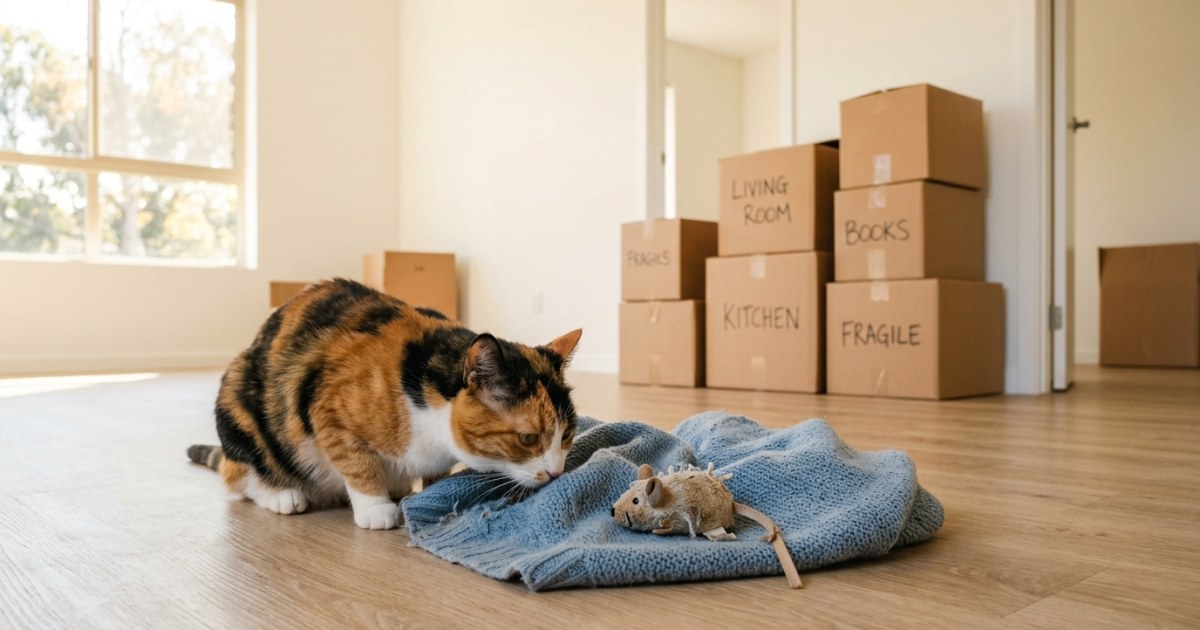
There is a tendency, when travelling with cats, to focus almost entirely on the logistics of the journey itself — the carrier, the paperwork, the airline approval. These things matter enormously, but the recovery period after travel is equally important and far less discussed. How a cat settles after an international flight or a long-distance move depends heavily on what you do in the days and weeks that follow.
Sameness is a powerful medicine: Use the same bowls your cat has always eaten from, not new ones bought for the new home. Feed at the same times, in the same quantities, with the same food. If your cat has a favourite toy or a particular spot they like to be brushed, continue those rituals without interruption. These small constants communicate stability in a way that no amount of reassurance or environmental enrichment can quite match.
Watch for post-travel stress signs without over-reacting: It's normal for cats to eat less, hide more, or vocalise more than usual in the first few days after a move. Some cats will be off their food for 24–48 hours; this is expected and not immediately alarming. What warrants a vet call is not eating for more than 48–72 hours (particularly in overweight cats, where hepatic lipidosis is a risk), persistent diarrhoea or vomiting, laboured breathing, or any sign that your cat is in physical distress rather than just emotional adjustment.
Pro Tip
Register with a local vet before you need one. In a new country or city, finding a practice in an emergency is stressful and may not yield the best outcome. Do the research, make an introductory appointment, and have the emergency number saved in your phone before your cat shows any sign of illness.
Don't rush the exploration process: A cat allowed to explore a new environment at their own pace will be fully settled — relaxed, territorial, eating and grooming normally — considerably faster than one who is forced into the whole space before they're ready. Counterintuitive as it feels when you're eager for them to love their new home, patience at this stage pays dividends in weeks, not months.
Your own calm matters more than you think: Cats are acutely sensitive to the emotional state of their primary human. If you're anxious and stressed — as many people are during a major move — your cat will register this as environmental threat. This doesn't mean you should feel guilty for being human, but it does mean that carving out quiet, calm time with your cat during the settling-in period is worth prioritising. Sitting on the floor of the base camp room, reading, simply being present and unhurried, gives your cat access to the most reassuring presence in their world: you.
Post-Travel Recovery Timeline
| Days 1–3 | Confine to base camp room; establish feeding and litter routines; limit visitors and noise |
| Days 4–7 | Allow supervised access to one or two additional rooms; continue familiar routines |
| Weeks 2–3 | Gradual full-home access; watch for territorial marking and address promptly |
| Weeks 4+ | Most cats fully settled; reassess if anxiety or appetite issues persist and consult vet |
Frequently Asked Questions
Can cats fly in the cabin on long haul flights?
Most long-haul flights — particularly transatlantic routes — do not permit pets in the cabin, meaning cats would need to travel as cargo, which carries significant risks. Before booking any long-distance international flight, research the specific pet policy for that route and airline, as policies vary considerably. If cabin travel is not possible on your preferred route, consider alternative airlines, stopovers, or specialist pet relocation services.
How do I keep my cat calm during a flight?
The most effective approach is a combination of thorough carrier preparation (starting weeks before travel), familiar scents inside the carrier, a carrier cover to reduce visual stimulation, and pheromone sprays. For mildly anxious cats, non-toxic flower essence remedies or veterinary calming supplements can help. Prescription medication is available for genuinely panicked cats, but must be trialled at home first under veterinary guidance — never for the first time on travel day.
Do I have to take my cat out of the carrier at airport security?
Yes — at TSA checkpoints in the US, and at most international airport security points, you are required to remove your cat from the carrier so it can pass through the X-ray machine. You can request a private screening room to do this more safely. It is strongly recommended to have your cat wearing an escape-proof harness before you arrive at security, as a startled cat in a busy airport can bolt easily.
What do I need to put in my cat's carrier for a long flight?
Line the carrier with a puppy pee pad and familiar bedding — ideally something that smells of home and of you. Avoid bulky items that reduce your cat's space. Spray the interior with a feline pheromone product before departure. Pack spare pads, pet-safe wipes, small towels, and a carrier cover in your hand luggage for mid-journey accidents, which are common on longer trips.
Is it safe to sedate a cat for a flight?
Sedation is appropriate only for cats that experience genuine panic during travel, and should always be done under veterinary guidance using medications specifically recommended for cats. Any prescription sedative must be trialled at home before travel day to check your individual cat's response. Sedation without veterinary supervision — including giving human medications — can be dangerous or fatal. For most cats, non-pharmaceutical approaches alongside good carrier preparation are both safer and more effective.
How long does it take for a cat to settle after moving house or flying internationally?
Most cats show significant improvement within one to two weeks of arriving in a new home, provided they are given a quiet base camp with familiar items and their routines are kept consistent. Full territorial confidence — where they are relaxed throughout the entire space — typically takes three to four weeks. Cats that were already anxious, or who had a particularly stressful journey, may take longer, and persistent anxiety or appetite loss beyond 72 hours warrants a vet consultation.
What is the best cat carrier for flying in the cabin?
The best cabin carrier is a soft-sided bag that meets the specific under-seat dimensions of your airline — check these for your exact flight before purchasing. Look for a carrier with mesh panels on multiple sides for ventilation, a solid base that holds its shape, and a top-loading opening which makes removing and replacing your cat at security significantly easier. Washable, removable interior liners are a practical bonus for long journeys.
What documents do I need to fly with my cat internationally?
Requirements vary by country and are strict — missing documentation can result in your cat being refused boarding or quarantined on arrival. At minimum, you will typically need a veterinary health certificate issued within a specific window before travel (often 10 days), proof of up-to-date vaccinations (particularly rabies), and a microchip record. Many countries require an official government-endorsed health certificate. Research the entry requirements for your destination country at least three months in advance, as some documents have long processing times.