
Every year, thousands of cat owners move to the EU from the UK, US, Canada, and beyond — and every year, a significant number get turned away at the border, face costly delays, or trigger a quarantine hold because they missed a step, got the sequence wrong, or used the wrong document. The EU pet import system is not difficult, but it is precise. Get the order right, and your cat clears customs in minutes. Get it wrong, and you could be looking at weeks of detention at your expense. Here is exactly how to do it right.
The Golden Rule: Sequence Matters More Than Anything
The single most common mistake people make when bringing a cat into the EU is getting the microchip and vaccination sequence wrong. The rule is absolute: your cat must be microchipped before or at the same time as the rabies vaccination. If the vaccination happens first — even by one day — the entire vaccination is considered invalid under EU law, and you have to start again.
This is not a technicality that border officials overlook. EU Regulation 576/2013 is explicit: the microchip must be verifiable at the time of vaccination. The vet must scan the chip before administering the jab and record the 15-digit microchip number on the vaccination certificate. If there is no chip to scan, there is no valid record.
Why does this matter so much? Because the microchip is the only way to link the vaccination record to your specific cat. Without that link, a vaccination certificate is just a piece of paper that could belong to any animal. The EU treats the microchip as the anchor for the cat’s entire medical identity.
The Correct Sequence Is Vital
Step 2: Rabies vaccination administered (vet scans chip first, records number)
Step 3: 21-day waiting period after primary vaccination
Step 4: Health certificate or EU Pet Passport issued
If steps 1 and 2 are reversed, you must revaccinate after chipping and wait another 21 days.
Step 1: The ISO Microchip
Your cat needs a 15-digit ISO-compliant microchip meeting ISO standard 11784 or Annex A of ISO standard 11785. This is the international standard used across the EU, UK, and most of the world. The chip is injected subcutaneously, usually between the shoulder blades, and takes about 30 seconds.
If you are in the UK, virtually all microchips now sold are ISO-compliant. If you are in the US, check carefully — older AVID 9-digit and HomeAgain 10-digit chips are not ISO-compliant and will not be accepted. If your cat has a non-ISO chip, you have two options: get an ISO chip implanted alongside it (cats can have two chips), or bring your own ISO-compatible scanner to the border. The second option is risky — border officials are under no obligation to use your scanner.
The chip itself costs $30–$75 / £15–£30 / €15–€30 depending on your country and vet. It is permanent, lasts the lifetime of the cat, and cannot be deactivated. Once implanted, have your vet scan it immediately to confirm the number matches the paperwork.
Step 2: Rabies Vaccination
Once the microchip is in place, your cat needs a rabies vaccination. The EU requires that cats are at least 12 weeks old at the time of vaccination. The vaccine must be an inactivated virus or recombinant vaccine — modified live virus (MLV) vaccines are not accepted.
Commonly accepted vaccines include Nobivac Rabies, Purevax Feline Rabies, Rabisin, and Imrab 3. Your vet will know which are available in your country. The key requirement is that the vaccine is administered according to the manufacturer’s instructions and the batch number, date, and administering vet are all recorded alongside the microchip number.
The 21-Day Waiting Period
After your cat’s first ever rabies vaccination (the primary jab), you must wait at least 21 days before travelling to the EU. This is non-negotiable and cannot be shortened. The 21 days allows the cat’s immune system to develop adequate antibodies.
If your cat has had a previous rabies vaccination and you are giving a booster before the previous one expires, there is no waiting period — the booster is valid immediately. This is a crucial distinction: if the previous vaccination has lapsed (even by one day), the new jab is treated as a primary vaccination and the 21-day clock resets.
This catches people out constantly. If your cat’s rabies booster was due in March and you get it done in April, that one-month gap means a fresh 21-day wait. Keep your cat’s vaccinations current and you avoid this entirely.
Choosing the Right Travel Document
This is where most of the confusion lives. There are three different documents that can be used to bring a cat into the EU, and using the wrong one will get you turned away at the border.
1. EU Pet Passport
The EU Pet Passport is a small blue booklet issued by an authorised veterinarian in an EU member state (or Northern Ireland). It contains your cat’s microchip number, vaccination records, and owner details. It is only available to pets already registered with a vet in the EU.
If you already live in the EU and are travelling between EU countries with your cat, this is the document you want. It is valid for the lifetime of the cat as long as rabies boosters are kept current. You do not need a new one for each trip.
Important post-Brexit note: EU Pet Passports issued in Great Britain (England, Scotland, Wales) are no longer valid for entry into the EU. If you have an old blue GB-issued passport, it cannot be used. You need an Animal Health Certificate instead. EU Pet Passports issued in Northern Ireland remain valid.
2. Animal Health Certificate (AHC)
If you are entering the EU from a third country — the UK, US, Canada, Australia, or any non-EU nation — you need an Animal Health Certificate. This is the standard document for non-commercial pet movements into the EU.
The AHC must be issued by an Official Veterinarian (OV) in your country of departure. In the UK, this means a vet authorised by APHA. In the US, it means a USDA-accredited veterinarian, with the certificate then endorsed by USDA APHIS. The AHC must be issued within 10 days of your arrival in the EU.
Once inside the EU, the AHC is valid for onward travel between EU countries for up to 4 months from the date of issue (or until the rabies vaccination expires, whichever comes first). So if you enter France and then drive to Spain, Italy, or Germany, you do not need new paperwork for each country.
AHC Validity Windows
For onward EU travel: Valid for 4 months from date of issue
For return to origin country: Check your home country’s re-entry rules separately
The 10-day window is tight. Book your OV appointment as close to departure as practical, and have a backup plan if travel gets delayed.
3. Commercial Certificate
If you and your cat are not travelling together within 5 days of each other, the move is classified as “commercial” under EU rules — even if no money changes hands and even if it is your own pet. This triggers a completely different set of requirements.
A commercial certificate must be issued within 48 hours of departure, the cat must enter through a designated Border Control Post (BCP) rather than a regular travellers’ point of entry, and additional health testing may be required depending on the country of origin. The process is significantly more complex and expensive.
The practical takeaway: always plan to travel within 5 days of your cat. If your cat flies on Monday, you must arrive in the EU no later than Saturday (or vice versa). If circumstances change and you cannot make the 5-day window, you will need to switch to the commercial route — which means new paperwork, different entry points, and higher costs.
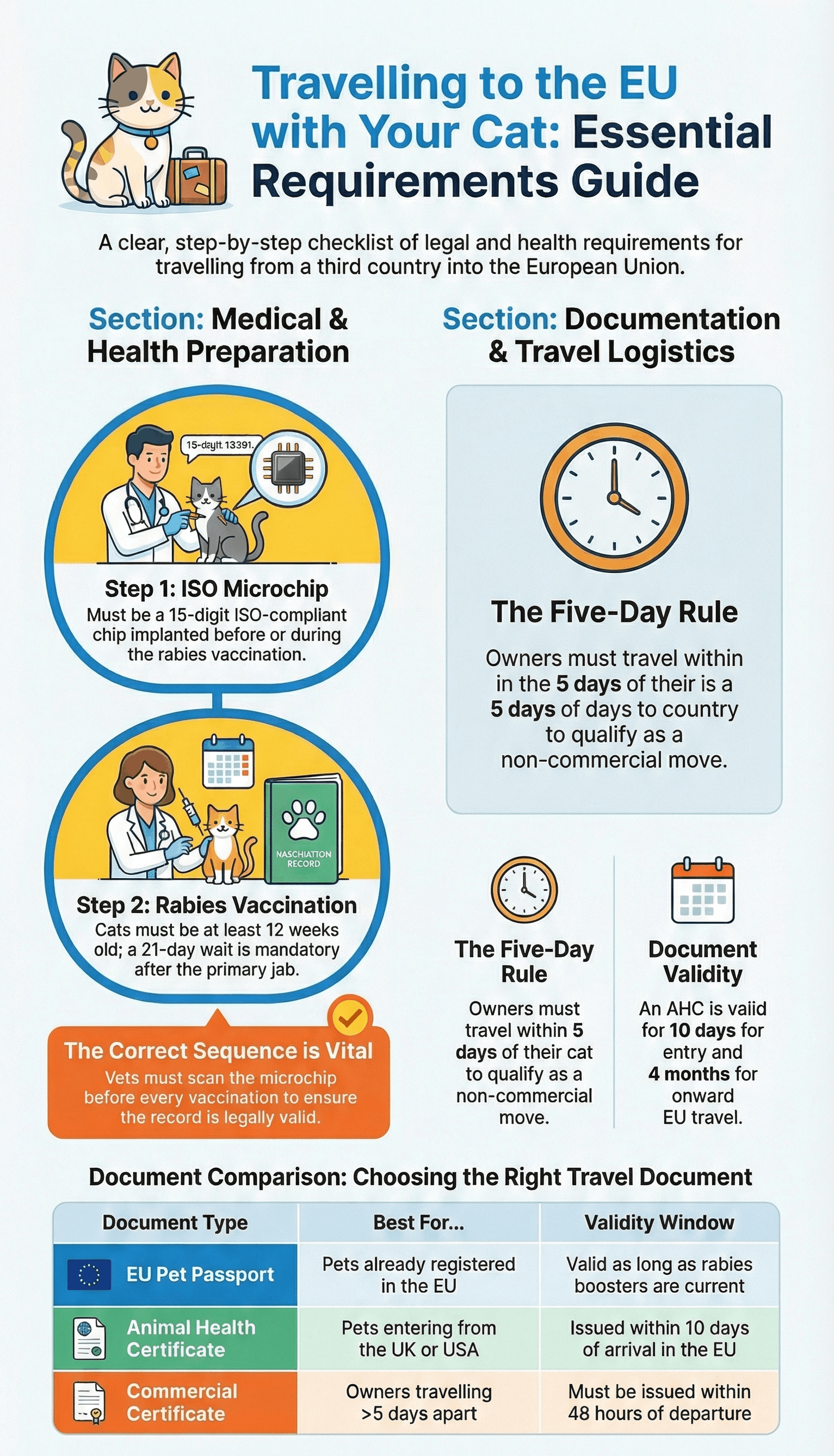
The Five-Day Rule in Practice
The five-day rule is one of the least understood aspects of EU pet travel. Here is what it actually means: for a pet movement to qualify as “non-commercial,” the owner (or an authorised person) must travel to the EU within 5 days before or after the pet. The pet does not have to be on the same flight — it just has to arrive within 5 days of the owner.
This matters because many people ship their cat via cargo a week or two before they fly out themselves. If the gap exceeds 5 days, the entire movement is reclassified as commercial, requiring different documentation, different entry procedures, and often significantly higher costs.
The most common scenario where this causes problems: someone relocating to Europe ships their cat with a pet transport company, then gets delayed by work commitments or housing issues. If the delay pushes them past the 5-day window, they are technically in violation — and border officials can and do enforce this.
How to Stay Within the Five-Day Window
Entering the EU: Points of Entry
When arriving in the EU with your cat from a third country, you must enter through a designated travellers’ point of entry. These are specific airports and seaports where customs officials are trained and equipped to check pet documentation. You cannot simply walk through the regular arrivals gate.
At the point of entry, an official will check your cat’s microchip (they have ISO scanners), verify the vaccination dates against the AHC, confirm the 21-day waiting period has passed, and check that the document is within its validity window. If everything is in order, the process takes 5–15 minutes.
Most major international airports in EU countries are designated points of entry, but not all. If you are flying into a smaller regional airport, check with the destination country’s competent authority beforehand. A list of designated entry points is available on each EU member state’s government website.
Countries with Extra Requirements
While the core EU rules apply across all 27 member states plus Norway and Northern Ireland, a handful of countries have additional requirements on top of the standard ones.
Finland, Ireland, Malta, Norway, and Northern Ireland require dogs (not cats) to be treated for the tapeworm Echinococcus multilocularis between 24 and 120 hours before entry. This does not apply to cats, but if you are also travelling with a dog, be aware of this.
Sweden previously had additional requirements but now follows standard EU rules. Austria has banned certain dog breeds but has no additional cat-specific requirements. In general, if you are meeting the standard EU requirements for cats, you will have no issues in any member state.
What Happens If You Get It Wrong
If you arrive at the EU border and your documentation is incomplete, incorrect, or out of date, the authorities have three options under EU Regulation 576/2013:
Return: Your cat is sent back to the country of origin at your expense. This is the most common outcome for paperwork issues that cannot be resolved on the spot.
Isolation: Your cat is placed in an approved quarantine facility until the documentation requirements are met. You pay all costs — typically €15–€30 per day for basic care, plus veterinary fees for any additional vaccinations or tests.
Euthanasia: In extreme cases (primarily where rabies is suspected or the cat’s origin cannot be verified), this is legally permitted. This is exceedingly rare for pet cats from listed countries but is worth mentioning as motivation to get the paperwork right.
The Complete Checklist
• Confirm ISO microchip is implanted and scannable
• Primary rabies vaccination (if not already done) — starts 21-day clock
4 weeks before:
• Book Official Veterinarian appointment for AHC (within 10-day window)
• Confirm airline pet policy and book pet transport
• Confirm your destination airport is a designated point of entry
Within 10 days of travel:
• AHC issued by Official Veterinarian
• Microchip scanned and verified
• All vaccination dates confirmed current
Travel day:
• AHC, vaccination records, and microchip details in hand
• Enter through designated travellers’ point of entry
• Present documents to customs — expect 5–15 minute check
The Bottom Line
The EU pet import system is designed to keep rabies out of Europe while making legitimate pet travel as straightforward as possible. The requirements are clear, logical, and consistent across all member states. The people who have problems are almost always those who either got the microchip/vaccination sequence wrong, used an expired or incorrect document, or missed the five-day owner travel window.
Get the sequence right (chip → jab → wait → certificate), use the correct document for your situation (AHC from a third country, EU Pet Passport within the EU), travel within five days of your cat, and enter through a designated point of entry. Do those four things and your cat will be through EU customs in the time it takes you to collect your luggage.
 Spain
Spain France
 Germany
 Italy
Italy Netherlands
 Portugal